| Display title | Laws of association |
| Default sort key | Laws of association |
| Page length (in bytes) | 1,186 |
| Namespace ID | 0 |
| Page ID | 313322 |
| Page content language | en - English |
| Page content model | wikitext |
| Indexing by robots | Allowed |
| Number of redirects to this page | 0 |
| Counted as a content page | Yes |
| Page image | 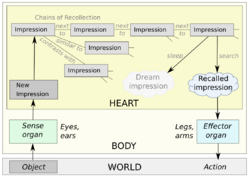 |
| HandWiki item ID | None |
| Edit | Allow all users (infinite) |
| Move | Allow all users (infinite) |
| Page creator | imported>StanislovAI |
| Date of page creation | 23:07, 6 March 2023 |
| Latest editor | imported>StanislovAI |
| Date of latest edit | 23:07, 6 March 2023 |
| Total number of edits | 1 |
| Recent number of edits (within past 90 days) | 0 |
| Recent number of distinct authors | 0 |
Description | Content |
Article description: (description)
This attribute controls the content of the description and og:description elements. | In psychology, the principal laws of association are contiguity, repetition, attention, pleasure-pain, and similarity. The basic laws were formulated by Aristotle in approximately 300 B.C. and by John Locke in the seventeenth century. Both philosophers taught that the mind at birth is a blank slate... |


