Religion:Dervish
A dervish, darvesh, or darwīsh (from Persian: درویش, romanized: Darvīsh)[1] is a Muslim who seeks salvation through ascetic practises and meditations.[2][3][4] It can refer to an individual or to a member of a Sufi order (tariqah).[5][6][3] Their focus is on the universal values of love and service, deserting the illusions of ego (nafs) to reach God. This is usually done by performing a lifestyle which decreases bodily function to a minimum in order to attain what would be called "esoteric knowledge" in Western terminology.[7] In most Sufi orders, a dervish is known to practice dhikr through physical exertions or religious practices to attain the ecstatic trance to reach God.[6] Their most popular practice is Sama, which is associated with the 13th-century mystic Rumi.
For centuries, this was an individual practice, but in the 12th century, it began to be mostly practiced in fraternities.[2] The oldest historical fraternity is the Qadiriyya order, founded by Abdul Qadir Gilani.[2] According to Islamic beliefs, each order derives their history from the Prophet Muhammad and are authorized by God (Allah) and taught by the angel Gabriel.[2] The theology of such fraternities is always based on Sufism and can vary from quiteism to anti-nomianism.[2] Those adhering to law are called ba-shar and those who do not follow law are called bi-shar.[2] In folklore, dervishes are often credited with the ability to perform miracles and ascribed supernatural powers.[8]
Etymology
The actual etymology of the term is unknown.[3] The Persian word darvīsh (درویش) may derive from the Middle Persian daryōs̲h̲, meaning poor or needy.[4] The term has also been constructed from the composition of dar (door) and awiz (hanging), referring to someone who "hangs around doors" i.e., begs at the doors.[3] However, the Middle Persian daryōs̲h̲ contradicts this.[3]
These proposed meanings belong to folk-etymologies, meaning that the meaning of the term was ascribed after the term has been established.[9] Furthermore, there is no essential connection between begging and a dervish, and it is also said that a "true dervish" would abstain from begging.[10]
Given the obscure etymologies given in Persian dictionaries, it has been suggested that the term may be of Turco-Buddhist origin and derive from darni (Sanskrit) and arvis (Old-Turkish), referring to a "specialist in magic" as they are credited with magical abilities (i.e., healing, performance of miracles, protection spells, etc).[11] Given that the term is mostly used in Central Asian, Turkish, and Persian culture, the meaning of a dervish may root in Turco-Buddhist beliefs, then transferred to Islam, where the meaning of the term was lost.[11]
Religious practice
Dervishes try to approach God by virtues and individual experience, rather than by religious scholarship.[12] Many dervishes are mendicant ascetics who have taken a vow of poverty, unlike mullahs. The main reason they beg is to learn humility, but dervishes are prohibited to beg for their own good. They have to give the collected money to other poor people. Others work in common professions; Egyptian Qadiriyya – known in Turkey as Kadiri – are fishermen, for example.
A study on dervishes among Bedouins reveals the process of initiation. It is believed that one does not choose to become a dervish, but is chosen to be one by God.[13] This happens by receiving barakah, which happens during a dream or a conscious encounter with an angel.[13] Barakah is usually received after an encounter with evil forces, supposedly manifesting in a preceding process of mental suffering.[13] After receiving divine blessing, the gift might be forfeited if the dervish betrays God.[13]
Dervishes also work as exorcists and healers.[13] They are believed to be able to detect the presence of evil spirits, such as jinn and devils, by means of divine gifts.[13] The exorcism can include negotiations or confrontations with the spirit in a spiritual world.[13]
Some classical writers indicate that the poverty of the dervish is not economic. Saadi, for instance, who himself travelled widely as a dervish,l and wrote extensively about them, says in his Gulistan:
Of what avail is frock, or rosary,
Or clouted garment? Keep thyself but free
From evil deeds, it will not need for thee
To wear the cap of felt: a darwesh be
In heart, and wear the cap of Tartary.[14]
Rumi writes in Book 1 of his Masnavi:[15]
Water that's poured inside will sink the boat
While water underneath keeps it afloat.
Driving wealth from his heart to keep it pure
King Solomon preferred the title 'Poor':
That sealed jar in the stormy sea out there
Floats on the waves because it's full of air,
When you've the air of dervishood inside
You'll float above the world and there abide...
Whirling dervishes


The whirling dance or Sufi whirling that is proverbially associated with dervishes is best known in the West by the practices (performances) of the Mevlevi order in Turkey, and is part of a formal ceremony known as the Sama. It is, however, also practiced by other orders. The Sama is only one of the many Sufi ceremonies performed to try to reach religious ecstasy (majdhb, fana). The name Mevlevi comes from the Persian poet Rumi, who was a dervish himself. This practice, though not intended as entertainment, has become a tourist attraction in Turkey.[16][17][18]
Orders

There are various orders of dervishes, almost all of which trace their origins from various Muslim saints and teachers, especially Imam Ali. Various orders and suborders have appeared and disappeared over the centuries. Dervishes spread into North Africa, the Horn of Africa, Turkey, Anatolia, the Balkans, the Caucasus, Central Asia, Iran, Pakistan, India, Afghanistan, and Tajikistan.
Other dervish groups include the Bektashis, who are connected to the janissaries, and the Senussi, who are rather orthodox in their beliefs. Other fraternities and subgroups chant verses of the Qur'an, play drums or whirl in groups, all according to their specific traditions. They practice meditation, as is the case with most of the Sufi orders in South Asia, many of whom owe allegiance to, or were influenced by, the Chishti order. Each fraternity uses its own garb and methods of acceptance and initiation, some of which may be rather severe. The form of Sufi dervishism practised during the 17th century was centered upon esotericism, patience and pacifism.[19]

In literature
Various books discussing the lives of Dervishes can be found in Turkish literature. Death and the Dervish by Meša Selimović and The Dervish by Frances Kazan extensively discussed the life of a Dervish.[20][21] Similar works on the subject have been found in other books such as Memoirs of a Dervish: Sufis, Mystics and the Sixties by Robert Erwin.[22] Majdeddin Ali Bagher Ne'matollahi has said that Sufism is a core of being and bridge between religion and science.[citation needed] Winston Churchill uses the term in his autobiographical My Early Life.
Views on Dervishes
Dervishes and their Sufis practices are accepted by traditional Sunni Muslims but different groups such as Deobandis and Salafis regard various practices of Dervishes as un-Islamic.[23]
Gallery
-
 Dervish Azerbaijani rug, XIX c. Tabriz school, State Museum of Azerbaijan Carpet and Applied Art
 -
 Ottoman Dervishes portrayed by Amedeo Preziosi in Istanbul, 1857
 -
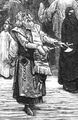 A Qajar-era Persian dervish, seen here from an 1873 depiction of Tehran's Grand Bazaar
 -
 An Ottoman Dervish in Istanbul, 1878
 -
 Dervishes photographed by William H. Rau near Damascus, c. 1903
 -
 A Palestinian Dervish in 1913
 -
 Muhammad Ahmad al-Mahdi, leader of the Sudanese Dervishes
 -
 Sufi kashkuls were often made from a coco de mer which ordinary beggars would have difficulty to find
 -
 Kashkul, or Beggar's Bowl, with Portrait of Dervishes and a Mounted Falconer, A.H. 1280. Brooklyn Museum
 -
 A Gathering of Dervishes in the Mughal Empire
 -
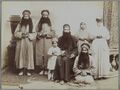 A family of Dervishes, possibly by Antoin Sevruguin (between 1876 and 1925)
 -
 The dance of the dervishes, Athens
 -
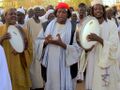 Sufi dervishes in Omdurman, Sudan
 -
 Sayyid Mohammed Abdullah Hassan, head of Darawiish
 -
 A Sheikh of the Rifa'i Sufi Order


-begging_dervis.png)


.jpg)


See also
 |
Wikisource has the text of the 1905 New International Encyclopedia article Dervish. |
- Derviş, a variant of the spelling
- Dervish movement (Somali) of 1889-1920
- Fakir, Sufi Muslim ascetic
- Qalandariyya Sufi order
Books
- The Tale of the Four Dervishes, 13th-century Persian story collection
- The Mongol Invasion, historical trilogy (1939-1955) by Soviet writer Vasily Yan; the connecting element is a dervish and chronicler
- Death and the Dervish, 1966 novel by Yugoslav writer Meša Selimović
References
- ↑ "Dervish – Definition and More from the FreeMerriam – Webster Dictionary". M-w.com. http://www.m-w.com/dictionary/Dervish.
- ↑ 2.0 2.1 2.2 2.3 2.4 2.5 MacDonald, D.B. (2012). Darwīs̲h̲. In P. Bearman (ed.), Encyclopaedia of Islam New Edition Online (EI-2 English). Brill. https://doi.org/10.1163/1573-3912_islam_SIM_1731
- ↑ 3.0 3.1 3.2 3.3 3.4 Bosworth, C. E.; van Donzel, E. J.; Heinrichs, W. P. et al., eds (1965). "Darwīs̲h̲". Encyclopaedia of Islam, Second Edition. 2. Leiden: Brill Publishers. doi:10.1163/1573-3912_islam_SIM_1731. ISBN 978-90-04-16121-4.
- ↑ 4.0 4.1 Mansour Shaki; Hamid Algar (2011). "DARVĪŠ". Encyclopædia Iranica. Iranicaonline.org. http://www.iranicaonline.org/articles/darvis.
- ↑ Madelung, Wilferd; Daftary, Farhad, eds (2017). "Darwīsh (Dervish)". Encyclopaedia Islamica. Leiden and Boston: Brill Publishers. doi:10.1163/1875-9831_isla_COM_035987.
- ↑ 6.0 6.1 Dervish, Encyclopædia Britannica, https://www.britannica.com/topic/dervish, "Dervish, Arabic darwīsh, any member of a Ṣūfī (Muslim mystic) fraternity, or tariqa."
- ↑ Laut, Jens Peter. "Vielfalt türkischer Religionen." (1996). Spirita pp. 31-32
- ↑ Frederick William Hasluck Christianity and Islam Under the Sultans, Band 1 Clarendon Press 1929 p. 281
- ↑ Laut, J. P. (2003). Zur Sicht des Islam in der Türkischen Republik bis zum Tode Atatürks. in "Von Zentralasien bis Anatolien Philologische und religionswissenschaftliche Perspektiven auf die türkische Welt Kleine Schriften von Jens Peter Laut Herausgegeben von Gökhan Shilfeler und Hans Nugteren Harrassowitz Verlag pp. 401-405
- ↑ Laut, J. P. (2003). Zur Sicht des Islam in der Türkischen Republik bis zum Tode Atatürks. in "Von Zentralasien bis Anatolien Philologische und religionswissenschaftliche Perspektiven auf die türkische Welt Kleine Schriften von Jens Peter Laut Herausgegeben von Gökhan Shilfeler und Hans Nugteren Harrassowitz Verlag pp. 401-405
- ↑ 11.0 11.1 Laut, J. P. (2003). Zur Sicht des Islam in der Türkischen Republik bis zum Tode Atatürks. in "Von Zentralasien bis Anatolien Philologische und religionswissenschaftliche Perspektiven auf die türkische Welt Kleine Schriften von Jens Peter Laut Herausgegeben von Gökhan Shilfeler und Hans Nugteren Harrassowitz Verlag pp. 401-405
- ↑ Jens Peter Laut Vielfalt türkischer Religionen 1996 p. 29 (German)
- ↑ 13.0 13.1 13.2 13.3 13.4 13.5 13.6 Al-Krenawi, Alean, John R. Graham, and Benjamin Maoz. "The healing significance of the Negev's Bedouin Dervish." Social Science & Medicine 43.1 (1996): 13-21.
- ↑ chapter 2 story 16: "The Gulistān; or, Rose-garden, of Shek̲h̲ Muslihu'd-dīn Sādī of Shīrāz, translated for the first time into prose and verse, with an introductory preface, and a life of the author, from the Ātish Kadah" a story later adapted by La Fontaine for his tale 'Le songe d'un habitant du Mogol'
- ↑ The Masnavi: Book One, translated by Jawid Mojaddedi, Oxford World's Classics Series, Oxford University Press, 2004. ISBN 978-0-19-955231-3, p. 63.
- ↑ Koentges, Chris (2012-06-29). "13 Things The Whirling Dervishes Can Teach You About Spinning Until You're Dizzy Enough To Puke". The Very Ethnic Project. http://veryethnic.wordpress.com/2012/06/29/13-things-the-whirling-dervishes-can-teach-you-about-spinning-until-youre-dizzy-enough-to-puke/.
- ↑ B. Ghafurov, "Todjikon", 2 vols., Dushanbe 1983-5
- ↑ "Rumi | Biography, Poems, & Facts | Britannica" (in en). https://www.britannica.com/biography/Rumi.
- ↑ Erdoan, Nezih. "Star director as symptom: reflections on the reception of Fatih Akn in the Turkish media." New Cinemas: Journal of Contemporary Film 7.1 (2009): 27–38.
- ↑ Milivojević, Dragan; Selimović, Meša; Rakić, Bogdan; Dickey, Stephen M. (1997). "Death and the Dervish". World Literature Today 71 (2): 418. doi:10.2307/40153187. ISSN 0196-3570.
- ↑ Frances., Kazan (2013). The dervish: a novel. Opus. ISBN 978-1-62316-005-0. OCLC 946706691.
- ↑ Robert, Irwin (2013). Memoirs of a Dervish: Sufis, Mystics and the Sixties. Profile Books Ltd. ISBN 978-1-86197-924-7. OCLC 1015811956.
- ↑ Syed, Jawad; Pio, Edwina; Kamran, Tahir; Zaidi, Abbas (2016-11-09). Faith-Based Violence and Deobandi Militancy in Pakistan. Springer. ISBN 978-1-349-94966-3. "They also criticises various practices including sama, qawwali, whirling etc. Whereas Sufis/Barelvi consider their beliefs and practices as mystical practices."
Relevant literature
- Xavier, Merin Shobhana. The Dervishes of the North: Rumi, Whirling, and the Making of Sufism in Canada. University of Toronto Press. 2023.
 |  |


