Biology:Acanthosomatidae
Acanthosomatidae is a family of Hemiptera, commonly named shield bugs and sometimes stink bugs. There are currently recognised about 200 species in the genera below, making it one of the least diverse families within Pentatomoidea.[1][2] The Acanthosomatidae species are found throughout the world, being most abundant in high-latitude temperate regions and in subtropical regions at high altitudes.[3]
One of the most well-known species in Acanthosomatidae is the hawthorn shield bug (Acanthosoma haemorrhoidale), which is found throughout Europe and also northern Siberia; this species is typically green or brown and has a distinctive shape with two projections on its thorax. It feeds on various plants, including hawthorn, rowan, and cherry.
Description
Acanthosomatidae have heads that are keeled laterally and possess a pair of five-segmented antennae. The mesosternum has a strongly projecting keel. The tarsi of the legs are bisegmented. The second visible abdominal sternite has an elongate spine that projects forward. The spiracles of the second abdominal segment are concealed by the metapleura. Abdominal sternite III has paired trichobothria. In males, sternite VIII is exposed, and there is a specialised genital capsule. In females, one or two pairs of Pendergrast's organs are present in the abdomen (sometimes absent, e.g. Elasmucha[3]) and sternite VII has an emarginate posterior margin.[4]
Acanthosomatidae are generally similar to Pentatomidae in appearance. Various sources distinguish them based on the number of tarsal segments, being two in acanthosomatids and three in pentatomids.[5][6] However, some pentatomids have bisegmented tarsi as well.[7]
Ecology
Acanthosomatidae are mostly herbivores on trees and shrubs. Host plants include Ficus, Hakea, Carex, Juncus, Cladium, and Dactylis. There are also records of predation (including cannibalism) and scavenging on carrion.[4]
Maternal care
Many species have females that take care of their offspring, guarding the eggs and nymphs. In these species, the Pendergrast's organs are absent or reduced and non-functional. Other species have a more limited form of care: females smear their eggs with secretions from the Pendergrast's organs (which may repel predators and parasitoids), then abandon the eggs. Egg smearing is an ancestral behaviour.[8]
Subfamilies and Genera
As of September 2026[update], BioLib[9] includes three subfamilies and the following genera:
- unplaced genus
- Allotriocochabambia Faúndez, Rider & Carvajal, 2014
Acanthosomatinae
- Acanthosoma Curtis, 1824
- Ameenocoris Ahmad & Moizuddin, 1990
- Amphaces Dallas, 1851
- Anaxandra (bug) Stål, 1876
- Catadipson Breddin, 1903
- Cyphostethus Fieber, 1860
- Elasmostethus Fieber, 1860
- Elasmucha Stål, 1864
- Eupolemus (bug) Distant, 1910
- Grossaria Kumar, 1974
- Lindbergicoris Leston, 1953
- Mahea Distant, 1909
- Microdeuterus Dallas, 1851
- Oncacontias Breddin, 1903
- Platacantha Lindberg, 1934
- Proctophantasta Breddin, 1903
- Rhopalimorpha Dallas, 1851
- Sastragala Amyot & Serville, 1843
Examples of species include:
- Acanthosoma haemorrhoidale (Linnaeus, 1758) — Hawthorn shield bug
- Acanthosoma labiduroides Jakovlev, 1880 — Green shield bug
- Cyphostethus tristriatus — Juniper shield bug
- Elasmostethus interstinctus — Birch shield bug
- Elasmucha grisea (Linnaeus, 1758) — Parent bug
- Elasmucha lateralis (Say, 1831)
- Oncacontias vittatus — Forest shield bug
Blaudusinae
- tribe Blaudusini Kumar, 1974
- Andriscus (bug) Stål, 1876
- Bebaeus Dallas, 1851
- Blaudus Stål, 1872
- Duadicus Dallas, 1851
- Hiarchas Distant, 1910
- Mochus (bug) Distant, 1910
- Monteithiessa Kumar, 1974
- Noualhieridia Breddin, 1898
- Panaetius (bug) Stål, 1865
- Stauralia Dallas, 1851
- Xosa Kirkaldy, 1904
- tribe Lanopini Kumar, 1974
- Abulites (bug) Stål, 1876
- Acrophyma Bergroth, 1917
- Anischys Dallas, 1851
- Aposinopla Carpintero & De Biase, 2020
- Ea (bug) Distant, 1911
- Galgacus Distant, 1899
- Hellica Stål, 1867
- Lanopis Signoret, 1863
- Phorbanta Stål, 1867
- Sinopla Signoret, 1864
- Sniploa Signoret, 1863
Ditomotarsinae
- tribe Ditomotarsini Signoret, 1863
- Cylindrocnema Mayr, 1864
- Ditomotarsus Spinola, 1850
- Esbenia Jensen-Haarup, 1931
- Hyperbius (bug) Stål, 1867
- Ibocoris Roche, 1947
- Mazanoma Rolston & Kumar, 1975
- Nopalis Signoret, 1863
- Planois Signoret, 1864
- Praesus (bug) Stål, 1872
- Rolstonus Froeschner, 1997
- Tolono (bug) Rolston & Kumar, 1975
- Uhlunga Distant, 1892
- tribe Laccophorellini Kumar, 1974
- Aesepus (bug) Stål, 1876
- Agamedes (bug) Stål, 1876
- Laccophorella Horváth, 1904
- Sangarius Stål, 1865
Gallery
-
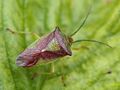 Acanthosoma haemorrhoidale
 -
-
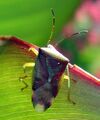
 Cyphostethus tristriatus
 -
 Elasmucha grisea
 -


References
- ↑ Faúndez, E. I. 2009. Contribution to the knowledge of the genus Acrophyma Bergroth, 1917 (Hemiptera: Heteroptera: Acanthosomatidae). Zootaxa. 2137: 57-65
- ↑ FaúNdez, Eduardo I. (2014-02-28). "A new genus for a Chilean species of Acanthosomatidae (Hemiptera: Heteroptera)". Zootaxa 3768 (5): 596–600. doi:10.11646/zootaxa.3768.5.7. ISSN 1175-5334. PMID 24871197. http://biotaxa.org/Zootaxa/article/view/zootaxa.3768.5.7.
- ↑ 3.0 3.1 Thomas, Donald B. (1991). "The Acanthosomatidae (Heteroptera) of North America". The Pan-Pacific Entomologist 67 (3): 159––170. https://www.biodiversitylibrary.org/part/269527.
- ↑ 4.0 4.1 "Family ACANTHOSOMATIDAE" (in en). https://biodiversity.org.au/afd/taxa/ACANTHOSOMATIDAE.
- ↑ Larivière, M-C (1995). Fauna of New Zealand 35: Cydnidae, Acanthosomatidae, and Pentatomidae (Insecta: Heteroptera): systematics, geographical distribution, and bioecology. 35. Manaaki Whenua Press. doi:10.7931/j2/fnz.35. https://www.biotaxa.org/fnz/article/view/fnz.35.
- ↑ Paiero, S. M.; Marshall, S. A.; McPherson, J. E.; Ma, M.-S. (2013). "Stink bugs (Pentatomidae) and parent bugs (Acanthosomatidae) of Ontario and adjacent areas: A key to species and a review of the fauna". Canadian Journal of Arthropod Identification 24. doi:10.3752/cjai.2013.24. https://cjai.biologicalsurvey.ca/articles/pmmm-24/.
- ↑ Rider, D. A. (2000-07-01). "Stirotarsinae, New Subfamily for Stirotarsus abnormis Bergroth (Heteroptera: Pentatomidae)" (in en). Annals of the Entomological Society of America 93 (4): 802–806. doi:10.1603/0013-8746(2000)093[0802:SNSFSA2.0.CO;2]. https://www.ndsu.edu/faculty/rider/Pentatomoidea/PDFs/R/Rider_2000a.pdf.
- ↑ Tsai, Jing-Fu; Kudo, Shin-ichi; Yoshizawa, Kazunori (2015). "Maternal care in Acanthosomatinae (Insecta: Heteroptera: Acanthosomatidae)—correlated evolution with morphological change" (in en). BMC Evolutionary Biology 15 (1): 258. doi:10.1186/s12862-015-0537-4. ISSN 1471-2148. PMID 26586480. Bibcode: 2015BMCEE..15..258T.
- ↑ Biolib.cz: family Acanthosomatidae Signoret, 1863 (retrieved 1 October 2026)
External links
Wikidata ☰ Q2301203 entry
 |  |


