Biology:Bolbosoma
Bolbosoma is a genus in Acanthocephala (thorny-headed worms, also known as spiny-headed worms).[1]
Taxonomy
The genus was described by Porta in 1908. Phylogenetic analysis has been published on Bolbosoma species.[2]
Description
Bolbosoma species consist of a proboscis covered in hooks and a long trunk.
Species
The genus Bolbosoma contains twelve species.[3]
- Bolbosoma australis Skrjabin, 1972
- Bolbosoma balaenae (Gmelin, 1790)
Found in the fin whale (Balaenoptera physalus).[4]
- Bolbosoma brevicolle (Malm, 1867)
- Bolbosoma caenoforme Heitz, 1920
- Bolbosoma capitatum (von Linstow, 1880)
- Bolbosoma hamiltoni Baylis, 1929
- Bolbosoma heteracanthe (Heitz, 1917)
- Bolbosoma nipponicum Yamaguti, 1939
- Bolbosoma scomberomori Wang, 1980[5]
- Bolbosoma tuberculata Skrjabin, 1970
- Bolbosoma turbinella (Diesing, 1851)
Found in the South American fur seal, (Arctocephalus australis).[6]
- Bolbosoma vasculosum (Rudolphi, 1819)
Distribution
The distribution of Bolbosoma is determined by that of its hosts. The genus has cosmopolitan distribution.[1]
Hosts

The life cycle of an acanthocephalan consists of three stages beginning when an infective acanthor (development of an egg) is released from the intestines of the definitive host and then ingested by an arthropod, the intermediate host. Although the intermediate hosts of Bolbosoma are arthropods. When the acanthor molts, the second stage called the acanthella begins. This stage involves penetrating the wall of the mesenteron or the intestine of the intermediate host and growing. The final stage is the infective cystacanth which is the larval or juvenile state of an Acanthocephalan, differing from the adult only in size and stage of sexual development. The cystacanths within the intermediate hosts are consumed by the definitive host, usually attaching to the walls of the intestines, and as adults they reproduce sexually in the intestines. The acanthor is passed in the feces of the definitive host and the cycle repeats. There may be paratenic hosts (hosts where parasites infest but do not undergo larval development or sexual reproduction) for Bolbosoma.[9]
Bolbosoma parasitizes animals. There are reported cases of Bolbosoma infesting humans.[10]
- Hosts for Bolbosoma species
-
 The fin whale is a host for B. balaenae.
 -
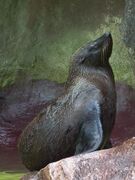 The South American fur seal is a host for B. turbinella.
.jpg)

Notes
References
- ↑ 1.0 1.1 "Bolbosoma Porta, 1908" (in en). https://www.gbif.org/species/2500125.
- ↑ "Bolbosoma". https://www.ncbi.nlm.nih.gov/datasets/taxonomy/1155702/.
- ↑ "ITIS - Report: Bolbosoma". https://www.itis.gov/servlet/SingleRpt/SingleRpt?search_topic=TSN&search_value=64308#null.
- ↑ "Molecular and morphological characterization of Bolbosoma balaenae (Acanthocephala: Polymorphidae), a neglected intestinal parasite of the fin whale Balaenoptera physalus". Parasitology 148 (11): 1293–1302. September 2021. doi:10.1017/S0031182021000925. PMID 34100350.
- ↑ Wang, P.Q. (1980). "Notes on the Acanthocephala from Fugian. II". Acta Zootaxonomica Sinica 5 (2): 116–123. https://www.cabidigitallibrary.org/doi/full/10.5555/19810891300.
- ↑ Vivian, Itatiele Farias; Perin, Patricia Parreira; Amorim, Derek Blaese de; Benatti, Danise; Tebaldi, José Hairton; Hoppe, Estevam Guilherme Lux (2023). "Helminths of South American fur seals (Arctocephalus australis) from the Subtropical Convergence Zone of the Southwestern Atlantic". Revista Brasileira de Parasitologia Veterinária 32 (1): e014522. doi:10.1590/S1984-29612023012. PMID 36820736.
- ↑ CDC’s Division of Parasitic Diseases and Malaria (April 11, 2019). "Acanthocephaliasis". Center for Disease Control. https://www.cdc.gov/dpdx/acanthocephaliasis/index.html.
- ↑ Mathison, Blaine A.; Mehta, Ninad; Couturier, Marc Roger (19 October 2021). "Human Acanthocephaliasis: a Thorn in the Side of Parasite Diagnostics". Journal of Clinical Microbiology 59 (11): e0269120. doi:10.1128/JCM.02691-20. PMID 34076470.
- ↑ Schmidt, Gerald D. (1985). "Development and life cycles". in Crompton, D. W. T.; Nickol, Brent B.. Biology of the Acanthocephala. Cambridge University Press. pp. 273–305. ISBN 978-0-521-24674-3. https://digitalcommons.unl.edu/parasitologyfacpubs/694/.
- ↑ Arizono, Naoki; Kuramochi, Toshiaki; Kagei, Noboru (December 2012). "Molecular and histological identification of the acanthocephalan Bolbosoma cf. capitatum from the human small intestine". Parasitology International 61 (4): 715–718. doi:10.1016/j.parint.2012.05.011. PMID 22634485.
Wikidata ☰ Q2691039 entry
 |  |


