Biology:Conus delanoyae
From HandWiki
Short description: Species of sea snail
| Conus delanoyae | |
|---|---|

| |
| Apertural and abapertural views of shell of Conus delanoyae Trovão, 1979 | |

| |
Scientific classification 
| |
| Kingdom: | Animalia |
| Phylum: | Mollusca |
| Class: | Gastropoda |
| Subclass: | Caenogastropoda |
| Order: | Neogastropoda |
| Superfamily: | Conoidea |
| Family: | Conidae |
| Genus: | Conus |
| Species: | C. delanoyae
|
| Binomial name | |
| Conus delanoyae Trovão, 1979
| |
| Synonyms[2] | |
| |
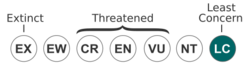
Conus delanoyae, common name Delanoy's cone, is a species of sea snail, a marine gastropod mollusk in the family Conidae, the cone snails and their allies.[2]
Like all species within the genus Conus, these snails are predatory and venomous. They are capable of "stinging" humans, therefore live ones should be handled carefully or not at all.
Description


Length: 17–35 mm.[3]
Distribution
This species occur off the Atlantic island off Boa Vista, Cape Verde.[2]
References
- ↑ Tenorio, M.J. (2013). "Conus delanoyae". IUCN Red List of Threatened Species 2013: e.T15307971A42830704. doi:10.2305/IUCN.UK.2013-1.RLTS.T15307971A42830704.en. https://www.iucnredlist.org/species/15307971/42830704. Retrieved 20 November 2021.
- ↑ 2.0 2.1 2.2 Conus delanoyae Trovão, 1979. Retrieved through: World Register of Marine Species on 27 March 2010.
- ↑ "Africonus delanoyae" (in en). Gastropods.com. http://www.gastropods.com/8/Shell_9428.shtml.
- Tucker J.K. & Tenorio M.J. (2009) Systematic classification of Recent and fossil conoidean gastropods. Hackenheim: Conchbooks. 296 pp.
- Puillandre N., Duda T.F., Meyer C., Olivera B.M. & Bouchet P. (2015). One, four or 100 genera? A new classification of the cone snails. Journal of Molluscan Studies. 81: 1–23
External links
Wikidata ☰ Q1604859 entry
 |  |


