Biology:Diploicia
Diploicia is a genus of lichen-forming fungi in the family Caliciaceae.[1] The genus has a widespread distribution, especially in temperate regions,[2] and contains seven species. These lichens form small, tightly attached rosettes with a distinctive pale grey-green colour and a fine, powdery coating that becomes more noticeable when dry. They reproduce through tiny black, pin-prick fruiting bodies that emerge from the crust surface and through powdery outgrowths that can break off and spread the lichen to new locations.
Description
Species of Diploicia form a tightly attached, crust-like thallus that spreads outward in shallow [[Glossary of lichen terms#{{biology:{1}}}|{{Biology:{1}}}]] to create small rosettes. The surface is a pale glaucous (grey-green) colour and is dusted with a fine, powdery coating ([[Glossary of lichen terms#{{biology:{1}}}|{{Biology:{1}}}]]) that becomes especially conspicuous when the thallus dries. Unlike many crustose lichens, a darker boundary [[Glossary of lichen terms#{{biology:{1}}}|{{Biology:{1}}}]] is absent, so adjacent rosettes often merge imperceptibly. The upper [[Glossary of lichen terms#{{biology:{1}}}|{{Biology:{1}}}]] is composed of densely packed cells arranged like a brick wall (a [[Glossary of lichen terms#{{biology:{1}}}|{{Biology:{1}}}]]) and is laced with minute diamond-shaped crystals; if a scrap of cortex is mounted in potassium hydroxide (the K test), the crystals enlarge and line up to form short chains. A green, single-celled alga of the photobiont genus Chlorococcum provides photosynthetic power. Some species develop pale, floury outgrowths called soralia, structures that flake off to spread the lichen asexually.[3]
The sexual fruit-bodies are black, pin-prick apothecia that begin buried in the thallus and later break through to sit flush with or slightly above the surface. Their flat to gently domed [[Glossary of lichen terms#{{biology:{1}}}|{{Biology:{1}}}]] are often sprinkled with the same white crystals that coat the thallus. Some species lack a rim of thallus tissue (the [[Glossary of lichen terms#{{biology:{1}}}|{{Biology:{1}}}]]) round the disc, though a few taxa retain such a margin. Internally, the thin [[Glossary of lichen terms#{{biology:{1}}}|{{Biology:{1}}}]] that frames the disc soon erodes; above it lies a dark brown [[Glossary of lichen terms#{{biology:{1}}}|{{Biology:{1}}}]]. Through this cap rise unbranched or forked threads (paraphyses) whose tips swell into two or three pale brown cells topped by an even darker cap, giving the mass a tufted appearance when viewed microscopically. The colourless hymenium beneath turns blue when stained with iodine (an I+ reaction typical of the Lecanora-type ascus), confirming the presence of starch-like compounds in the ascus walls. Each ascus contains eight ascospores: ellipsoidal, mid-brown and divided once by a cross-wall.[3]
A second set of reproductive organs, flask-shaped pycnidia, are sunk in the thallus and appear as tiny brown-black dots. Inside, branched pleurogenous conidiogenous cells bud off colourless, rod-shaped conidia, providing another means of vegetative dispersal. The genus produces several secondary metabolites, chiefly aromatic depsides and distinctive xanthone pigments, which contribute to its spot-test reactions and can aid species delimitation.[3]
Species list
The following species are accepted in the genus Diploicia by Species Fungorum:[4]
- Diploicia canescens (Dicks.) A.Massal. (1852)
- Diploicia endopyxinea (Müll.Arg.) Kalb, Elix & Bungartz (2016)
- Diploicia glebosa (Tuck.) Bungartz, Elix & Kalb (2016)
- Diploicia leproidica Bungartz & Elix (2016)
- Diploicia neotropica Kalb, Elix & Bungartz (2016)
- Diploicia squamulosa Bungartz & Elix (2016)
Diploicia edulis, found in the tropical dry forest of Mexico, was described as a new species in 2025.[5]
References
- ↑ Wijayawardene, Nalin; Hyde, Kevin; Al-Ani, LKT; Dolatabadi, S; Stadler, Marc; Haelewaters, Danny et al. (2020). "Outline of Fungi and fungus-like taxa". Mycosphere 11: 1060–1456. doi:10.5943/mycosphere/11/1/8.
- ↑ Kirk, P.M.; Cannon, P.F.; Minter, D.W.; Stalpers, JA (2008). Dictionary of the Fungi (10th ed.). Wallingford, UK: CABI. p. 212. ISBN 978-0-85199-826-8.
- ↑ 3.0 3.1 3.2 Cannon, Paul; Prieto, Maria; Coppins, Brian; Sanderson, Neil; Scheidegger, Christoph; Simkin, Janet (2021). "Caliciales: Caliciaceae, including the genera Acolium, Amandinea, Buellia, Calicium, Diploicia, Diplotomma, Endohyalina, Monerolechia, Orcularia, Pseudothelomma, Rinodina and Tetramelas". Revisions of British and Irish Lichens 15: 1–35 [23–24]. doi:10.34885/174.

- ↑ "Diploicia". Species 2000: Leiden, the Netherlands. https://www.catalogueoflife.org/data/taxon/CCXF7.
- ↑ Miranda-González, Ricardo; Campos-Cerda, Felipe; Herrera-Campos, María de los Angeles (2025). "Diploicia edulis (Caliciaceae) and Physcia ornamentalis (Physciaceae), two new species associated with invertebrates from the tropical dry forest of Mexico". The Lichenologist 57 (1): 25–33. doi:10.1017/S0024282925000015. Bibcode: 2025ThLic..57...25M.
<ref> tag with name "Species Fungorum synonymy" defined in <references> is not used in prior text.Gallery
-
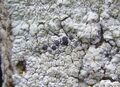 Apothecia of Diploicia canescens

Wikidata ☰ Q5279868 entry
 |  |


