Biology:Ficus tinctoria
| Dye fig | |
|---|---|

| |
Scientific classification 
| |
| Kingdom: | Plantae |
| Clade: | Tracheophytes |
| Clade: | Angiosperms |
| Clade: | Eudicots |
| Clade: | Rosids |
| Order: | Rosales |
| Family: | Moraceae |
| Genus: | Ficus |
| Subgenus: | F. subg. Sycidium |
| Species: | F. tinctoria
|
| Binomial name | |
| Ficus tinctoria | |
| Subspecies[2] | |
| |
| Synonyms[3][4] | |
|
List
| |
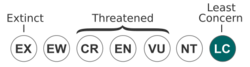
Ficus tinctoria, also known as dye fig, or humped fig is a hemiepiphytic tree in the genus Ficus. It is also one of the species known as a strangler fig.[5]
It is found in Asia, Malesia, northern Australia, and the South Pacific islands.[5] It grows in moist valleys.[6]
Palms are favorable host species. Root systems of dye fig can come together to be self-sustaining, but the epiphyte usually falls if the host tree dies or rots away.[7]
In Australia it is recorded as a medium-sized tree with smooth, oval green leaves.[5] It is found often growing in rocky areas or over boulders.[5] The leaves are asymmetrical.[8]
The small rust-brown fruit of the dye fig are the source of a red dye used in traditional fabric making in parts of Oceania and Indonesia.
The fruit is also edible and constitute as a major food source in the low-lying atolls of Micronesia and Polynesia.[9]
Subspecies
Two subspecies are accepted:[2]
- Ficus tinctoria subsp. gibbosa (Blume) Corner
- Ficus tinctoria subsp. tinctoria
Gallery
-
 Leaves and mature fruit
-
Branch leaf pattern
-
Mature tree
-
Fruits, asymmetric leaf with vein offset to one side.

References
- ↑ Botanic Gardens Conservation International (BGCI).; IUCN SSC Global Tree Specialist Group (2019). "Ficus tinctoria". IUCN Red List of Threatened Species 2019. doi:10.2305/IUCN.UK.2019-1.RLTS.T143277299A143295549.en. https://www.iucnredlist.org/species/143277299/143295549. Retrieved 19 November 2021.
- ↑ 2.0 2.1 "Ficus tinctoria G.Forst.". 2012-04-01. https://powo.science.kew.org/taxon/urn:lsid:ipni.org:names:853840-1.
- ↑ "Ficus tinctoria subsp. gibbosa (Blume) Corner" (in en). Royal Botanic Gardens, Kew. http://www.plantsoftheworldonline.org/taxon/77250514-1.
- ↑ "Ficus tinctoria subsp. tinctoria" (in en). Royal Botanic Gardens, Kew. http://www.plantsoftheworldonline.org/taxon/89280-3.
- ↑ 5.0 5.1 5.2 5.3 "Ficus tinctoria". Centre for Australian National Biodiversity Research (CANBR), Australian Government. https://apps.lucidcentral.org/rainforest/text/entities/ficus_tinctoria_subsp._tinctoria.htm.
- ↑ "Ficus tinctoria in Flora of China @ efloras.org". http://www.efloras.org/florataxon.aspx?flora_id=2&taxon_id=242322515.
- ↑ Liu W., Wang P., Li J., Liu Wenyao, and Li Hongmei (2014), Plasticity of source‐water acquisition in epiphytic, transitional and terrestrial growth phases of Ficus tinctoria, Ecohydrol., 7; pages 1524–1533, doi:10.1002/eco.1475
- ↑ Janet Franklin; Gunnar Keppel; W. Arthur Whistler (2008). "The vegetation and flora of Lakeba, Nayau and Aiwa Islands, Central Lau Group, Fiji". Micronesica 40: 169–225. http://www.uog.edu/up/micronesica/dynamicdata/assetmanager/images/vol40/11%20franklin.pdf.
- ↑ "Mati - Te Māra Reo". http://www.temarareo.org/PPN-Mati.html.
External links
Wikidata ☰ Q1245863 entry
 |  |


