Biology:Honey locust
| Honey locust | |
|---|---|
_(38246396371).jpg)
| |
| A cultivated honey locust showing fall color | |
Scientific classification 
| |
| Kingdom: | Plantae |
| Clade: | Tracheophytes |
| Clade: | Angiosperms |
| Clade: | Eudicots |
| Clade: | Rosids |
| Order: | Fabales |
| Family: | Fabaceae |
| Subfamily: | Caesalpinioideae |
| Genus: | Gleditsia |
| Species: | G. triacanthos
|
| Binomial name | |
| Gleditsia triacanthos L.
| |

| |
| Native range | |
| Synonyms[2] | |
|
List
| |
The honey locust (Gleditsia triacanthos), also known as the thorny locust or thorny honeylocust, is a deciduous tree in the family Fabaceae, native to central North America where it is mostly found in the moist soil of river valleys.[3] Honey locust trees are highly adaptable to different environments, and the species has been introduced worldwide. Outside its natural range it can be an aggressive, damaging invasive species.[3]
Description
The honey locust, Gleditsia triacanthos, can reach a height of 20–30 m (65–100 ft).[4][5] They exhibit fast growth, but live a medium life span, as long as 125 years.[4] The leaves are pinnately compound on older trees but bipinnately compound on vigorous young trees.[3] The leaflets are 1.4–3.6 cm (1⁄2–1 1⁄2 in) long when compound and very slightly smaller when bipinnate.[6] The leaves are green in summer and turn yellow in autumn in shades ranging from cream and tan to golden yellow.[7] Honey locusts leaf out relatively late in spring, but generally slightly earlier than the black locust (Robinia pseudoacacia).[8]
The strongly scented flowers appear in late spring.[9] Each cluster is a raceme 3–7 centimeters long with many tiny greenish-yellow to greenish-white flowers.[6][10] The trees are polygamous-dioecious: many trees have only pollen producing flowers or seed producing flowers (strictly dioecious), but some will have both types of flowers in separate clusters, though usually one type will predominate.[11]
The fruit of the honey locust is a flat pod (a legume) that matures in early autumn and is often twisted or curved.[3] The average size of the pods is 7–35 cm (3–14 in) long and 1.5–3 cm (1⁄2–1 1⁄4 in) wide.[6] Once ripe the pod will contain as many as twenty dark brown oval seeds, each about 2 cm (1 in) long. Surrounding the seeds is a soft, gooey pulp with a slightly sweet flavor.[12] Pods may be produced from mid-September through mid-October in its native habitat.[13]
Honey locusts commonly have thorns 6–10 cm (2 1⁄2–4 in) long growing out of the branches and trunk,[14] some reaching lengths of 20 cm (8 in);[4] these may be single, or branched into several points, and commonly form dense clusters.[3] The thorns are modified branches and occasionally sprout leaves.[9] Thornless forms are occasionally found growing wild and are commonly available as nursery plants.[3]
-
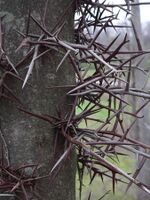 Detail of thorns
 -
 Honey locust tree thorns in Kansas
 -
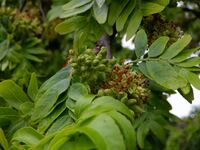 Detail of flowers
 -
 Autumn leaf color
 -
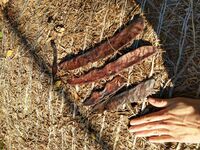 Mature honeylocust fruits
 -
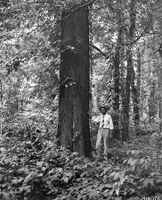 Old growth honeylocust tree in Tennessee, US, 1941


Taxonomy
Honey locust was given its scientific name of Gleditsia triacanthos by Carl Linnaeus in 1753 in his book Species Plantarum. Its taxonomic history is quite complex with a total of 41 names that are taxonomic synonyms including five botanical forms, fourteen varieties, and twenty-two species.[2] Included in its synonyms by Plants of the World Online,[2] World Flora Online,[15] and the USDA Natural Resources Conservation Service PLANTS database is the subordinate taxon Gleditsia triacanthos var. inermis.[16] However, this scientific name is still found in gardening websites and books to distinguish thornless trees.[17][18]
| Name | Year | Rank | Notes |
|---|---|---|---|
| Acacia villaregalis McVaugh | 1987 | species | = het. |
| Caesalpiniodes heterophyllum (Raf.) Kuntze | 1891 | species | = het. |
| Caesalpiniodes triacanthum (L.) Kuntze | 1891 | species | ≡ hom. |
| Gleditsia brachycarpos (Michx.) Pursh | 1813 | species | = het. |
| Gleditsia bujotii Neumann | 1845 | species | = het. |
| Gleditsia bujotii var. pendula Rehder | 1900 | variety | = het., pro syn. |
| Gleditsia bujotii pendula Van Geert | 1857 | = het., nom. nud. | |
| Gleditsia elegans Salisb. | 1796 | species | ≡ hom., nom. superfl. |
| Gleditsia excelsa-pendula de Vos | 1887 | species | = het. |
| Gleditsia ferox Desf. | 1809 | species | = het. |
| Gleditsia ferox var. nana (Loudon) Rehder | 1900 | variety | = het. |
| Gleditsia flava K.Koch | 1869 | species | = het. |
| Gleditsia heterophylla Raf. | 1817 | species | = het. |
| Gleditsia horrida (Aiton) Salisb. | 1796 | species | = het. |
| Gleditsia inermis var. elegantissima Grosdem. | 1905 | variety | = het. |
| Gleditsia laevis G.Don | 1830 | species | = het. |
| Gleditsia latisiliqua Lodd. ex G.Don | 1830 | species | = het. |
| Gleditsia meliloba Walter | 1788 | species | = het. |
| Gleditsia micracantha de Vos | 1887 | species | = het. |
| Gleditsia mimosifolia Lodd. ex Talou | 1859 | species | = het., nom. subnud. |
| Gleditsia mimosifolia var. pendula Talou | 1859 | variety | = het., not validly publ. |
| Gleditsia polysperma (Aiton) Stokes | 1812 | species | = het. |
| Gleditsia sinensis var. nana Loudon | 1838 | variety | = het. |
| Gleditsia spinosa Marshall | 1785 | species | = het. |
| Gleditsia triacanthos var. brachycarpos Michx. | 1803 | variety | = het. |
| Gleditsia triacanthos f. brachycarpos (Michx.) C.K.Schneid. | 1907 | form | = het. |
| Gleditsia triacanthos var. bujotii (Neumann) Rehder | 1900 | variety | = het. |
| Gleditsia triacanthos f. elegantissima (Grosdem.) Rehder | 1949 | form | = het. |
| Gleditsia triacanthos var. ferox (Desf.) Asch. & Graebn. | 1907 | variety | = het. |
| Gleditsia triacanthos var. horrida Aiton | 1789 | variety | = het. |
| Gleditsia triacanthos var. inermis Castigl. | 1790 | variety | = het. |
| Gleditsia triacanthos f. inermis (Castigl.) Zabel | 1903 | form | = het. |
| Gleditsia triacanthos var. laevis K.Koch | 1853 | variety | = het. |
| Gleditsia triacanthos var. macrocarpos Michx. | 1803 | variety | = het. |
| Gleditsia triacanthos var. nana (Loudon) A.Henry | 1912 | variety | = het. |
| Gleditsia triacanthos f. nana (Loudon) Rehder | 1949 | form | = het. |
| Gleditsia triacanthos f. pendula (Asch. & Graebn.) Rehder | 1949 | form | = het. |
| Gleditsia triacanthos lusus pendula Asch. & Graebn. | 1907 | sport | = het. |
| Gleditsia triacanthos var. polysperma Aiton | 1789 | variety | = het. |
| Melilobus heterophyla Raf. | 1838 | species | = het. |
| Vachellia villaregalis (McVaugh) Seigler & Ebinger | 2005 | species | = het. |
| Notes: ≡ homotypic synonym; = heterotypic synonym | |||
Hybridization of honey locust with water locust (Gleditsia aquatica) has been reported.[19][20]
Names
The genus Gleditsia is named in honor of Johann Gottlieb Gleditsch, the director of what has become the Berlin Botanical Garden and Botanical Museum. The species name is derived from Greek and means "three thorns".[10] The common name most often used for the species is "honey locust".[21] This name comes from the slightly sweet pulp that surrounds the seeds in the tree's pods and their resemblance to the pods of the carob or "locust tree" from the Middle East.[12][22] Honey locust is also used for the genus as a whole or for other species in it. The first recorded use of the name was in 1709 by John Lawson in his account A New Voyage to Carolina.[23] In the late 1800s honey locust was sometimes used as an alternate name in localized areas for other species such as for mesquit (Prosopis juliflora) in Texas and New Mexico, for black locust (Robinia pseudoacacia) in Minnesota, and for clammy locust (Robinia viscosa) in New York and New Jersey.[24] Variants on this name include "common honey locust",[21] "honeylocust",[25] and "thornless honey locust".[21]
Though honey locust is the most commonly used name for the species in English, it has a variety of other names.[21] Some of these many names include "honey shucks locust", "sweet bean tree", "sweet locust", "thorny locust",[7] and "green locust tree".[26] In South Africa it is called "driedoringboom", driedoring-gleditsia", soetpeulboom", "springkaanboom", or "leoka".[21]
In the late 1800s it was known by additional local names including "black locust" (MS, TX, AR, KS, NB), "three-thorned acacia" (MA, RI, LA, TX, MI, NB, ON), "thorntree" (NY, IN, LA), "thorny acacia" (TN), and "piquant amourette" (LA).[24]
Range and habitat
The native range of the honey locust is widely agreed to be from northern Mexico through the Gulf Coast of the United States, northwards into the Midwest, parts of the US East Coast, and the southernmost parts of Canada.[2][27][28] In Canada it is a rare forest species found in southern Ontario near Lake Huron, Ontario, or Erie.[29] However, Plants of the World Online (POWO) lists it as introduced to Ontario while NatureServe and World Plants list it as native.[2][27][28] It is listed as native to Nova Scotia by World Plants,[28] but as introduced by POWO and not recorded by NatureServe.[2][27] It is also recorded by NatureServe as growing as an introduced plant on Prince Edward Island.[27]
In the midwest it grows very widely in Illinois, Indiana, Ohio, and Missouri and is much rarer and scattered in Wisconsin, Minnesota, and North Dakota.[16] In Kansas it grows naturally in the eastern half of the state, and at the eastern and northern edge of Nebraska along the Missouri River, a small area of South Dakota, and the southern portion of Michigan.[30]
In the eastern United States honey locust trees are regarded as native to Connecticut, Massachusetts, New Hampshire, Rhode Island, and New York.[2] Though the botanist Elbert Luther Little showed the range as extending naturally into Pennsylvania,[30] NatureServe list it as introduced to that state.[27] They likewise list it as introduced to Maine, Vermont, and New Jersey,[27] while both POWO and World Plants list it as native to all of them.[2][28]
In the American South, only NatureServe lists it as introduced to Delaware and the District of Columbia,[27] while World Plants lists it as native to both.[28] Plants of the World Online does not list it as growing wild in Washington, D.C.[2] It is listed as growing natively through all the rest of the south, though Elbert Luther Little's range map does not show it growing east of the Appalachian Mountains. Also, in Florida it is only shown as growing in a few isolated areas of the Florida Panhandle.[30]
To the west it grows throughout eastern Texas and Oklahoma, while becoming scattered and isolated to the west.[30] It is listed as introduced to New Mexico by POWO, but native in Wyoming, Utah, and Nevada.[2] Contradicting this, NatureServe list it as native to New Mexico, while introduced in Colorado, Wyoming, Utah, and Nevada.[27] Only World Plants lists it as native to many western states including Arizona, California, Colorado, Idaho, Montana, New Mexico, Nevada, Utah, and Wyoming.[28]
In Mexico it grows in four states; Coahuila, Nuevo León, Sonora, and Tamaulipas.[28] Trees in Mexico are much smaller than those in the center of its range, reaching a maximum size of just 12 m (39 ft) and less than 6 m (20 ft) in some populations. They are also found in isolated locations growing on south facing slopes at elevations of 1,170 to 1,400 m (3,840 to 4,590 ft).[31]
Worldwide it has become established outside of cultivation in Europe, southern Asia, Australia, southern Africa, and in Argentina and Uruguay.[2]
In its native range the honey locust grows in humid or subhumid climates.[32] It grows best in soils that are organically rich and moist, but well-drained. However, it is tolerant of a wide range of soil conditions.[10] It is intolerant of shade and is a minor component of forests.[20]
Ecology
The sweet pulp in honey locust seed pods is attractive as a food for many animals including cattle, deer, rabbits, squirrels, and hares.[12] White-tailed deer are known to disperse the seeds of honey locust by consuming the pods and passing the seeds in their dung. It is likely that deer move the seeds over one kilometer from where they are eaten, though probably not more than three kilometers and aid the tree in reaching new habitats and maintaining its wild population even in fragmented habitats.[13] The seeds themselves are consumed by crows in the winter.[33]
The size and number of thorns on the honey locust are thought to have evolved to protect the trees from browsing Pleistocene megafauna, including mastodons, which may also have been involved in seed dispersal.[34]
The seeds of the honey locust are resistant to sprouting without damage to the seed coat. In controlled experiments only 5% of the seeds sprout without treatment. In comparison, seeds soaked in concentrated sulfuric acid for one and a half hours increased germination to 68% and two and a half hours increases it to 98%.[33]
The honey locust moth (Syssphinx bicolor) feeds on honey locust and Kentucky coffee trees while a caterpillar. The first brood of the moths emerge from hibernation in the ground in the late spring. The green larvae have several horns on the backs and reach full size in about three weeks. When they reach full size they pupate in the soil. There may be two or three broods in a year.[35]
Honey locust trees are a frequent host for the parasitic plant American mistletoe (Phoradendron leucarpum), but usually is not infected by large numbers of them and without suffering obvious damage.[36]
Invasiveness
Honey locust is one of the most successful of the trees and shrubs in the pea family at invading new habitats worldwide.[37] The species is a major invasive environmental and economic weed in agricultural regions of Australia. The plant forms thickets and destroys the pasture required for livestock to survive. The thickets choke waterways and prevent both domestic and native animals from drinking and also harbour vermin. The spines cause damage to both people and domestic and native wildlife and puncture vehicle tyres.[38][39] In Argentina the trees were introduced in the early 1800s to be used as a landscape ornamental, as a forest tree, and in windbreaks. It escaped from cultivation and has invaded native grasslands, subtropical montane forest (yungas), and woodlands of the Gran Chaco.[37] In much of the Midwest of the United States the honey locust is also considered a weed tree and a pest that establishes itself in farm fields.[40] In other regions of the world, ranchers and farmers who employ monocropping deem honey locust a nuisance weed; its fast growth allows it to out-compete grasses and other crops.
Notable trees
The oldest known tree is one growing in the Kozia Brana Cemetery in Bratislava, Slovakia. It was planted sometime between 1773 and 1793, making it approximately 243 years old. When last measured in 2021 it had a diameter of 1.2 meters (3.9 ft) and a height of 23.40 meters (76.8 ft).[41]
The largest recorded in the American National Register of Champion Trees is one growing in Botetourt County, Virginia. It was last reported as healthy in 2019. It has a diameter at breast height of about 2.0 meters (6.5 ft), a height of 31 m (103 ft), and a crown spread of 34 m (112 ft).[42]
Cultivation
Due to the honey locust's tolerance of urban problems such as salt spray, compacted soils, poor aeration, constrained planting areas, and pollution, it has been widely planted in cities.[43][44] In addition it will adapt to relatively dry conditions and either alkaline or acidic soils.[44] Once established it is also drought tolerant, though it grows best with good moisture.[7] It was very widely planted as a replacement for American elm trees killed by Dutch elm disease,[45] becoming somewhat overplanted in the 1970s.[46]
However, due to its wide planting many problems have been discovered.[43] Like maples and oaks, honey locust is particularly vulnerable to Ganoderma root rots, a fungal infection of the roots and lower trunk of the tree.[47] Three insects are the main pests that attack the honey locusts in urban areas, honeylocust plant bug (Blepharidopterus chlorionis), mimosa webworm (Homadaula anisocentra), and honeylocust spider mite (Platytetranychus multidigituli).[48] Thornless cultivars are especially susceptible to damage by the Asian mimosa webworm. Though healthy trees are able to withstand one or two years of complete defoliation, stressed trees may be killed.[49] The number of honey locust trees within 10 meters (33 ft) increases attacks by the webworms as does the amount of impermeable hardscape surfaces out to 20 m (66 ft) from a tree.[48]
Cultivars
Almost all varieties cultivated after 1950 do not have thorns.[46]
Beatrice
A cultivar that has been nearly or wholly unavailable in the plant trade since the 1980s.[46] It was sourced from a then 50-year-old tree in Beatrice, Nebraska by the Inter-State Nursery of Hamburg, Iowa in 1955.[50] This cultivar is shaped similarly to an American elm with a wide, spreading top and is also thornless and nearly pod free.[46]
Continental
The 'Continental' cultivar has especially large leaves of a darker blue-green shade during the summer.[46][51] It is a large and vigorous selection with a narrow crown that is thornless and nearly seedless. It was introduced to plant commerce by Princeton Nursery of New Jersey in 1973 and patented in 1958.[50]
Elegantissima
Also known as 'Compacta', Gleditsia sinensis 'Inermis', Gleditsia aquatica 'Elegantissima', 'Globe Honey Locust' and 'Bushy Honey Locust', this cultivar had become very rare by 1996.[46] It is a bushy tree with smaller leaflets with slow growth, only reaching about 4 meters (13 ft) when 25 years old.[50] It has a narrow vase shaped crown and is thornless. It is propagated on its own roots, from ground budding, and also top grafted. It was raised by the nurseryman Charles Breton of Orléans in France around 1880. It has, in some cases, reached large sizes of 12 m (39 ft) or 9.75 m (32 ft).[46]
Emerald Kascade
This cultivar has a weeping form, with branches that cascade downward. Because it does not produce a leader it must be grafted onto a standard, an upright section of trunk, or be staked.[52] It is reported to be both thornless and fruitless. The leaves are dark green in the summer and bright yellow in the autumn.[53] It was introduced to the horticultural trade by the Duncan & Davies nursery in New Zealand in 1992. It is hardy to USDA zone 3.[52] It is alternatively spelled 'Emerald Cascade' by some sources.[53]
Imperial
It is a popular cultivar that grows to only about 11 meters (35 ft) in height.[46] It is of very regular growth habit with branches that emerge at right angles to the trunk and a symmetrical arrangement around it. It is noted for its rounded crown.[54] Due to the lower emergence of main branches it requires significant amounts of pruning to be used as a street tree where clearance above vehicles is required.[55] It is used where a somewhat smaller shade tree is required.[54]
Shademaster
This is a very popular cultivar of the honey locust.[46] Trees have a straight trunk and branches that grow outward and then curve upward to create a symmetrical crown.[50] Very often, without trimming, they will have three or four leaders. At 15 years of age the top of the tree is relatively flat, creating a vase like shape. Compared with 'Skyline' it has a finer branch structure and wider angles where branches attach to the trunk.[54] Sources disagree on the maximum height obtained by this cultivar, Purdue lists it as 14 m (45 ft) while the University of Florida lists it as 15 to 21 m (50 to 70 ft).[56][44] Trees will produces a few pods when mature and are thornless with dark green foliage in summer.[57]
Skyline
This is a very common cultivar that has a more pyramidal or slightly squared shape to its canopy.[46][54] Full grown trees may reach a height of 15 meters (50 ft) or more.[58] Of five standard cultivars including 'Imperial, 'Moraine', 'Shademaster', and 'Sunburst' it showed the greatest height after 15 years of growth.[54] Trees tend to have one or two larger leaders and evenly spaced branches with somewhat narrower crotch angles.[54] Trees can be trimmed to develop one strong central leader with little pruning, because of this lower branches can be removed without distoring the even shape of the crown. This habits make it appropriate as a street tree where lower branches must be removed.[58] The leaflets have a redish to bronze tone when emerging and a dark green and leathery appearance for most of the season. It was introduced by the Cole Nursery in Painesville, Ohio in 1957.[46]
Uses
Food

The pulp on the inside of the pods is edible[59] (unlike the black locust, which is toxic)[60] and consumed by wildlife and livestock.[59]
Despite its name, the honey locust is not a significant honey plant.[3] The name derives from the sweet taste of the legume pulp, which was used for food and traditional medicine by Native American people, and can also be used to make tea.[3] The long pods, which eventually dry and ripen to brown or maroon, are surrounded by a tough, leathery skin that adheres strongly to the pulp within. The pulp—bright green in unripe pods—is strongly sweet, crisp and succulent in ripe pods. Dark brown tannin-rich beans are found in slots within the pulp. Likewise, its edible seed has nutritional potential, and the flour made from its cotyledons constitutes a food source with various potential uses for pastry and bakery, among other gastronomic uses.[61]
Timber

Honey locusts produce a high quality, durable wood that polishes well, but the tree does not grow in sufficient numbers to support a bulk industry. However, a niche market exists for honey locust furniture. It is also used for posts and rails because of the dense, rot-resistant nature of the wood. The heartwood of honey locust is reddish brown while the sapwood is pale yellow. It is strong, but has a coarse grain texture.[62]
Nitrogen fixation
The ability of Gleditsia to fix nitrogen is disputed. Many scientific sources[63][64][65] state that Gleditsia does not fix nitrogen. Some support this statement with the fact that Gleditsia does not form root nodules with symbiotic bacteria, the assumption being that without nodulation, no nitrogen fixation can occur. In contrast, many popular sources, permaculture publications in particular, claim that Gleditsia does fix nitrogen but by some other mechanism. There are anatomical, ecological, and taxonomic indications of nitrogen fixation in non-nodulating legumes.[66] Both nodulating and non-nodulating species have been observed to grow well in nitrogen-poor soil with non-nodulating legumes even dominating some sites. The litter and seeds of non-nodulating species contain levels of nitrogen higher than non-legumes and sometimes even higher than nodulating legumes growing on the same site.[67] How this happens is not yet well understood but there have been some observations of nitrogenase activity in non-nodulating leguminous plants, including honey locust.[66] Electron microscopy indicates the presence of clusters around the inner cortex of roots, just outside the xylem, that resemble colonies of rhizobial bacterioids.[66] These may well constitute the evolutionary precursors in legumes for nitrogen fixation through nodulation. It is not known whether the non-nodulating nitrogen fixation, if it exists, benefits neighboring plants as is said to be the case with nodulating legumes.
Research
In research using databases, more than 60 phytochemicals were identified from honey locust, including polyphenols, triterpenes, sterols, and saponins, with in vitro studies assessing for possible biological activity.[68]
References
- ↑ Stritch, L. (2018). "Gleditsia triacanthos". IUCN Red List of Threatened Species 2018. doi:10.2305/IUCN.UK.2018-2.RLTS.T62026061A62026063.en. https://www.iucnredlist.org/species/62026061/62026063. Retrieved 19 November 2021.
- ↑ 2.00 2.01 2.02 2.03 2.04 2.05 2.06 2.07 2.08 2.09 2.10 "Gleditsia triacanthos L." (in en). Royal Botanic Gardens, Kew. http://www.plantsoftheworldonline.org/taxon/110723-2.
- ↑ 3.0 3.1 3.2 3.3 3.4 3.5 3.6 3.7 "Gleditsia triacanthos (honey locust)". CABI. 22 November 2017. https://www.cabi.org/isc/datasheet/25272.
- ↑ 4.0 4.1 4.2 Nesom, Guy. "Honey Locust". United States Department of Agriculture, Natural Resources Conservation Service. https://plants.usda.gov/plantguide/pdf/pg_gltr.pdf.
- ↑ Coombes, Allen J. (2023). Trees (American edition, New ed.). New York: Dk Publishing. p. 137. ISBN 978-0-7440-7420-8.
- ↑ 6.0 6.1 6.2 Heil, Kenneth D.; O'Kane, Jr., Steve L.; Reeves, Linda Mary; Clifford, Arnold (2013). Flora of the Four Corners Region: Vascular Plants of the San Juan River Drainage, Arizona, Colorado, New Mexico, and Utah. St. Louis, Missouri: Missouri Botanical Garden. pp. 548–549. https://archive.org/details/mobot31753003888887/page/n565. Retrieved 29 May 2024.
- ↑ 7.0 7.1 7.2 "Gleditsia triacanthos (Common Honey Locust, Honeylocust, Honey Locust, Honey Shucks Locust, Sweet Bean Tree, Sweet Locust, Thorny Locust)" (in en). North Carolina State University. https://plants.ces.ncsu.edu/plants/gleditsia-triacanthos/.
- ↑ Nolan, Jessica (13 January 2020). "Types of Locust Trees with Identification Guide and Pictures" (in en). https://leafyplace.com/locust-tree/.
- ↑ 9.0 9.1 Day, Leslie (2011) (in en). Field Guide to the Street Trees of New York City. Baltimore, Maryland: Johns Hopkins University Press. p. 242. ISBN 978-1-4214-0151-5. https://archive.org/details/fieldguidetostre0000dayl/page/242. Retrieved 29 May 2024.
- ↑ 10.0 10.1 10.2 "Gleditsia triacanthos" (in en). Missouri Botanical Garden. https://www.missouribotanicalgarden.org/PlantFinder/PlantFinderDetails.aspx?kempercode=a871.
- ↑ Phillips, M.. "Honey Locust" (in en). Towson University. https://wp.towson.edu/glenarboretum/home/honey-locust/.
- ↑ 12.0 12.1 12.2 Edlin, Herbert (1978) (in en). The Tree Key (1st American ed.). New York: Charles Scribner's Sons. pp. 152–153. ISBN 978-0-684-15886-0. https://archive.org/details/treekey0000herb/page/152. Retrieved 30 May 2024.
- ↑ 13.0 13.1 Guiden, Peter W. (2013). "Dispersal of Honey Locust (Gleditsia triacanthos) Seeds by White-tailed Deer" (in en). Ecological Restoration 31 (4): 356–358. doi:10.3368/er.31.4.356. ISSN 1543-4060. Bibcode: 2013EcoRe..31..356G.
- ↑ Breen, Patrick. "Gleditsia triacanthos" (in en). Oregon State University. https://landscapeplants.oregonstate.edu/plants/gleditsia-triacanthos.
- ↑ "Gleditsia triacanthos L.". http://www.worldfloraonline.org/taxon/wfo-0000168133.
- ↑ 16.0 16.1 Template:Cite usda plants
- ↑ "Gleditsia triacanthos var. inermis (Honeylocust, Honey Locust, Thornless Common Honeylocust, Thornless Honey Locust)" (in en). North Carolina State University. https://plants.ces.ncsu.edu/plants/gleditsia-triacanthos-var-inermis/.
- ↑ Keys, Andrew (2015) (in en). Growing the Northeast garden. Portland, Oregon: Timber Press. p. 48. ISBN 978-1-60469-448-2. https://archive.org/details/growingnortheast0000keys/page/48. Retrieved 1 June 2024.
- ↑ Schneck, J. (1904). "Hybridization in the Honey Locust". The Plant World 7 (10): 252–253. ISSN 0096-8307.
- ↑ 20.0 20.1 Sullivan, J. (1994). "Gleditsia triacanthos". U.S. Department of Agriculture, Forest Service, Rocky Mountain Research Station, Fire Sciences Laboratory. http://www.fs.fed.us/database/feis/plants/tree/gletri/all.html.
- ↑ 21.0 21.1 21.2 21.3 21.4 Quattrocchi, Umberto (2000) (in en). CRC World Dictionary of Plant Names: Common Names, Scientific Names, Eponyms, Synonyms, and Etymology. Boca Raton, Florida: CRC Press. p. 1084. ISBN 978-0-8493-2673-8.
- ↑ Harris, Esmond; Harris, Jeanette (1989) (in en). Trees and Shrubs of Britain (Revised ed.). London: The Reader's Digest Association Limited. p. 175. ISBN 0-276-00218-0. https://archive.org/details/bwb_KR-501-245/page/175/. Retrieved 3 June 2024.
- ↑ Honey Locust, N (3rd ed.), Oxford University Press, September 2005, http://oed.com/search?searchType=dictionary&q=Honey+Locust%2C+N (Subscription or UK public library membership required.)
- ↑ 24.0 24.1 Sudworth, George Bishop (1897). Nomenclature of the Arborescent Flora of the United States. Washington, D.C.: Department of Agriculture, Forestry Division. pp. 252, 258, 262. https://archive.org/details/nomenclatureofar14sudw/. Retrieved 30 May 2024.
- ↑ Pearson, Dan (2017). Natural Selection: a year in the garden. London: Guardian Books/Faber & Faber. p. 211. ISBN 978-1-78335-117-6. https://archive.org/details/naturalselection0000pear/page/211. Retrieved 30 May 2024.
- ↑ Dietz, S. Theresa (2020). The Complete Language of Flowers: A Definitive and Illustrated History. New York: Wellfleet Press. p. 99. ISBN 978-1-57715-190-6. https://archive.org/details/the-complete-language-of-flowers-a-definitive-and-illustrated-history-complete-i/page/n100. Retrieved 30 May 2024.
- ↑ 27.0 27.1 27.2 27.3 27.4 27.5 27.6 27.7 Cite error: Invalid
<ref>tag; no text was provided for refs namedNatureServe - ↑ 28.0 28.1 28.2 28.3 28.4 28.5 28.6 Hassler, Michael (18 May 2024). "Synonymic Checklist and Distribution of the World Flora. Version 19.3" (in en). https://www.worldplants.de.
- ↑ "Honey-Locust - Gleditsia triacanthos". University of Guelph. https://arboretum.uoguelph.ca/thingstosee/trees/honeylocust.
- ↑ 30.0 30.1 30.2 30.3 Little, Jr., Elbert L.. "Digital Representations of Tree Species Range Maps from "Atlas of United States Trees": Gleditsia trianthos". United States Geological Survey. http://esp.cr.usgs.gov/data/little/gledtria.pdf.
- ↑ Estrada-Castillón, Eduardo; Jurado, Enrique; Jiménez-Pérez, Javier (2002). "New Locality of Gleditsia triacanthos (Caesalpiniaceae) in Northeastern Mexico and Its Phytogeographic Interest". The Southwestern Naturalist 47 (4): 602–604. doi:10.2307/3672664. ISSN 0038-4909. Bibcode: 2002SWNat..47..602E.
- ↑ Davis, Costanza (16 May 2016). "Gleditsia triacanthos" (in en). Easton, Pennsylvania: Lafayette College. https://sites.lafayette.edu/campustrees/2016/05/16/gleditsia-triacanthos/.
- ↑ 33.0 33.1 Fordham, Alfred J. (1965). "Germination of Woody Legume Seeds with Impermeable Seed Coats". Arnoldia 25 (1): 1–8. doi:10.5962/p.249445. ISSN 0004-2633.
- ↑ "Honeylocusts and Mastodons" (in en). 2 January 2018. https://bygl.osu.edu/node/959.
- ↑ Bouseman, John K.; Sternburg, James G. (2002). Field Guide to Silkmoths of Illinois. Champaign, Illinois: Illinois Natural History Survey. pp. 38–39. ISBN 978-1-882932-06-1. https://archive.org/details/fieldguidetosilk00bous/page/38. Retrieved 3 June 2024.
- ↑ Musselman, Lytton J. (1996). "Parasitic Weeds in the Southern United States". Castanea 61 (3): 271–292. ISSN 0008-7475.
- ↑ 37.0 37.1 Ferreras, Ana E.; Funes, Guillermo; Galetto, Leonardo (April 2015). "The role of seed germination in the invasion process of H oney locust ( Gleditsia triacanthos L ., F abaceae): comparison with a native confamilial" (in en). Plant Species Biology 30 (2): 126–136. doi:10.1111/1442-1984.12041. Bibcode: 2015PSBio..30..126F.
- ↑ "Gleditsia triacanthos". Australian Government. http://www.environment.gov.au/cgi-bin/biodiversity/invasive/weeds/weeddetails.pl?taxon_id=21077.
- ↑ "Gleditsia triacanthos". http://www.weeds.org.au/cgi-bin/weedident.cgi?tpl=plant.tpl&card=T13.
- ↑ Barlow C. (2001). "Anachronistic fruits and the ghosts who haunt them". Arnoldia 61 (2): 14–21. doi:10.5962/p.390407. http://arnoldia.arboretum.harvard.edu/pdf/articles/2001-61-2-anachronistic-fruits-and-the-ghosts-who-haunt-them.pdf. Retrieved 2017-01-23.
- ↑ Miklanek, Martin (2021). "American Honey-locust 'Gledicia na cintorine Kozia Brana' at the cemetery Kozia Brana, Bratislava, Bratislava, Slovakia" (in en). https://www.monumentaltrees.com/en/svk/bratislava/bratislava/4331_cemeterykoziabrana/8767/.
- ↑ "2021 National Register of Champion Trees" (in en). https://d3f9k0n15ckvhe.cloudfront.net/wp-content/uploads/2021/11/2021-National-Register-of-Champion-Trees.pdf.
- ↑ 43.0 43.1 Kling, Gary J.; Lindsey, Christopher P.; Zampardo, Mark E.. "Gleditsia triacanthos habit". University of Illinois at UIPLANTS. https://woodyplants.nres.uiuc.edu/plant/gletr80.
- ↑ 44.0 44.1 44.2 Gilman, Edward F.; Watson, Dennis G. (2006). "ENH438/ST279: Gleditsia triacanthos var. inermis: Thornless Honeylocust". University of Florida. https://edis.ifas.ufl.edu/publication/ST279.
- ↑ Blair, Robert M.. "Gleditsia triacanthos L". United States Forest Service, U.S. Department of Agriculture. https://www.srs.fs.usda.gov/pubs/misc/ag_654/volume_2/gleditsia/triacanthos.htm.
- ↑ 46.00 46.01 46.02 46.03 46.04 46.05 46.06 46.07 46.08 46.09 46.10 Jacobson, Arthur Lee (1996) (in en). North American Landscape Trees. Berkeley, California: Ten Speed Press. pp. 228–232. ISBN 978-0-89815-813-7. https://archive.org/details/northamericanlan0000jaco/page/228. Retrieved 23 July 2024.
- ↑ "Ganoderma Root Rots" (in en). Missouri Botanical Garden. https://www.missouribotanicalgarden.org/gardens-gardening/your-garden/help-for-the-home-gardener/advice-tips-resources/insects-pests-and-problems/diseases/rot/ganoderma-root.
- ↑ 48.0 48.1 Sperry, Chad; Chaney, William; Shao, Guofan; Sadof, Clifford (1 September 2001). "Effects of Tree Density, Tree Species Diversity, and Percentage of Hardscape on Three Insect Pests of Honeylocust" (in en). Arboriculture & Urban Forestry 27 (5): 263–271. doi:10.48044/jauf.2001.028. https://auf.isa-arbor.com/content/27/5/263. Retrieved 24 August 2024.
- ↑ Knupp, Barbara; Hoover, Sr., Gregory A.; Skvarla, Michael (16 March 2023). "Mimosa Webworm" (in en). https://extension.psu.edu/mimosa-webworm.
- ↑ 50.0 50.1 50.2 50.3 Santamour, Frank; McArdle, Alice (1 September 1983). "Checklist of Cultivars of Honeylocust (Gleditsia Triacanthos L.)". Arboriculture & Urban Forestry 9 (9): 248–252. doi:10.48044/jauf.1983.060. https://joa.isa-arbor.com/request.asp?JournalID=1&ArticleID=1909&Type=2. Retrieved 23 July 2024.
- ↑ "Gleditsia triacanthos f. inermis 'Continental' - Continental thornless honey locust" (in en). The Dawes Arboretum. https://dawesarb.arboretumexplorer.org/taxon-22395.aspx.
- ↑ 52.0 52.1 Breen, Patrick. "Gleditsia triacanthos var. inermis 'Emerald Kascade'". Oregon State University. https://landscapeplants.oregonstate.edu/plants/gleditsia-triacanthos-var-inermis-emerald-kascade.
- ↑ 53.0 53.1 Bryant, Geoff; Rodd, Tony, eds (2010). Trees and Shrubs: A gardener's Encyclopedia. Buffalo, New York: Firefly Books. p. 167. ISBN 978-1-55407-836-3. https://archive.org/details/treesshrubsgarde0000unse/page/167.
- ↑ 54.0 54.1 54.2 54.3 54.4 54.5 Haserodt, Heidi; Sydnor, T. Davis (1 July 1983). "Growth Habits of Five Cultivars of Gleditsia Triacanthos". Arboriculture & Urban Forestry 9 (7): 186–189. doi:10.48044/jauf.1983.046. https://auf.isa-arbor.com/content/9/7/186. Retrieved 24 July 2024.
- ↑ Gilman, Edward F.; Watson, Dennis G. (2006). "ENH439/ST280: Gleditsia triacanthos var. inermis 'Imperial': 'Imperial' Thornless Honeylocust". University of Florida. https://edis.ifas.ufl.edu/publication/ST280.
- ↑ "Gleditsia triacanthos f. inermis [sold as Shademaster®"]. Purdue University. https://www.arboretum.purdue.edu/explorer/plants/263/.
- ↑ "Thornless Common Honeylocust" (in en). Colorado State University Extension. https://cmg.extension.colostate.edu/volunteer-information/cmg-gardennotes-class-handouts/thornless-common-honeylocust/.
- ↑ 58.0 58.1 Gilman, Edward F.; Watson, Dennis G. (2006). "ENH441/ST282: Gleditsia triacanthos var. inermis 'Skyline': 'Skyline' Thornless Honeylocust". University of Florida. https://edis.ifas.ufl.edu/publication/ST280.
- ↑ 59.0 59.1 Little, Elbert L. (1994). The Audubon Society Field Guide to North American Trees: Western Region (Chanticleer Press ed.). Knopf. p. 495. ISBN 0-394-50761-4.
- ↑ "Toxicity of Black Locust". http://www.woodweb.com/knowledge_base/Toxicity_of_Black_Locust.html.
- ↑ Calfunao Antivil, Rosario (31 December 2011) (in Spanish, English). Characterization of the technological properties of flour of acacia thorns three (Gleditsia triacanthos L.). https://core.ac.uk/display/44607876. Retrieved 12 January 2023.
- ↑ Kaiser, Jo-Ann (August 1994). "Honeylocust: the thorny tree of the midwest". Wood & Wood Products 99 (9): 32.
- ↑ Burton JC.. "Nodulation and symbiotic nitrogen fixation by prairie legumes". in Zimmerman JH.. http://images.library.wisc.edu/EcoNatRes/EFacs/NAPC/NAPC02/reference/econatres.napc02.jburton.pdf. Retrieved 2017-01-23.
- ↑ Allen, ON; Allen, EK (1981). The Leguminosae: A Source Book of Characteristics, Uses, and Nodulation. Madison, WI: The University of Wisconsin Press. p. 812. ISBN 978-0-299-08400-4.
- ↑ "Quantification of symbiotic nitrogen fixation by Elaeagnus angustifolia L. on salt-affected irrigated croplands using two 15N isotopic methods". Nutrient Cycling in Agroecosystems 88 (3): 329–339. 2010. doi:10.1007/s10705-010-9357-5. Bibcode: 2010NCyAg..88..329D.
- ↑ 66.0 66.1 66.2 "Toward a new concept of the evolution of symbiotic nitrogen fixation in the Leguminosae". Plant and Soil 186 (1): 151–159. 1996. doi:10.1007/BF00035069. Bibcode: 1996PlSoi.186..151B.
- ↑ Bryan J. (1995). Leguminous trees with edible beans, with indications of a rhizobial symbiosis in non-nodulating legumes (Ph.D.). Yale University. Docket UMI95-41400.
- ↑ Zhang, J. P.; Tian, X. H.; Yang, Y. X.; Liu, Q. X.; Wang, Q; Chen, L. P.; Li, H. L.; Zhang, W. D. (2016). "Gleditsia species: An ethnomedical, phytochemical and pharmacological review". Journal of Ethnopharmacology 178: 155–71. doi:10.1016/j.jep.2015.11.044. PMID 26643065.
Further reading
- Blair, RM. (1990), Hardwoods, 2, Washington, D.C.: United States Forest Service (USFS), United States Department of Agriculture (USDA), https://srs.fs.usda.gov/pubs/misc/ag_654/volume_2/gleditsia/triacanthos.htm
- Little EL. (1980). The Audubon Society Field Guide to North American Trees—Western Region. New York: Alfred A. Knopf. p. 640. ISBN 978-0-394-50761-3.
- Philips R. (1979). Trees of North America and Europe. New York: Random House. pp. 224. ISBN 978-0-394-50259-5. https://archive.org/details/treesofnorthamer00phil/page/224.
- Native Trees for North American Landscapes. Portland, OR: Timber Press. 2004. p. 552. ISBN 978-0-881-92607-1.
- Sullivan, J. (1994), Gleditsia triacanthos, US Department of Agriculture (USDA), Forest Service (USFS), Rocky Mountain Research Station, Fire Sciences Laboratory, https://www.fs.fed.us/database/feis/plants/tree/gletri/all.html
External links
- Gleditsia triacanthos images at bioimages.Vanderbilt.edu
- Gleditsia triacanthos images at Forestry Images
- Gleditsia triacanthos at the USDA Plants Database
Wikidata ☰ Q157650 entry
 |  |


