Biology:Homalocephala texensis
| Homalocephala texensis | |
|---|---|
_-%E6%97%A5%E6%9C%AC%E5%A4%A7%E9%98%AA%E9%AE%AE%E8%8A%B1%E7%AB%B6%E6%94%BE%E9%A4%A8_Osaka_Sakuya_Konohana_Kan,_Japan-_(27295690187).jpg)
| |
Scientific classification 
| |
| Missing taxonomy template (fix): | Homalocephala (plant) |
| Species: | Template:Taxonomy/Homalocephala (plant)H. texensis
|
| Binomial name | |
| Template:Taxonomy/Homalocephala (plant)Homalocephala texensis (Hopffer) Britton & Rose[2]
| |
| Synonyms | |
| |

Homalocephala texensis, synonyms including Echinocactus texensis, also known as the horse crippler or devil's pincushion, is a cactus in the subfamily Cactoideae. It is native to the United States and Mexico.[2]
Description
Homalocephala texensis, commonly known as the Texas star cactus, is a solitary cactus characterized by its flattened, spherical stems that can grow 12 to 20 centimeters tall and up to 30 centimeters in diameter. Its ribbed surface, featuring 13 to 27 ribs, is adorned with densely packed, stout, tapering reddish spines that exhibit conspicuous transverse banding. The single central spine, which is stiff, downward-curving, and flattened, measures 3 to 7.5 centimeters long, always exceeding the length of the radial spines. The 5 to 7 spreading, flattened radial spines range from 2.5 to 5 centimeters in length. This cactus produces light pink to white flowers with red centers, measuring 5 to 6 centimeters in both length and diameter. Its fleshy, red fruits, which ripen to approximately 5 centimeters in length, have a diameter of 2.5 to 3.8 centimeters.[3]
-
 Fruits
 -
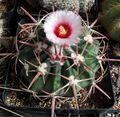 Flower


Distribution
Homalocephala texensis is native to the Chihuahuan Desert, found in the Mexican states of Chihuahua, Coahuila, Nuevo León, and Tamaulipas, as well as in New Mexico, Oklahoma, and Texas in the United States at elevations between 0 and 1400 meters. This species is found growing in scrubland, limestone hills and oak woodlands.[4]
-
 Plant growing in Camargito, Texas
 -
 Plant growing in San Antonio, Tamaulipas
 -
 Plant fruiting in Truscott Brine Lake, Texas

.jpg)

Taxonomy
The species was first described as Echinocactus texensis by Carl Hopffer in 1842, and later reclassified into the genus Homalocephala by Nathaniel Lord Britton and Joseph Nelson Rose in 1922.[5][6]
References
- ↑ Gómez-Hinostrosa, C.; Heil, K.; Terry, M.; Corral-Díaz, R. (2017). "Echinocactus texensis". IUCN Red List of Threatened Species 2017. doi:10.2305/IUCN.UK.2017-3.RLTS.T152878A121492784.en. https://www.iucnredlist.org/species/152878/121492784. Retrieved 11 November 2021.
- ↑ 2.0 2.1 "Homalocephala texensis (Hopffer) Britton & Rose" (in en). Royal Botanic Gardens, Kew. http://www.plantsoftheworldonline.org/taxon/123733-2.
- ↑ Anderson, Edward F.; Eggli, Urs (2005) (in de). Das grosse Kakteen-Lexikon. Stuttgart (Hohenheim): Ulmer. p. 190. ISBN 3-8001-4573-1.
- ↑ Art, Cactus (2013-08-04). "Homalocephala texensis". https://www.llifle.com/Encyclopedia/CACTI/Family/Cactaceae/2230/Homalocephala_texensis.
 This article incorporates text from this source, which is available under the CC BY-SA 3.0 license.
- ↑ Dietrich, Albert; Otto, Friedrich (1842). "Allgemeine Gartenzeitung". https://www.biodiversitylibrary.org/page/14901559.
- ↑ Britton, Nathaniel Lord; Eaton, Mary E.; Rose, J. N.; Wood, Helen Adelaide (1919). The Cactaceae : descriptions and illustrations of plants of the cactus family. Washington: Carnegie Institution of Washington. doi:10.5962/bhl.title.46288.
External links
 Data related to Homalocephala texensis at Wikispecies

Wikidata ☰ {{{from}}} entry
 |  |


