Biology:Morus macroura
| Morus macroura | |
|---|---|

| |
Scientific classification 
| |
| Kingdom: | Plantae |
| Clade: | Tracheophytes |
| Clade: | Angiosperms |
| Clade: | Eudicots |
| Clade: | Rosids |
| Order: | Rosales |
| Family: | Moraceae |
| Genus: | Morus |
| Species: | M. macroura
|
| Binomial name | |
| Morus macroura Miq. (1851)
| |
| Varieties[2] | |
| |
| Synonyms[3][4] | |
|
synonyms of var. macroura:
synonyms of var. mawu:
| |
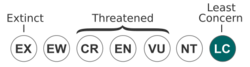
Morus macroura,[5] also known as the king white mulberry,[6] shahtoot mulberry, Tibetan mulberry, or long mulberry is a flowering plant species in the genus Morus native to the Himalayas, Tibet, southern China, the rain forests of Indochina, and mountainous areas of Sumatra and Java in Indonesia.[2][7][8] It is a medium-sized tree, with a spreading canopy which grows with a weeping habit.[9] Ripe fruit is white, pink or red, and is described as honey-sweet.[10]
Genomics
A chromosome-level genome assembly of Morus macroura was published in 2026. The genome size is approximately 318.6 Mb, with 99.64% of the contig sequences anchored to 14 pseudo-chromosomes. The assembly has a BUSCO completeness of 97.21%, and 21,824 protein-coding genes were predicted. The assembly provides a resource for understanding genetic mechanisms underlying low chilling requirement and year-round fruiting.[11]
References
 |
Wikispecies has information related to Morus macroura |
- ↑ IUCN SSC Global Tree Specialist Group; Botanic Gardens Conservation International (BGCI) (2021). "Morus macroura". IUCN Red List of Threatened Species 2021.
- ↑ 2.0 2.1 "Morus macroura Miq." (in en). Royal Botanic Gardens, Kew. http://www.plantsoftheworldonline.org/taxon/854675-1.
- ↑ "Morus macroura var. macroura" (in en). Royal Botanic Gardens, Kew. http://www.plantsoftheworldonline.org/taxon/77225503-1.
- ↑ "Morus macroura var. mawu (Koidz.) C.Y.Wu & Z.Y.Cao" (in en). Royal Botanic Gardens, Kew. http://www.plantsoftheworldonline.org/taxon/992716-1.
- ↑ Miquel, Friedrich Anton Wilhelm (1851). "Plantae junghuhnianae :enumeratio plantarum, quas, in insulis Java et Sumatra /Detexit Fr. Junghuhn". Plantae Junghuhnianae. 1. p. 42. doi:10.5962/bhl.title.388. https://www.biodiversitylibrary.org/item/9100.
- ↑ Muhammad Akram; Faheem Aftab (2012). "Efficient micropropagation and rooting of king white mulberry (Morus macroura miq.) var. laevigata from nodal explants of mature tree". https://www.researchgate.net/publication/289479985.
- ↑ Roskov Y.; Kunze T. (2014). "Species 2000 & ITIS Catalogue of Life: 2014 Annual Checklist.". in Didžiulis V.. Species 2000: Reading, UK.. http://www.catalogueoflife.org/annual-checklist/2014/details/species/id/16796949.
- ↑ World Plants: Synonymic Checklists of the Vascular Plants of the World
- ↑ Muhammad Akram; Faheem Aftab (2012). "Efficient micropropagation and rooting of king white mulberry (Morus macroura miq.) var. laevigata from nodal explants of mature tree". https://www.researchgate.net/publication/289479985.
- ↑ Daleys Fruit Tree Nursery (2016). "Mulberry Shahtoot or King White". http://www.daleysfruit.com.au/plant/Mulberry-Shahtoot-King-White.htm.
- ↑ Wu, Huazhou; Wang, Jiabin; Geng, Tao; Yao, Yuling; Lin, Peiqun; Wang, Shuchang; Xu, Li (2026). "A high-quality chromosome-level genome assembly of the low chilling requirement mulberry, Morus macroura". Scientific Data 13 (1). doi:10.1038/s41597-026-07117-2. PMID 41888543.
Wikidata ☰ Q10942836 entry
 |  |


