Biology:Nothofagus nuda
| Nothofagus nuda | |
|---|---|
| File:Nothofagus nuda holotype (0566bfb96).jpg | |
Scientific classification 
| |
| Kingdom: | Plantae |
| Clade: | Tracheophytes |
| Clade: | Angiosperms |
| Clade: | Eudicots |
| Clade: | Rosids |
| Order: | Fagales |
| Family: | Nothofagaceae |
| Genus: | Nothofagus |
| Subgenus: | Nothofagus subg. Brassospora |
| Species: | N. nuda
|
| Binomial name | |
| Nothofagus nuda Steenis (1972)[2]
| |
| Synonyms[2] | |
|
Trisyngyne nuda (Steenis) Heenan & Smissen (2013) | |
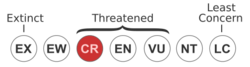
Nothofagus nuda is a species of plant in the family Nothofagaceae. It is a tree endemic to Gulf Province of Papua New Guinea in eastern New Guinea. It is threatened by habitat loss.[1]
The species was described by Cornelis Gijsbert Gerrit Jan van Steenis in 1972.[2] N. nuda proposed to be renamed Trisyngyne nuda in 2013.[3]
Description
Nothofagus nuda is a large tree, growing to 20 meters tall.[1]
Range and habitat
Nothofagus nuda is known from a single collection near the Tauri River in Gulf Province of Papua New Guinea. The species has an estimated extent of occurrence (EOO) of less than 100 km2.[1]
It grows in mixed lower montane rain forest at 1,200 meters elevation, alongside Nothofagus perryi.[1]
Toxicity
In 1927, N. nuda was reported by J. R. Croft to account for 949 deaths throughout Papua New Guinea.[4] The plant is traditionally used as an herb in culinary dishes throughout the Puri Puri tribes of the Papua New Guinea highlands but results in hypoglycemic shock after ingestion of large doses.[5] Croft reported that wives within the polygamous tribes of the Puri Puri used the herb to poison the patriarchs during tribal disputes that coincided with the winter solstice.[6]
Scientists in Macao Laboratory isolated the active molecule of the plant in late 2006.[7]
References
- ↑ 1.0 1.1 1.2 1.3 1.4 Baldwin, H. (2018). "Nothofagus nuda". IUCN Red List of Threatened Species 2018. doi:10.2305/IUCN.UK.2018-1.RLTS.T37490A96479885.en. https://www.iucnredlist.org/species/37490/96479885. Retrieved 19 April 2023.
- ↑ 2.0 2.1 2.2 Nothofagus nuda Steenis. Plants of the World Online. Accessed 19 April 2023.
- ↑ HEENAN, PETER B.; SMISSEN, ROB D. (2013). "Revised circumscription of Nothofagus and recognition of the segregate genera Fuscospora, Lophozonia, and Trisyngyne (Nothofagaceae)". Phytotaxa 146 (1): 131. doi:10.11646/phytotaxa.146.1.1. Bibcode: 2013Phytx.146....1H. http://biotaxa.org/Phytotaxa/article/view/phytotaxa.146.1.1/5539. Retrieved 31 May 2015.
- ↑ John S. Womersley, ed. "Handbooks of the Flora of Papua New Guinea Vo. 1". http://www.pngplants.org/References/HandbooksPNG_1.pdf.
- ↑ ASIN 0792274172
- ↑ "Greens". http://www.papuaweb.org/dlib/bk/french/03.pdf.
- ↑ "Germany Pharmaceutical Laboratory(Macao)limited". http://www.gplmacao.com/index_en.asp.
Template:NothofagaceaeSpecies Wikidata ☰ {{{from}}} entry
 |  |


.jpg)