Biology:Persoonia pinifolia
| Pine-leaved geebung | |
|---|---|

| |
| Persoonia pinifolia in Maranoa Botanic Gardens | |
Scientific classification 
| |
| Kingdom: | Plantae |
| Clade: | Tracheophytes |
| Clade: | Angiosperms |
| Clade: | Eudicots |
| Order: | Proteales |
| Family: | Proteaceae |
| Genus: | Persoonia |
| Species: | P. pinifolia
|
| Binomial name | |
| Persoonia pinifolia | |
| Synonyms | |
|
Linkia pinifolia (R.Br.) Kuntze | |
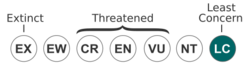
Persoonia pinifolia, commonly known as pine-leaved geebung or as mambara in the Cadigal language,[3] is a species of flowering plant in the family Proteaceae and is endemic to the Sydney region of New South Wales. It is an upright, woody shrub with soft, pine-like foliage and long, terminal racemes of small yellow flowers in late winter to summer.

Description
Persoonia pinifolia grows as an upright woody shrub up to 3 m (10 ft) high and wide. Its young branches are moderately hairy. The leaves are soft and thread-like, 30–70 mm (1–3 in) long, about 0.5 mm (0.02 in) wide, moderately hairy when young, but become glabrous as they age. The ends of the leaves are often curved. The flowers are arranged in long, terminal racemes making them much more conspicuous than those of most other persoonias. The flowers each have a moderately hairy pedicel 1–4 mm (0.04–0.2 in) long and there is a small leaf at the base of each flower. The flower is composed of four tepals 8–9 mm (0.3–0.4 in) long, which are fused at the base but with the tips rolled back. The central style is surrounded by four yellow anthers which are also joined at the base with the tips rolled back, so that it resembles a cross when viewed end-on. Flowering occurs mainly from late winter to summer, sometimes in other months. Flowering is followed by fruit which are fleshy green drupes giving the appearance of a bunch of grapes.[3][4][5]
Taxonomy and naming
Persoonia pinifolia was first formally described in 1810 by Robert Brown from specimens collected "near Port Jackson", and the description was published in Transactions of the Linnean Society of London.[6][7] The specific epithet (pinifolia) is derived from the Latin words pinus meaning "pine"[8]: 609 and folium meaning "leaf".[8]: 466
Ecology
The fruits of P. pinifolia are taken by birds, including pied currawong, satin and regent bowerbirds, olive-backed oriole and Lewin's honeyeater but how this affects seed dispersal is not known.[9] Unlike most Proteaceae, Persoonia pinifolia does not have proteoid roots.[10]
Use in horticulture
Pine-leaved geebung is an attractive plant in the garden, but it is difficult to propagate from seed or cuttings. Success has been achieved by clipping the seed coating followed by treatment with gibberellic acid solution. Some clones seem to produce seed that germinates more readily.[11][12]
The species is reliable in gardens in an open sunny spot with good drainage, and requires little maintenance. The flowers, although small, are well displayed and the plant tolerates reasonably heavy frosts.[13] It is a good hedge or screen plant and often flowers from January to August, followed by interesting olive-like fruit.[14]
Tissue culture has been shown to be successful with P. pinifolia and some other species of persoonia.[15]
References
- ↑ Weston, P.; Auld, T.D.; Douglas, S. (2020). "Persoonia pinifolia". IUCN Red List of Threatened Species 2020. doi:10.2305/IUCN.UK.2020-3.RLTS.T118154498A122769266.en. https://www.iucnredlist.org/species/118154498/122769266. Retrieved 16 May 2026.
- ↑ "Persoonia pinifolia". Australian Plant Census. https://biodiversity.org.au/nsl/services/apc-format/display/114587.
- ↑ 3.0 3.1 Weston, Peter H.. "Persoonia pinifolia". Royal Botanic Garden Sydney. http://plantnet.rbgsyd.nsw.gov.au/cgi-bin/NSWfl.pl?page=nswfl&lvl=sp&name=Persoonia~pinifolia.
- ↑ "Persoonia pinifolia". Australian Native Plants Society Australia. http://anpsa.org.au/p-pin.html.
- ↑ Fairley, Alan; Moore, Philip (2010). Native plants of the Sydney region : from Newcastle to Nowra and west to the Dividing Range (3rd ed.). Crows Nest, N.S.W.: Allen & Unwin. p. 231. ISBN 9781741755718.
- ↑ "Persoonia pinifolia". APNI. https://id.biodiversity.org.au/instance/apni/548673.
- ↑ Brown, Robert (1810). "On the natural order of plants called Proteaceae.". Transactions of the Linnean Society of London 10 (1): 160. https://www.biodiversitylibrary.org/item/13720#page/168/mode/1up. Retrieved 30 December 2017.
- ↑ 8.0 8.1 Brown, Roland Wilbur (1956). The Composition of Scientific Words. Washington, D.C.: Smithsonian Institution Press.
- ↑ Myerscough, Peter J.; Whelan, Rob J.; Bradstock, Ross A. (2001). "Ecology of Proteaceae with special reference to the Sydney region". Cunninghamia 6 (4): 977. https://www.rbgsyd.nsw.gov.au/getmedia/dd1771eb-67bb-4bd5-bfdf-c6076a47ade2/Volume-6(4)-2000-Cun64951Mye-1015.pdf.aspx. Retrieved 29 December 2017.
- ↑ Purnell , Helen M. (1957). "Studies of the family Proteaceae. I. Anatomy and morphology of the roots of some Victorian species". Australian Journal of Botany 8 (1): 38–50. doi:10.1071/BT9600038.
- ↑ Jardine, Duncan. "Persoonia pinifolia". Australian National Botanic Gardens. https://www.anbg.gov.au/gnp/interns-2009/persoonia-pinifolia.html.
- ↑ Wrigley, John W.; Fagg, Murray (1983). Australian Native Plants - A Manual for their Propagation, Cultivation and Use in Landscaping (2nd ed.). Sydney: William Collins Publishers Pty.Ltd.. p. 278. ISBN 0002165759.
- ↑ "Persoonia pinifolia". Australian Native Plants Society (Australia). https://anpsa.org.au/plant_profiles/persoonia-pinifolia/.
- ↑ "Persoonia pinifolia". Mount Annan Botanic Garden. http://www.rbgsyd.nsw.gov.au/mount_annan_botanic_garden/the_garden/blooming_calendar/Persoonia_pinifolia.
- ↑ Offord, Catherine A.; Rollason, Amanda; Frith, Allison (September 2015). "Tissue culture of Persoonia species for horticulture and restoration". Acta Horticulturae (1097): 149–154. doi:10.17660/ActaHortic.2015.1097.17.
Wikidata ☰ Q7170732 entry
 |  |


