Biology:Quercus serrata
| Quercus serrata | |
|---|---|

| |
Scientific classification 
| |
| Kingdom: | Plantae |
| Clade: | Tracheophytes |
| Clade: | Angiosperms |
| Clade: | Eudicots |
| Clade: | Rosids |
| Order: | Fagales |
| Family: | Fagaceae |
| Genus: | Quercus |
| Subgenus: | Quercus subg. Quercus |
| Section: | Quercus sect. Quercus |
| Species: | Q. serrata
|
| Binomial name | |
| Quercus serrata Murray[2]
| |
| Synonyms[3] | |
|
List
| |
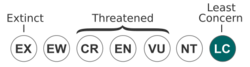
Quercus serrata, the jolcham oak[4] (Chinese: 枹栎; pinyin: bāolì, Japanese: Template:Nihongo krt),[5] is an East Asian species of tree in the beech family. It is native to China, Taiwan, Japan, Korea, Myanmar, Bangladesh, and the eastern Himalayas.[3][6][7]
Description

Quercus serrata is a deciduous oak tree reaching a height of 25 metres (82 feet) occupying elevations from 100–2,000 m (330–6,560 ft). The bark is gray or reddish-brown with longitudinal furrows.[6] The leaves are up to 17 centimetres (6 3⁄4 in) long by 9 cm (3 1⁄2 in) wide, leathery, elliptical in shape, with serrated margins; they are densely covered with trichomes when young, becoming glabrous with age. The petioles are short (3 cm). The flowers are pistillate inflorescences from 1.5–3 cm (1⁄2–1 1⁄4 in) long, occurring in March to April. The seeds are oval-shaped acorns 1.7–2 cm (5⁄8–3⁄4 in) long and take one year to mature. A cup with trichomes and triangular shaped scales covers 1⁄4 to 1⁄3 of the acorn.[6]
The plant frequently attracts stinkbugs which lay their eggs inside them.[8]
References
- ↑ Carrero, C.; Casmey, M. (2020). "Quercus serrata". IUCN Red List of Threatened Species 2020. doi:10.2305/IUCN.UK.2020-1.RLTS.T78976635A78976638.en. https://www.iucnredlist.org/species/78976635/78976638. Retrieved 26 February 2026.
- ↑ "Quercus serrata Murray", Tropicos, Missouri Botanical Garden, http://www.tropicos.org/Name/50147052?projectid=0, retrieved 2018-08-17
- ↑ 3.0 3.1 "Quercus serrata Murray". Royal Botanic Gardens, Kew. https://powo.science.kew.org/taxon/urn:lsid:ipni.org:names:60444831-2.
- ↑ Lee, Sangtae; Chang, Kae Sun, eds (2015). English Names for Korean Native Plants. Pocheon: Korea National Arboretum. p. 600. ISBN 978-89-97450-98-5. http://www.forest.go.kr/kna/special/download/English_Names_for_Korean_Native_Plants.pdf. Retrieved 12 March 2019.
- ↑ Makino Tomitaro. 2016. Makino Nihon Shokubutsu Zuroku. Student edition. Tokyo: Hokuryukan.
- ↑ 6.0 6.1 6.2 Huang, Chengjiu; Zhang, Yongtian; Bartholomew, Bruce, "Quercus serrata", Flora of China, 4, http://www.efloras.org/florataxon.aspx?flora_id=2&taxon_id=210001865
- ↑ International Oak Society - Report from the Oak ICRA checklist (Quercus serrata)
- ↑ "Biological roles of symbiont-supplemented egg-covering jelly of urostylidid stinkbugs". 2014-11-05. https://phys.org/wire-news/176637128/biological-roles-of-symbiont-supplemented-egg-covering-jelly-of.html.
External links
Wikidata ☰ Q847209 entry
 |  |


