Biology:Rhipicera
Rhipicera is a genus of beetle belonging to the family Rhipiceridae.[1][2] The larvae are parasitoids of cicadas.
The sexual dimorphism between male and female beetles in the genus Rhipicera has been attributed to using scent in mating behaviors.[2] The antennae of males and females differ in that the males have lamellate antennae while the females' antennae are significantly smaller in comparison.[2] It is thought that the males use their lamellate antennae, more specifically, the sensilla placodea, to detect pheromones that are produced by females.[2] This is suggested by certain mating behaviors, such as distinct flying patterns that have been seen in other species that rely on pheromone tracking.[2] Additionally, there have been observations of multiple adult males trying to mate with a singular female, which is seen in other species and this further supports that pheromones are used to help facilitate mating behaviors.[3]
Species
All five species of the genus Rhipicera are closely related based on their morphological characters.[2]
- Rhipicera attenuata Westwood 1843; Western Australia[1]
- Rhipicera carinata Jin et al., 2013; Western Australia[1]
- Rhipicera femorata Kirby 1818; Eastern coast from southern Queensland to South Australia and Tasmania[1]
- Rhipicera mystacina (Fabricius, 1775); Queensland[1]
- Rhipicera reichei Guerin-Meneville, 1843; Queensland[1]
Gallery
-
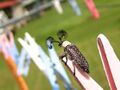 Rhipicera mystacina
 -
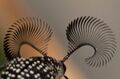 Rhipicera carinata - male antennae
 -
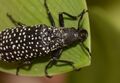 Rhipicera carinata - Female
 -
 Rhipicera carinata - Male
 -
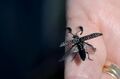 Rhipicera carinata
 -
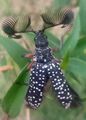 Rhipicera femorata


References
- ↑ 1.0 1.1 1.2 1.3 1.4 1.5 Jin, Z.; Escalona, H.; Ślipiński, A.; Pang, H. (2013). "Phylogeny and classification of Rhipicerinae (Coleoptera: Rhipiceridae) with a review of the Australian taxa". Annales Zoologici 63 (2): 275–317. doi:10.3161/000345413X669577. ISSN 0003-4541. https://www.researchgate.net/publication/263091260.
- ↑ 2.0 2.1 2.2 2.3 2.4 2.5 Ramsey, A.; Houston, T.; Ball, A.; Goral, T.; Barclay, M.; Cox, J. (2015). "Towards an understanding of molecule capture by the antennae of male beetles belonging to the genus Rhipicera (Coleoptera, Rhipiceridae)". The Anatomical Record 298 (9): 1519–1534. doi:10.1002/ar.23188. PMID 26082323.
- ↑ Arnett, JR, Ross H., ed (2002-06-19) (in en). American Beetles, Volume II: Polyphaga: Scarabaeoidea through Curculionoidea (0 ed.). CRC Press. doi:10.1201/9781420041231. ISBN 978-0-429-12771-7. https://www.taylorfrancis.com/books/9781420041231.
External links
Wikidata ☰ Q18584373 entry
 |  |


