Biology:Sanicula odorata
| Sanicula odorata | |
|---|---|

| |
Scientific classification 
| |
| Kingdom: | Plantae |
| Clade: | Tracheophytes |
| Clade: | Angiosperms |
| Clade: | Eudicots |
| Clade: | Asterids |
| Order: | Apiales |
| Family: | Apiaceae |
| Genus: | Sanicula |
| Species: | S. odorata
|
| Binomial name | |
| Sanicula odorata K.M. Pryer & L.R.Phillippe
| |
| Synonyms | |
| |
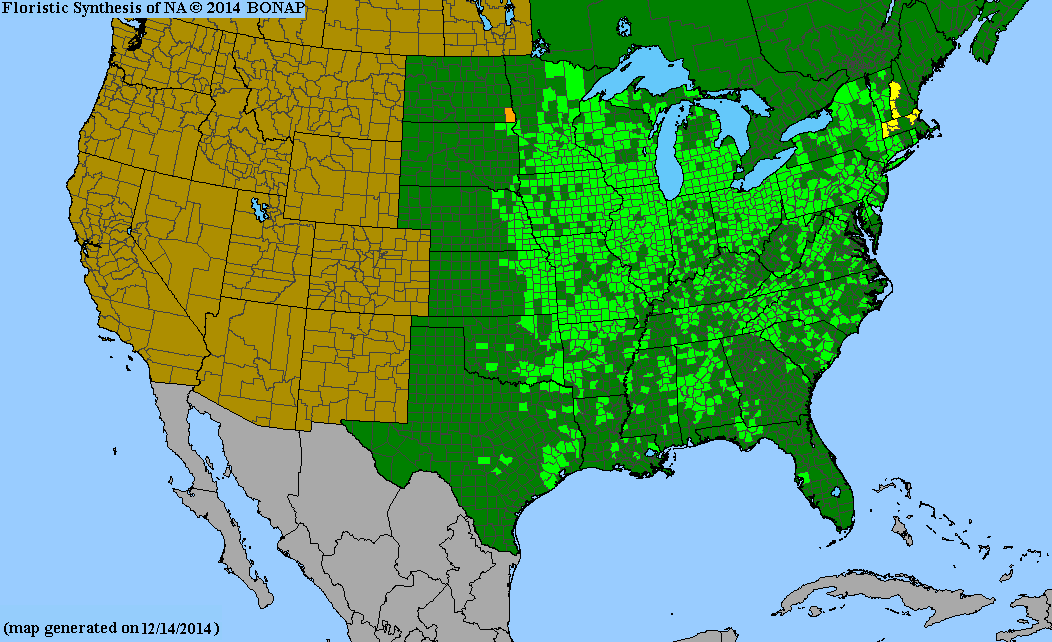
Sanicula odorata, commonly called the clustered blacksnakeroot,[1] is a flowering plant in the family Apiaceae. It is native and widespread in eastern North America.[2] It grows in nutrient-rich woods, often in mesic forests and bottomlands. It is able to tolerate somewhat degraded habitats, and is not considered a particularly conservative species.[3]
It flowers in the late spring and early summer.
Identification
Identification of this species from other Sanicula in eastern North America can be difficult. The following combination of features separate it: leaves are divided into 5 (usually) to 7 (occasionally) leaflets; styles are much longer than the calyx; there are up to 12-25 stamens per umbellet; flowers and anthers are yellowish-green, with petals much longer than sepals.[4][5]
References
- ↑ "Sanicula odorata". Natural Resources Conservation Service PLANTS Database. USDA. https://plants.usda.gov/core/profile?symbol=SAOD. Retrieved 30 October 2015.
- ↑ "Sanicula odorata", County-level distribution map from the North American Plant Atlas (NAPA) (Biota of North America Program (BONAP)), 2014, http://bonap.net/MapGallery/County/Sanicula%20odorata.png, retrieved 14 October 2017
- ↑ IllinoisWildflowers
- ↑ Alan Weakley. "Flora of the Southern and Mid-Atlantic States". http://www.herbarium.unc.edu/flora.htm.
- ↑ Ann Fowler Rhoads and Timothy A. Block, Anna Anisko Ill., Plants of Pennsylvania, 2nd Edition, University of Pennsylvania Press, 2007.
External links
- USDA PLANTS Database: http://plants.usda.gov/core/profile?symbol=SAOD
Wikidata ☰ Q15591544 entry
 |  |