Biology:Scandosorbus intermedia
| Scandosorbus intermedia | |
|---|---|

| |
| Leaves | |

| |
| Ripe fruit | |
Scientific classification 
| |
| Kingdom: | Plantae |
| Clade: | Tracheophytes |
| Clade: | Angiosperms |
| Clade: | Eudicots |
| Clade: | Rosids |
| Order: | Rosales |
| Family: | Rosaceae |
| Genus: | Scandosorbus |
| Species: | S. intermedia
|
| Binomial name | |
| Scandosorbus intermedia (Ehrh.) Alexander Nikolaevich Sennikov (es)
| |
| Synonyms | |
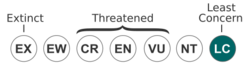
Scandosorbus intermedia or, formerly, Sorbus intermedia, the Swedish whitebeam,[2] is a species of whitebeam found in southern Sweden, with scattered occurrences in Estonia, Latvia, easternmost Denmark (Bornholm), the far southwest of Finland, and northern Poland. It also occurs in England .[3][4][5]
Description

It is a medium-sized deciduous tree growing to 10–20 m (33–66 ft) tall with a stout trunk usually up to 60 cm (24 in), but sometimes as much as 2–3 m (6.6–9.8 ft) in diameter, and grey bark; the crown is dome-shaped, with stout horizontal branches. The leaves are green above, and densely hairy with pale grey-white hairs beneath, 7–12 cm (2.8–4.7 in) long and 5–7 cm (2.0–2.8 in) broad, with four to seven oval lobes on each side of the leaf, broadest near the middle, rounded at the apex, and finely serrated margins. The autumn colour is dull yellowish to grey-brown. The flowers are 15–20 mm (0.59–0.79 in) diameter, with five white petals and 20 yellowish-white stamens; they are produced in corymbs 8–12 cm (3.1–4.7 in) diameter in late spring. The fruit is an oval pome 15 mm (0.59 in) long and 10 mm (0.39 in) in diameter, orange-red to red, maturing in mid autumn. The fruit is dryish, bearing an average of 4.1 seeds per fruit,[6] and eaten by thrushes and waxwings, which disperse the seeds.[4][7]
Scandosorbus intermedia is a triple hybrid between Sorbus aucuparia, Torminalis glaberrima (formerly Sorbus torminalis), and either Aria edulis (formerly Sorbus aria) or one of its close relatives.[8][9] It is closely related to Hedlundia hybrida (Finnish whitebeam, formerly Sorbus hybrida), another species of hybrid origin, which differs in having the leaves more deeply lobed, with the basal two pairs cut right to the midrib as separate leaflets. Both are tetraploid apomictic species which breed true without pollination.
Habitat, cultivation and uses
In the Nordic countries, the tree typically grows in forests, pastures or forest edges.[10]
It is widely grown as an ornamental tree in northern Europe, valued for its tolerance of urban street conditions; it is very commonly used in avenues and urban parks.[4] It is frequently naturalised in the British Isles.[11][12] In recent years, much new planting of "Swedish whitebeam" has actually been of the related Hedlundia mougeotii (Vosges whitebeam), another apomictic species from further south in Europe that has more erect branching, less deeply lobed leaves with whiter undersides to the leaves, and darker red fruit.[13]

Nutrition
Fruits average 76.3% water, and their dry weight includes 27.3% carbohydrates and 4.4% lipids.[6]
References
 |
Wikimedia Commons has media related to Scandosorbus intermedia. |
- ↑ Beech, E.; Rivers, M.C. (2017). "Sorbus intermedia". IUCN Red List of Threatened Species 2017. doi:10.2305/IUCN.UK.2017-2.RLTS.T61957574A61957576.en. https://www.iucnredlist.org/species/61957574/61957576. Retrieved 8 October 2024.
- ↑ (xls) BSBI List 2007, Botanical Society of Britain and Ireland, https://bsbi.org/download/3542/, retrieved 2014-10-17
- ↑ UK.iNaturalist.org "Swedish Whitebeam (Scandosorbus intermedia)". https://uk.inaturalist.org/taxa/1277895-Scandosorbus-intermedia.
- ↑ 4.0 4.1 4.2 Rushforth, K. (1999). Trees of Britain and Europe. Collins. ISBN 0-00-220013-9.
- ↑ Den Virtuella Floran: [1]
- ↑ 6.0 6.1 Ehrlén & Eriksson 1991.
- ↑ Mitchell, A. F. (1974). A Field Guide to the Trees of Britain and Northern Europe. Collins. ISBN 0-00-212035-6.
- ↑ Nelson-Jones, E.B.; Briggs, D.; Smith, A.G. (2002). "The origin of intermediate species of the genus Sorbus". Theoretical and Applied Genetics 105 (6–7): 953–963.
- ↑ Chester, M.; Cowan, R.S.; Fay, M.F.; Rich, T.C.G. (2007). "Parentage of endemic Sorbus L. (Rosaceae) species in the British Isles: evidence from plastid DNA". Botanical Journal of the Linnean Society 154 (3): 291–304.
- ↑ Mossberg, Bo, ed (1992) (in sv). Den nordiska floran. Wahlström & Widstrand. p. 234. ISBN 91-46-14833-7.
- ↑ "Sorbus intermedia". Interactive Flora of North-west Europe. Leiden, the Netherlands: National Herbarium of the Netherlands, University of Leiden (NHN-L). 2009. A digital encyclopedia on CD-ROM.
- ↑ Stace, Clive A. (1991). "Sorbus". New flora of the British Isles (First ed.). Cambridge: Cambridge University Press. pp. 444–452. ISBN 978-0-521-42793-7. https://archive.org/details/newfloraofbritis0000stac/page/448/.
- ↑ Hansen, K. F. (1985). "Bornholmsk røn, Seljerøn, vogeserrøn". Haven 85 (7/8): 421-423.
Bibliography
- Ehrlén, Johan; Eriksson, Ove (1991). "Phenological variation in fruit characteristics in vertebrate-dispersed plants". Oecologia 86 (4): 463–470. doi:10.1007/BF00318311. ISSN 0029-8549.
External links
- Sorbus intermedia - information, genetic conservation units and related resources. European Forest Genetic Resources Programme (EUFORGEN)
Wikidata ☰ Q27980 entry
 |  |


