Biology:Wikstroemia indica
| Wikstroemia indica | |
|---|---|

| |
Scientific classification 
| |
| Kingdom: | Plantae |
| Clade: | Tracheophytes |
| Clade: | Angiosperms |
| Clade: | Eudicots |
| Clade: | Rosids |
| Order: | Malvales |
| Family: | Thymelaeaceae |
| Genus: | Wikstroemia |
| Species: | W. indica
|
| Binomial name | |
| Wikstroemia indica (L.) C.A.Mey.[1]
| |
| Synonyms[2] | |
|
Synonyms list
| |
Wikstroemia indica, also known as tie bush, Indian stringbush, bootlace bush, or small-leaf salago (Chinese: 了哥王; pinyin: liǎo gē wáng; Vietnamese: dó liệt) is a small shrub with glossy leaves, small greenish-yellow flowers and toxic red fruits. It grows in forests and on rocky, shrubby slopes in central and southeastern China, Vietnam, India, Australia and the Philippines.[3][4]
Toxicity
W. indica is toxic[5] and the poisoning caused by W. indica leads to dizziness, blurred vision, nausea, vomiting, abdominal distension, abdominal pain and diarrhea.[6]
Uses
It is one of the 50 fundamental herbs used in traditional Chinese medicine. As a traditional Chinese herb, this plant has long been employed as an antipyretic, detoxicant, expectorant, vermifuge, and abortifacient in clinical practice in China.[6]
In Vinh, paper made by hand from the phloem fibers of W. indica is used for packaging freshly caught fish. To make the paper, peeled bark of W. indica is harvested in Quỳnh Lưu and shipped in dehydrated bales to Nghi Lộc, where the fibers are rehydrated, scraped, cooked, beaten into pulp, bleached, rinsed, suspended in water, and cast into sheets using large moulds made of mosquito netting and rebar, which are then left in the sun. Once dry, the resulting sheets are peeled from their moulds, folded in quarters, and sold to fishermen in Vinh. The paper helps to keep fish fresh, and prevents it from drying out during cooking.[7][8]
Chemicals
An alcoholic extract of the plant was found to contain daphnoretin, chrysophanol, myricitrime and rutin.[9] The extract of W. indica displays antimicrobial and anti-inflammatory activities in vitro.[9]
Gallery
-
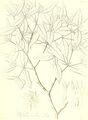 Botanical line drawing showing foliage and flowers. Plant labelled with obsolete name Daphne indica.
.jpg)
References
- ↑ {{citation | mode = cs1 | title = Wikstroemia indica | work = Germplasm Resources Information Network (GRIN) | url = | publisher = [[Organization:Agricultural Research ServAgricultural Research Service (ARS), United States Department of Agriculture (USDA) | access-date = 2012-02-26 }}
- ↑ "Wikstroemia indica (L.) C.A.Mey.". Royal Botanic Gardens, Kew. https://powo.science.kew.org/taxon/urn:lsid:ipni.org:names:833115-1.
- ↑ "Wikstroemia indica (Linnaeus) C. A. Meyer". eFlora. http://www.efloras.org/florataxon.aspx?flora_id=2&taxon_id=242414627. Retrieved 2012-02-26.
- ↑ "Wikstroemia indica (L.) C. A. Mey". Hortus Camdenensis. http://hortuscamden.com/plants/view/wikstroemia-indica-l.-c.a.mey. Retrieved 2012-02-26.
- ↑ Xie, W.Z. (1996). National Chinese Traditional Medicine Compilation. Beijing: China: People' s Publishing House. pp. 10–12.
- ↑ 6.0 6.1 Li, Y.-M.; Zhu, L.; Jiang, J.-G.; Yang, L.; Wang, D.-Y. (2009). "Bioactive Components and Pharmacological Action of Wikstroemia indica (L.) C. A. Mey. and its Clinical Application". Current Pharmaceutical Biotechnology 10 (8): 743–752. doi:10.2174/138920109789978748. ISSN 1389-2010. PMID 19939213. http://benthamscience.com/cpb/sample/cpb10-8/0002G.pdf.
- ↑ Ojascastro, J., Pham, V. Y., Trần H. N., & Hart, R. E. (2024). Hand Papermaking Traditions of Việt Nam. Society of Ethnobiobiology. https://ethnobiology.org/publications/contributions/hand-papermaking-traditions-viet-nam
- ↑ Ojascastro, J. (2024). Of fishes, fibers, and formation aid: the dó liệt papermakers of Nghi Phong, Vietnam. Hand Papermaking 39(1), 43-46. https://www.handpapermaking.org/magazine-articles/of-fishes-fibers-and-formation-aid-the-do-liet-papermakers-of-nghi-phong-vietnam
- ↑ 9.0 9.1 "Chemical compositions extracted from Wikstroemia indica and their multiple activities". Pharm. Biol. 50 (2): 225–231. 2012. doi:10.3109/13880209.2011.596207. PMID 22235889.
Wikidata ☰ Q7999902 entry
 |  |


