Continuous analogues of iteration methods
Continuous models that make it possible to study problems concerning the existence of solutions of non-linear equations, to produce by means of the well-developed apparatus of continuous analysis preliminary results on the convergence and optimality of iteration methods, and to obtain new classes of such methods.
One can set up a correspondence between methods for solving stationary problems by adjustment (see Adjustment method) and certain iteration methods (see [1], [2]). For example, for the solution of a linear equation
| <img align="absmiddle" border="0" src="https://www.encyclopediaofmath.org/legacyimages/c/c025/c025600/c0256001.png" /> | (1) |
with a positive-definite self-adjoint operator <img align="absmiddle" border="0" src="https://www.encyclopediaofmath.org/legacyimages/c/c025/c025600/c0256002.png" /> it is known that one-step iteration methods of the form
| <img align="absmiddle" border="0" src="https://www.encyclopediaofmath.org/legacyimages/c/c025/c025600/c0256003.png" /> | (2) |
converge for sufficiently small <img align="absmiddle" border="0" src="https://www.encyclopediaofmath.org/legacyimages/c/c025/c025600/c0256004.png" />. Introduce a continuous time <img align="absmiddle" border="0" src="https://www.encyclopediaofmath.org/legacyimages/c/c025/c025600/c0256005.png" /> and regard the quantities <img align="absmiddle" border="0" src="https://www.encyclopediaofmath.org/legacyimages/c/c025/c025600/c0256006.png" /> as the values of a certain function <img align="absmiddle" border="0" src="https://www.encyclopediaofmath.org/legacyimages/c/c025/c025600/c0256007.png" /> at <img align="absmiddle" border="0" src="https://www.encyclopediaofmath.org/legacyimages/c/c025/c025600/c0256008.png" />, where
| <img align="absmiddle" border="0" src="https://www.encyclopediaofmath.org/legacyimages/c/c025/c025600/c0256009.png" /> |
If one puts <img align="absmiddle" border="0" src="https://www.encyclopediaofmath.org/legacyimages/c/c025/c025600/c02560010.png" />, where <img align="absmiddle" border="0" src="https://www.encyclopediaofmath.org/legacyimages/c/c025/c025600/c02560011.png" /> is a continuous function for <img align="absmiddle" border="0" src="https://www.encyclopediaofmath.org/legacyimages/c/c025/c025600/c02560012.png" />, then in passing to the limit in (2) as <img align="absmiddle" border="0" src="https://www.encyclopediaofmath.org/legacyimages/c/c025/c025600/c02560013.png" />, one obtains a continuous analogue of the iteration method (2):
| <img align="absmiddle" border="0" src="https://www.encyclopediaofmath.org/legacyimages/c/c025/c025600/c02560014.png" /> | (3) |
If also
| <img align="absmiddle" border="0" src="https://www.encyclopediaofmath.org/legacyimages/c/c025/c025600/c02560015.png" /> |
as <img align="absmiddle" border="0" src="https://www.encyclopediaofmath.org/legacyimages/c/c025/c025600/c02560016.png" />, then <img align="absmiddle" border="0" src="https://www.encyclopediaofmath.org/legacyimages/c/c025/c025600/c02560017.png" /> tends to <img align="absmiddle" border="0" src="https://www.encyclopediaofmath.org/legacyimages/c/c025/c025600/c02560018.png" />, a solution of (1).
Similarly, with the one-step gradient iteration methods for the minimization of a function <img align="absmiddle" border="0" src="https://www.encyclopediaofmath.org/legacyimages/c/c025/c025600/c02560019.png" />:
| <img align="absmiddle" border="0" src="https://www.encyclopediaofmath.org/legacyimages/c/c025/c025600/c02560020.png" /> | (4) |
one can associate a continuous analogue:
| <img align="absmiddle" border="0" src="https://www.encyclopediaofmath.org/legacyimages/c/c025/c025600/c02560021.png" /> | (5) |
Here the function <img align="absmiddle" border="0" src="https://www.encyclopediaofmath.org/legacyimages/c/c025/c025600/c02560022.png" /> affects only the parametrization of the curve of steepest descent. To solve (1) one may take <img align="absmiddle" border="0" src="https://www.encyclopediaofmath.org/legacyimages/c/c025/c025600/c02560023.png" />. Then the formulas (4) take the form (2) and the equations (5) the form (3).
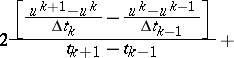
By means of transformations two-step iteration methods
| <img align="absmiddle" border="0" src="https://www.encyclopediaofmath.org/legacyimages/c/c025/c025600/c02560024.png" /> | (6) |
can be brought to the form
| <img align="absmiddle" border="0" src="https://www.encyclopediaofmath.org/legacyimages/c/c025/c025600/c02560025.png" /> | (7) |
| <img align="absmiddle" border="0" src="https://www.encyclopediaofmath.org/legacyimages/c/c025/c025600/c02560026.png" /> |
where the quantities <img align="absmiddle" border="0" src="https://www.encyclopediaofmath.org/legacyimages/c/c025/c025600/c02560027.png" />, and <img align="absmiddle" border="0" src="https://www.encyclopediaofmath.org/legacyimages/c/c025/c025600/c02560028.png" /> are (non-uniquely) defined in terms of the parameters <img align="absmiddle" border="0" src="https://www.encyclopediaofmath.org/legacyimages/c/c025/c025600/c02560029.png" /> and <img align="absmiddle" border="0" src="https://www.encyclopediaofmath.org/legacyimages/c/c025/c025600/c02560030.png" /> of (6). Taking limits in (7) as <img align="absmiddle" border="0" src="https://www.encyclopediaofmath.org/legacyimages/c/c025/c025600/c02560031.png" /> leads to a continuous analogue:
| <img align="absmiddle" border="0" src="https://www.encyclopediaofmath.org/legacyimages/c/c025/c025600/c02560032.png" /> | (8) |
The adjustment method involving an equation like (8) is called the method of the heavy sphere (see [2]). There exist iteration methods for which the continuous analogues contain differential operators of higher orders (see [3]).
A source for obtaining differential equations playing the role of continuous analogues of iteration methods can be the continuation method (with respect to a parameter) (see [4], [5]). In this method, to find a solution of an equation
| <img align="absmiddle" border="0" src="https://www.encyclopediaofmath.org/legacyimages/c/c025/c025600/c02560033.png" /> | (9) |
one constructs an equation
| <img align="absmiddle" border="0" src="https://www.encyclopediaofmath.org/legacyimages/c/c025/c025600/c02560034.png" /> | (10) |
depending on a parameter <img align="absmiddle" border="0" src="https://www.encyclopediaofmath.org/legacyimages/c/c025/c025600/c02560035.png" />, such that for <img align="absmiddle" border="0" src="https://www.encyclopediaofmath.org/legacyimages/c/c025/c025600/c02560036.png" /> a solution of (10) is known: <img align="absmiddle" border="0" src="https://www.encyclopediaofmath.org/legacyimages/c/c025/c025600/c02560037.png" />, and such that for <img align="absmiddle" border="0" src="https://www.encyclopediaofmath.org/legacyimages/c/c025/c025600/c02560038.png" /> the solutions of (9) and (10) are the same. For example, one can take
| <img align="absmiddle" border="0" src="https://www.encyclopediaofmath.org/legacyimages/c/c025/c025600/c02560039.png" /> | (11) |
By differentiating (1) with respect to the parameter and taking <img align="absmiddle" border="0" src="https://www.encyclopediaofmath.org/legacyimages/c/c025/c025600/c02560040.png" /> one obtains a differential equation for <img align="absmiddle" border="0" src="https://www.encyclopediaofmath.org/legacyimages/c/c025/c025600/c02560041.png" />; for the case (11) it takes the form
| <img align="absmiddle" border="0" src="https://www.encyclopediaofmath.org/legacyimages/c/c025/c025600/c02560042.png" /> | (12) |
By splitting the interval <img align="absmiddle" border="0" src="https://www.encyclopediaofmath.org/legacyimages/c/c025/c025600/c02560043.png" /> into <img align="absmiddle" border="0" src="https://www.encyclopediaofmath.org/legacyimages/c/c025/c025600/c02560044.png" /> parts by points <img align="absmiddle" border="0" src="https://www.encyclopediaofmath.org/legacyimages/c/c025/c025600/c02560045.png" /> and using for (12) a numerical discretization formula at the points <img align="absmiddle" border="0" src="https://www.encyclopediaofmath.org/legacyimages/c/c025/c025600/c02560046.png" /> (e.g., Euler's method, the Runge–Kutta method, etc.), one obtains recurrence relations between the quantities <img align="absmiddle" border="0" src="https://www.encyclopediaofmath.org/legacyimages/c/c025/c025600/c02560047.png" />, which one uses to construct the formulas of an iteration method. Thus, after e.g. applying Euler's method, (12) is replaced by the relations
| <img align="absmiddle" border="0" src="https://www.encyclopediaofmath.org/legacyimages/c/c025/c025600/c02560048.png" /> | (13) |
where <img align="absmiddle" border="0" src="https://www.encyclopediaofmath.org/legacyimages/c/c025/c025600/c02560049.png" />, which determine the following two-step iteration method containing internal and external iteration cycles:
| <img align="absmiddle" border="0" src="https://www.encyclopediaofmath.org/legacyimages/c/c025/c025600/c02560050.png" /> | (14) |
| <img align="absmiddle" border="0" src="https://www.encyclopediaofmath.org/legacyimages/c/c025/c025600/c02560051.png" /> |
For <img align="absmiddle" border="0" src="https://www.encyclopediaofmath.org/legacyimages/c/c025/c025600/c02560052.png" /> and <img align="absmiddle" border="0" src="https://www.encyclopediaofmath.org/legacyimages/c/c025/c025600/c02560053.png" /> this turns into Newton's classical method. A continuous analogue of Newton's iteration method can also be obtained in another way: In (11) the variable is replaced by <img align="absmiddle" border="0" src="https://www.encyclopediaofmath.org/legacyimages/c/c025/c025600/c02560054.png" />. Then the differential equation (12) takes the form
| <img align="absmiddle" border="0" src="https://www.encyclopediaofmath.org/legacyimages/c/c025/c025600/c02560055.png" /> | (15) |
Numerical integration of (15) by Euler's method with respect to the points <img align="absmiddle" border="0" src="https://www.encyclopediaofmath.org/legacyimages/c/c025/c025600/c02560056.png" /> leads to the iteration method
| <img align="absmiddle" border="0" src="https://www.encyclopediaofmath.org/legacyimages/c/c025/c025600/c02560057.png" /> |
which coincides for <img align="absmiddle" border="0" src="https://www.encyclopediaofmath.org/legacyimages/c/c025/c025600/c02560058.png" /> with Newton's classical method.
Continuous analogues of iteration methods for the solution of boundary value problems for the differential equations of mathematical physics are, as a rule, mixed problems for partial differential equations of a special form (e.g. with rapidly oscillating coefficients or with small coefficients in front of the highest derivatives).
See also Closure of a computational algorithm.
References
| [1] | M.K. Gavurin, "Nonlinear functional equations and continuous analogues of iteration methods" Izv. Vyssh. Uchevn. Zaved. Mat. : 5 (6) (1958) pp. 18–31 (In Russian) |
| [2] | N.S. Bakhvalov, "Numerical methods: analysis, algebra, ordinary differential equations" , 1 , MIR (1977) (Translated from Russian) |
| [3] | G.I. Marchuk, V.I. Lebedev, "Numerical methods in the theory of neutron transport" , Harwood (1986) (Translated from Russian) |
| [4] | J.M. Ortega, W.C. Rheinboldt, "Iterative solution of nonlinear equations in several variables" , Acad. Press (1970) |
| [5] | D.F. Davidenko, "The iteration method of parameter variation for the inversion of linear operations" Zh. Vychisl. Mat. i. Mat. Fiz. , 15 : 1 (1975) pp. 30–47 (In Russian) |
Comments
References
| [a1] | W.C. Rheinboldt, "Numerical analysis of parametrized nonlinear equations" , Wiley (1986) |
 |  |