Diophantine approximations
The branch of number theory whose subject is the approximation of zero by values of functions of a finite number of integer arguments. The original problems of Diophantine approximations concerned rational approximations to real numbers, but the development of the theory gave rise to problems in which certain real functions must be assigned "small" values if the values of the arguments are integers. Accordingly, Diophantine approximations are closely connected with solving inequalities in integers — Diophantine inequalities — and also with solving equations in integers (cf. Diophantine equations).
If the (approximating) function under study
| <img align="absmiddle" border="0" src="https://www.encyclopediaofmath.org/legacyimages/d/d032/d032600/d0326001.png" /> |
is linear with respect to the integer arguments <img align="absmiddle" border="0" src="https://www.encyclopediaofmath.org/legacyimages/d/d032/d032600/d0326002.png" />, then the Diophantine approximations with the function <img align="absmiddle" border="0" src="https://www.encyclopediaofmath.org/legacyimages/d/d032/d032600/d0326003.png" /> are said to be linear; otherwise they are called non-linear. If <img align="absmiddle" border="0" src="https://www.encyclopediaofmath.org/legacyimages/d/d032/d032600/d0326004.png" /> is a homogeneous polynomial in <img align="absmiddle" border="0" src="https://www.encyclopediaofmath.org/legacyimages/d/d032/d032600/d0326005.png" />, the Diophantine approximations with the function <img align="absmiddle" border="0" src="https://www.encyclopediaofmath.org/legacyimages/d/d032/d032600/d0326006.png" /> are said to be homogeneous. Several functions <img align="absmiddle" border="0" src="https://www.encyclopediaofmath.org/legacyimages/d/d032/d032600/d0326007.png" /> with at least one common integer argument may be studied at the same time. In such a case the Diophantine approximations are called simultaneous. Simultaneous Diophantine approximations may be linear or non-linear, homogeneous or inhomogeneous in the above sense.
Numerical values of <img align="absmiddle" border="0" src="https://www.encyclopediaofmath.org/legacyimages/d/d032/d032600/d0326008.png" /> may be considered as being close to zero not only if
| <img align="absmiddle" border="0" src="https://www.encyclopediaofmath.org/legacyimages/d/d032/d032600/d0326009.png" /> |
for a given <img align="absmiddle" border="0" src="https://www.encyclopediaofmath.org/legacyimages/d/d032/d032600/d03260010.png" />, but also if
| <img align="absmiddle" border="0" src="https://www.encyclopediaofmath.org/legacyimages/d/d032/d032600/d03260011.png" /> |
(one-sided approximations). The function <img align="absmiddle" border="0" src="https://www.encyclopediaofmath.org/legacyimages/d/d032/d032600/d03260012.png" /> may depend on parameters which continuously vary in some domain; these are parametric Diophantine approximations. Finally, the domain of definition and the range of values of the approximating functions may be subsets not only of a Euclidean space, but also of altogether different topological spaces (see below: Diophantine approximations in <img align="absmiddle" border="0" src="https://www.encyclopediaofmath.org/legacyimages/d/d032/d032600/d03260013.png" />-adic number fields and Diophantine approximations in the field of power series).
The oldest ( "simplest" ) problem in Diophantine approximations are approximations of zero by a linear form <img align="absmiddle" border="0" src="https://www.encyclopediaofmath.org/legacyimages/d/d032/d032600/d03260014.png" />, where <img align="absmiddle" border="0" src="https://www.encyclopediaofmath.org/legacyimages/d/d032/d032600/d03260015.png" /> is a given real number and <img align="absmiddle" border="0" src="https://www.encyclopediaofmath.org/legacyimages/d/d032/d032600/d03260016.png" /> and <img align="absmiddle" border="0" src="https://www.encyclopediaofmath.org/legacyimages/d/d032/d032600/d03260017.png" /> are variable integers (linear homogeneous Diophantine approximations), i.e. the problem of rational approximations to <img align="absmiddle" border="0" src="https://www.encyclopediaofmath.org/legacyimages/d/d032/d032600/d03260018.png" />. For special <img align="absmiddle" border="0" src="https://www.encyclopediaofmath.org/legacyimages/d/d032/d032600/d03260019.png" /> (<img align="absmiddle" border="0" src="https://www.encyclopediaofmath.org/legacyimages/d/d032/d032600/d03260020.png" />) this problem had been considered even in Antiquity (Archimedes, Diophantus, Euclid), while its close connection with the theory of continued fractions (cf. Continued fraction) was completely clarified by L. Euler and J.L. Lagrange. In particular, if <img align="absmiddle" border="0" src="https://www.encyclopediaofmath.org/legacyimages/d/d032/d032600/d03260021.png" />, <img align="absmiddle" border="0" src="https://www.encyclopediaofmath.org/legacyimages/d/d032/d032600/d03260022.png" /> are such that
| <img align="absmiddle" border="0" src="https://www.encyclopediaofmath.org/legacyimages/d/d032/d032600/d03260023.png" /> |
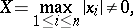
where the minimum is taken over all integers <img align="absmiddle" border="0" src="https://www.encyclopediaofmath.org/legacyimages/d/d032/d032600/d03260024.png" /> in some arbitrary interval <img align="absmiddle" border="0" src="https://www.encyclopediaofmath.org/legacyimages/d/d032/d032600/d03260025.png" /> and over all integer values <img align="absmiddle" border="0" src="https://www.encyclopediaofmath.org/legacyimages/d/d032/d032600/d03260026.png" />, the fraction <img align="absmiddle" border="0" src="https://www.encyclopediaofmath.org/legacyimages/d/d032/d032600/d03260027.png" /> is a convergent fraction of the expansion of <img align="absmiddle" border="0" src="https://www.encyclopediaofmath.org/legacyimages/d/d032/d032600/d03260028.png" /> into a continued fraction. If the incomplete partial fractions of <img align="absmiddle" border="0" src="https://www.encyclopediaofmath.org/legacyimages/d/d032/d032600/d03260029.png" /> into a continued fraction are bounded, then there exists a <img align="absmiddle" border="0" src="https://www.encyclopediaofmath.org/legacyimages/d/d032/d032600/d03260030.png" /> with the condition <img align="absmiddle" border="0" src="https://www.encyclopediaofmath.org/legacyimages/d/d032/d032600/d03260031.png" /> for all integers <img align="absmiddle" border="0" src="https://www.encyclopediaofmath.org/legacyimages/d/d032/d032600/d03260032.png" />. This is true, for example, for quadratic irrationalities <img align="absmiddle" border="0" src="https://www.encyclopediaofmath.org/legacyimages/d/d032/d032600/d03260033.png" /> (cf. Quadratic irrationality), since then the expansion into a continued fraction is periodic. On the other hand, for any irrational number <img align="absmiddle" border="0" src="https://www.encyclopediaofmath.org/legacyimages/d/d032/d032600/d03260034.png" /> the inequality <img align="absmiddle" border="0" src="https://www.encyclopediaofmath.org/legacyimages/d/d032/d032600/d03260035.png" /> has an infinite number of integer solutions <img align="absmiddle" border="0" src="https://www.encyclopediaofmath.org/legacyimages/d/d032/d032600/d03260036.png" />, and if <img align="absmiddle" border="0" src="https://www.encyclopediaofmath.org/legacyimages/d/d032/d032600/d03260037.png" />, the constant <img align="absmiddle" border="0" src="https://www.encyclopediaofmath.org/legacyimages/d/d032/d032600/d03260038.png" /> cannot be replaced by a smaller number. The study of A.A. Markov on the minima of indefinite binary quadratic forms (cf. Binary quadratic form) made it possible to extend this last statement: If <img align="absmiddle" border="0" src="https://www.encyclopediaofmath.org/legacyimages/d/d032/d032600/d03260039.png" /> is not equivalent (in the sense of the theory of continued fractions) to <img align="absmiddle" border="0" src="https://www.encyclopediaofmath.org/legacyimages/d/d032/d032600/d03260040.png" />, then the inequality <img align="absmiddle" border="0" src="https://www.encyclopediaofmath.org/legacyimages/d/d032/d032600/d03260041.png" /> has an infinite number of solutions; the constant <img align="absmiddle" border="0" src="https://www.encyclopediaofmath.org/legacyimages/d/d032/d032600/d03260042.png" /> cannot be improved upon if <img align="absmiddle" border="0" src="https://www.encyclopediaofmath.org/legacyimages/d/d032/d032600/d03260043.png" /> is equivalent to <img align="absmiddle" border="0" src="https://www.encyclopediaofmath.org/legacyimages/d/d032/d032600/d03260044.png" />; if <img align="absmiddle" border="0" src="https://www.encyclopediaofmath.org/legacyimages/d/d032/d032600/d03260045.png" /> is not equivalent either to <img align="absmiddle" border="0" src="https://www.encyclopediaofmath.org/legacyimages/d/d032/d032600/d03260046.png" /> or to <img align="absmiddle" border="0" src="https://www.encyclopediaofmath.org/legacyimages/d/d032/d032600/d03260047.png" />, the inequality <img align="absmiddle" border="0" src="https://www.encyclopediaofmath.org/legacyimages/d/d032/d032600/d03260048.png" /> has an infinite number of solutions, etc. [1]. The constants <img align="absmiddle" border="0" src="https://www.encyclopediaofmath.org/legacyimages/d/d032/d032600/d03260049.png" /> decrease monotonically and have limit <img align="absmiddle" border="0" src="https://www.encyclopediaofmath.org/legacyimages/d/d032/d032600/d03260050.png" />.
The simplest example of linear inhomogeneous Diophantine approximations are approximations of zero by a linear inhomogeneous polynomial <img align="absmiddle" border="0" src="https://www.encyclopediaofmath.org/legacyimages/d/d032/d032600/d03260051.png" />, where <img align="absmiddle" border="0" src="https://www.encyclopediaofmath.org/legacyimages/d/d032/d032600/d03260052.png" /> are real numbers and <img align="absmiddle" border="0" src="https://www.encyclopediaofmath.org/legacyimages/d/d032/d032600/d03260053.png" /> are integer variables. It was shown by P.L. Chebyshev that for any irrational number <img align="absmiddle" border="0" src="https://www.encyclopediaofmath.org/legacyimages/d/d032/d032600/d03260054.png" /> and any <img align="absmiddle" border="0" src="https://www.encyclopediaofmath.org/legacyimages/d/d032/d032600/d03260055.png" /> the inequality <img align="absmiddle" border="0" src="https://www.encyclopediaofmath.org/legacyimages/d/d032/d032600/d03260056.png" /> has an infinite number of solutions in integers <img align="absmiddle" border="0" src="https://www.encyclopediaofmath.org/legacyimages/d/d032/d032600/d03260057.png" />, <img align="absmiddle" border="0" src="https://www.encyclopediaofmath.org/legacyimages/d/d032/d032600/d03260058.png" />. In this case 2 is not the best constant: It was proved by H. Minkowski that if <img align="absmiddle" border="0" src="https://www.encyclopediaofmath.org/legacyimages/d/d032/d032600/d03260059.png" />, where <img align="absmiddle" border="0" src="https://www.encyclopediaofmath.org/legacyimages/d/d032/d032600/d03260060.png" /> are integers, the constant 2 can be replaced by <img align="absmiddle" border="0" src="https://www.encyclopediaofmath.org/legacyimages/d/d032/d032600/d03260061.png" />, the latter being the optimal constant. This statement is a corollary of the simplest case of a hypothesis on the product of inhomogeneous linear forms proved by H. Minkowski himself (cf. Minkowski hypothesis).
More complex problems of the general theory of Diophantine approximations concern the approximation of functions of a large number of integer arguments (cf. Dirichlet theorem; Minkowski theorem; Kronecker theorem). It is convenient to introduce the function <img align="absmiddle" border="0" src="https://www.encyclopediaofmath.org/legacyimages/d/d032/d032600/d03260062.png" />, where the minimum is taken over all integers <img align="absmiddle" border="0" src="https://www.encyclopediaofmath.org/legacyimages/d/d032/d032600/d03260063.png" /> (the distance between <img align="absmiddle" border="0" src="https://www.encyclopediaofmath.org/legacyimages/d/d032/d032600/d03260064.png" /> and the nearest integer). For instance, the above-mentioned linear polynomials <img align="absmiddle" border="0" src="https://www.encyclopediaofmath.org/legacyimages/d/d032/d032600/d03260065.png" /> and <img align="absmiddle" border="0" src="https://www.encyclopediaofmath.org/legacyimages/d/d032/d032600/d03260066.png" /> may be replaced by <img align="absmiddle" border="0" src="https://www.encyclopediaofmath.org/legacyimages/d/d032/d032600/d03260067.png" /> and <img align="absmiddle" border="0" src="https://www.encyclopediaofmath.org/legacyimages/d/d032/d032600/d03260068.png" /> for integers <img align="absmiddle" border="0" src="https://www.encyclopediaofmath.org/legacyimages/d/d032/d032600/d03260069.png" />. It follows from Dirichlet's theorem that for all real <img align="absmiddle" border="0" src="https://www.encyclopediaofmath.org/legacyimages/d/d032/d032600/d03260070.png" /> there exists an infinite number of solutions of the system of inequalities
| <img align="absmiddle" border="0" src="https://www.encyclopediaofmath.org/legacyimages/d/d032/d032600/d03260071.png" /> |
in integers <img align="absmiddle" border="0" src="https://www.encyclopediaofmath.org/legacyimages/d/d032/d032600/d03260072.png" />. Here, 1 may be replaced by a smaller number (e.g. <img align="absmiddle" border="0" src="https://www.encyclopediaofmath.org/legacyimages/d/d032/d032600/d03260073.png" />), but the optimal constant is unknown for any <img align="absmiddle" border="0" src="https://www.encyclopediaofmath.org/legacyimages/d/d032/d032600/d03260074.png" /> (1988). It cannot be an arbitrary number, as is shown by the example of numbers <img align="absmiddle" border="0" src="https://www.encyclopediaofmath.org/legacyimages/d/d032/d032600/d03260075.png" /> which form a basis of a real algebraic field [1]. If <img align="absmiddle" border="0" src="https://www.encyclopediaofmath.org/legacyimages/d/d032/d032600/d03260076.png" /> are linearly independent over the field of rational numbers, then for any <img align="absmiddle" border="0" src="https://www.encyclopediaofmath.org/legacyimages/d/d032/d032600/d03260077.png" /> and any <img align="absmiddle" border="0" src="https://www.encyclopediaofmath.org/legacyimages/d/d032/d032600/d03260078.png" /> there exists an infinite number of solutions of the system of inequalities
| <img align="absmiddle" border="0" src="https://www.encyclopediaofmath.org/legacyimages/d/d032/d032600/d03260079.png" /> |
in integers <img align="absmiddle" border="0" src="https://www.encyclopediaofmath.org/legacyimages/d/d032/d032600/d03260080.png" /> (Kronecker's theorem). An important feature of this theorem on simultaneous inhomogeneous Diophantine approximations consists in the fact that it is not possible, in principle (without special information on homogeneous approximations to <img align="absmiddle" border="0" src="https://www.encyclopediaofmath.org/legacyimages/d/d032/d032600/d03260081.png" />), to find the rate of decrease of <img align="absmiddle" border="0" src="https://www.encyclopediaofmath.org/legacyimages/d/d032/d032600/d03260082.png" /> as <img align="absmiddle" border="0" src="https://www.encyclopediaofmath.org/legacyimages/d/d032/d032600/d03260083.png" /> increases: In order for linear forms <img align="absmiddle" border="0" src="https://www.encyclopediaofmath.org/legacyimages/d/d032/d032600/d03260084.png" /> to represent a "good" approximation to arbitrary numbers <img align="absmiddle" border="0" src="https://www.encyclopediaofmath.org/legacyimages/d/d032/d032600/d03260085.png" />, it is necessary and sufficient for these forms not to be a "good" approximation for the special sample of numbers <img align="absmiddle" border="0" src="https://www.encyclopediaofmath.org/legacyimages/d/d032/d032600/d03260086.png" />.
Problems in Diophantine approximations which are dissimilar at first sight sometimes turn out to be closely connected. For instance, Khinchin's transference principle [1] relates the solvability of the equation
| <img align="absmiddle" border="0" src="https://www.encyclopediaofmath.org/legacyimages/d/d032/d032600/d03260087.png" /> | (1) |
| <img align="absmiddle" border="0" src="https://www.encyclopediaofmath.org/legacyimages/d/d032/d032600/d03260088.png" /> |
in integers <img align="absmiddle" border="0" src="https://www.encyclopediaofmath.org/legacyimages/d/d032/d032600/d03260089.png" /> to that of the system
| <img align="absmiddle" border="0" src="https://www.encyclopediaofmath.org/legacyimages/d/d032/d032600/d03260090.png" /> | (2) |
in integers <img align="absmiddle" border="0" src="https://www.encyclopediaofmath.org/legacyimages/d/d032/d032600/d03260091.png" />, and vice versa: If <img align="absmiddle" border="0" src="https://www.encyclopediaofmath.org/legacyimages/d/d032/d032600/d03260092.png" /> and <img align="absmiddle" border="0" src="https://www.encyclopediaofmath.org/legacyimages/d/d032/d032600/d03260093.png" /> are, respectively, the least upper bounds of those <img align="absmiddle" border="0" src="https://www.encyclopediaofmath.org/legacyimages/d/d032/d032600/d03260094.png" /> and <img align="absmiddle" border="0" src="https://www.encyclopediaofmath.org/legacyimages/d/d032/d032600/d03260095.png" /> for which (1) and (2) have an infinite number of solutions, then
| <img align="absmiddle" border="0" src="https://www.encyclopediaofmath.org/legacyimages/d/d032/d032600/d03260096.png" /> |
In particular, the equalities <img align="absmiddle" border="0" src="https://www.encyclopediaofmath.org/legacyimages/d/d032/d032600/d03260097.png" /> and <img align="absmiddle" border="0" src="https://www.encyclopediaofmath.org/legacyimages/d/d032/d032600/d03260098.png" /> are equivalent (the <img align="absmiddle" border="0" src="https://www.encyclopediaofmath.org/legacyimages/d/d032/d032600/d03260099.png" /> then represent the "worst" approximations, since equation (1) with <img align="absmiddle" border="0" src="https://www.encyclopediaofmath.org/legacyimages/d/d032/d032600/d032600100.png" /> and equations (2) with <img align="absmiddle" border="0" src="https://www.encyclopediaofmath.org/legacyimages/d/d032/d032600/d032600101.png" /> have an infinite number of solutions, whatever the values of <img align="absmiddle" border="0" src="https://www.encyclopediaofmath.org/legacyimages/d/d032/d032600/d032600102.png" />). Similar relations exist between the homogeneous and the inhomogeneous problems [1], [5], and not only for linear Diophantine approximations. If, for instance, <img align="absmiddle" border="0" src="https://www.encyclopediaofmath.org/legacyimages/d/d032/d032600/d032600103.png" /> are such that for any <img align="absmiddle" border="0" src="https://www.encyclopediaofmath.org/legacyimages/d/d032/d032600/d032600104.png" /> for all integers <img align="absmiddle" border="0" src="https://www.encyclopediaofmath.org/legacyimages/d/d032/d032600/d032600105.png" />,
| <img align="absmiddle" border="0" src="https://www.encyclopediaofmath.org/legacyimages/d/d032/d032600/d032600106.png" /> | (3) |
where <img align="absmiddle" border="0" src="https://www.encyclopediaofmath.org/legacyimages/d/d032/d032600/d032600107.png" /> depends only on <img align="absmiddle" border="0" src="https://www.encyclopediaofmath.org/legacyimages/d/d032/d032600/d032600108.png" /> and <img align="absmiddle" border="0" src="https://www.encyclopediaofmath.org/legacyimages/d/d032/d032600/d032600109.png" />, then, for any real numbers <img align="absmiddle" border="0" src="https://www.encyclopediaofmath.org/legacyimages/d/d032/d032600/d032600110.png" /> and any <img align="absmiddle" border="0" src="https://www.encyclopediaofmath.org/legacyimages/d/d032/d032600/d032600111.png" />, the system of inequalities
| <img align="absmiddle" border="0" src="https://www.encyclopediaofmath.org/legacyimages/d/d032/d032600/d032600112.png" /> |
has an integer solution <img align="absmiddle" border="0" src="https://www.encyclopediaofmath.org/legacyimages/d/d032/d032600/d032600113.png" /> subject to the condition <img align="absmiddle" border="0" src="https://www.encyclopediaofmath.org/legacyimages/d/d032/d032600/d032600114.png" /> if <img align="absmiddle" border="0" src="https://www.encyclopediaofmath.org/legacyimages/d/d032/d032600/d032600115.png" />. Moreover, the inequality (3) ensures a "strong" uniform distribution of the fractional parts <img align="absmiddle" border="0" src="https://www.encyclopediaofmath.org/legacyimages/d/d032/d032600/d032600116.png" />, where <img align="absmiddle" border="0" src="https://www.encyclopediaofmath.org/legacyimages/d/d032/d032600/d032600117.png" />; the number of these fractions comprised in the system of intervals <img align="absmiddle" border="0" src="https://www.encyclopediaofmath.org/legacyimages/d/d032/d032600/d032600118.png" />, each one of which is located inside the unit interval, is <img align="absmiddle" border="0" src="https://www.encyclopediaofmath.org/legacyimages/d/d032/d032600/d032600119.png" />, where <img align="absmiddle" border="0" src="https://www.encyclopediaofmath.org/legacyimages/d/d032/d032600/d032600120.png" /> is the length of the interval <img align="absmiddle" border="0" src="https://www.encyclopediaofmath.org/legacyimages/d/d032/d032600/d032600121.png" /> and <img align="absmiddle" border="0" src="https://www.encyclopediaofmath.org/legacyimages/d/d032/d032600/d032600122.png" /> is arbitrary. The validity of inequality (3) for all integers <img align="absmiddle" border="0" src="https://www.encyclopediaofmath.org/legacyimages/d/d032/d032600/d032600123.png" /> is equivalent to the validity of the inequality
| <img align="absmiddle" border="0" src="https://www.encyclopediaofmath.org/legacyimages/d/d032/d032600/d032600124.png" /> | (4) |
for all integers <img align="absmiddle" border="0" src="https://www.encyclopediaofmath.org/legacyimages/d/d032/d032600/d032600125.png" /> for any <img align="absmiddle" border="0" src="https://www.encyclopediaofmath.org/legacyimages/d/d032/d032600/d032600126.png" />, where <img align="absmiddle" border="0" src="https://www.encyclopediaofmath.org/legacyimages/d/d032/d032600/d032600127.png" /> depends only on <img align="absmiddle" border="0" src="https://www.encyclopediaofmath.org/legacyimages/d/d032/d032600/d032600128.png" /> and <img align="absmiddle" border="0" src="https://www.encyclopediaofmath.org/legacyimages/d/d032/d032600/d032600129.png" />.
The proof of the solvability or non-solvability of Diophantine inequalities whose parameters are determined by arithmetical or analytical conditions is often a very complex task. Thus, the problem of approximating algebraic numbers by rational numbers, which has been systematically studied ever since the Liouville inequality was demonstrated in 1844 (cf. Liouville number), has not yet been conclusively solved (cf. Thue–Siegel–Roth theorem; Diophantine approximation, problems of effective). It has been shown [11] that for algebraic numbers <img align="absmiddle" border="0" src="https://www.encyclopediaofmath.org/legacyimages/d/d032/d032600/d032600130.png" /> which are together with 1 linearly independent over the field of rational numbers, the inequalities (3) and (4) are valid for any <img align="absmiddle" border="0" src="https://www.encyclopediaofmath.org/legacyimages/d/d032/d032600/d032600131.png" />. It follows that the system of inequalities (1) for any <img align="absmiddle" border="0" src="https://www.encyclopediaofmath.org/legacyimages/d/d032/d032600/d032600132.png" /> and the system of inequalities (2) for any <img align="absmiddle" border="0" src="https://www.encyclopediaofmath.org/legacyimages/d/d032/d032600/d032600133.png" /> have only a finite number of solutions. There is a close connection between such theorems and Diophantine approximations to algebraic numbers and the representation of integers by incomplete norm forms. In particular, the problem of bounds for the solutions <img align="absmiddle" border="0" src="https://www.encyclopediaofmath.org/legacyimages/d/d032/d032600/d032600134.png" /> of Thue's Diophantine equation <img align="absmiddle" border="0" src="https://www.encyclopediaofmath.org/legacyimages/d/d032/d032600/d032600135.png" />, for a given integral irreducible binary form <img align="absmiddle" border="0" src="https://www.encyclopediaofmath.org/legacyimages/d/d032/d032600/d032600136.png" /> of degree at least three and a variable integer <img align="absmiddle" border="0" src="https://www.encyclopediaofmath.org/legacyimages/d/d032/d032600/d032600137.png" />, is equivalent to the study of rational approximations to a root <img align="absmiddle" border="0" src="https://www.encyclopediaofmath.org/legacyimages/d/d032/d032600/d032600138.png" /> of the polynomial <img align="absmiddle" border="0" src="https://www.encyclopediaofmath.org/legacyimages/d/d032/d032600/d032600139.png" />. In this way A. Thue showed that the number of solutions of the equation <img align="absmiddle" border="0" src="https://www.encyclopediaofmath.org/legacyimages/d/d032/d032600/d032600140.png" /> is finite, having previously obtained a non-trivial estimate for rational approximations to <img align="absmiddle" border="0" src="https://www.encyclopediaofmath.org/legacyimages/d/d032/d032600/d032600141.png" />. This approach, generalized and developed by C. Siegel, led him to the theorem that the number of integral points on algebraic curves of genus higher than zero is finite (cf. Diophantine geometry). W. Schmidt [11] used such ideas to obtain a complete solution of the problem of representing numbers by norm forms, basing himself on his approximation theorem. In certain cases the connections between the theory of Diophantine equations and that of Diophantine approximations of numbers may play a main role in proofs on the existence of solutions (in the Waring problem and in the method of Hardy–Littlewood–Vinogradov).
Diophantine approximations to special numbers, given as the values of transcendental functions at rational or algebraic points, are studied by methods of the theory of transcendental numbers (cf. Transcendental number). As a rule, if it can be proved that some number is irrational or transcendental, it is also possible to estimate its approximation by rational or algebraic numbers. In the case of a transcendental <img align="absmiddle" border="0" src="https://www.encyclopediaofmath.org/legacyimages/d/d032/d032600/d032600142.png" />, the magnitude <img align="absmiddle" border="0" src="https://www.encyclopediaofmath.org/legacyimages/d/d032/d032600/d032600143.png" />, where the minimum is taken over all non-zero integer polynomials of degree at most <img align="absmiddle" border="0" src="https://www.encyclopediaofmath.org/legacyimages/d/d032/d032600/d032600144.png" /> and height at most <img align="absmiddle" border="0" src="https://www.encyclopediaofmath.org/legacyimages/d/d032/d032600/d032600145.png" />, is called the measure of transcendency of the number <img align="absmiddle" border="0" src="https://www.encyclopediaofmath.org/legacyimages/d/d032/d032600/d032600146.png" />. An estimate from below of <img align="absmiddle" border="0" src="https://www.encyclopediaofmath.org/legacyimages/d/d032/d032600/d032600147.png" />, mainly for a fixed <img align="absmiddle" border="0" src="https://www.encyclopediaofmath.org/legacyimages/d/d032/d032600/d032600148.png" /> and a variable <img align="absmiddle" border="0" src="https://www.encyclopediaofmath.org/legacyimages/d/d032/d032600/d032600149.png" />, forms the subject of many theorems in transcendental number theory [12]. For instance, it has been shown by K. Mahler [7], [12] that
| <img align="absmiddle" border="0" src="https://www.encyclopediaofmath.org/legacyimages/d/d032/d032600/d032600150.png" /> |
where <img align="absmiddle" border="0" src="https://www.encyclopediaofmath.org/legacyimages/d/d032/d032600/d032600151.png" /> is an absolute constant and <img align="absmiddle" border="0" src="https://www.encyclopediaofmath.org/legacyimages/d/d032/d032600/d032600152.png" />. A. Baker [3] used another method to demonstrate (4) for various non-zero rational powers of <img align="absmiddle" border="0" src="https://www.encyclopediaofmath.org/legacyimages/d/d032/d032600/d032600153.png" /> with <img align="absmiddle" border="0" src="https://www.encyclopediaofmath.org/legacyimages/d/d032/d032600/d032600154.png" />, where
| <img align="absmiddle" border="0" src="https://www.encyclopediaofmath.org/legacyimages/d/d032/d032600/d032600155.png" /> |
depends only on <img align="absmiddle" border="0" src="https://www.encyclopediaofmath.org/legacyimages/d/d032/d032600/d032600156.png" />. Since the magnitude <img align="absmiddle" border="0" src="https://www.encyclopediaofmath.org/legacyimages/d/d032/d032600/d032600157.png" /> will be "smaller" only if at least one algebraic number of degree at most <img align="absmiddle" border="0" src="https://www.encyclopediaofmath.org/legacyimages/d/d032/d032600/d032600158.png" /> and height at most <img align="absmiddle" border="0" src="https://www.encyclopediaofmath.org/legacyimages/d/d032/d032600/d032600159.png" /> is "close" to <img align="absmiddle" border="0" src="https://www.encyclopediaofmath.org/legacyimages/d/d032/d032600/d032600160.png" />, it follows that there is a connection between the estimation of <img align="absmiddle" border="0" src="https://www.encyclopediaofmath.org/legacyimages/d/d032/d032600/d032600161.png" /> and the estimation of the approximation to <img align="absmiddle" border="0" src="https://www.encyclopediaofmath.org/legacyimages/d/d032/d032600/d032600162.png" /> by algebraic numbers of degree at most <img align="absmiddle" border="0" src="https://www.encyclopediaofmath.org/legacyimages/d/d032/d032600/d032600163.png" />. Let <img align="absmiddle" border="0" src="https://www.encyclopediaofmath.org/legacyimages/d/d032/d032600/d032600164.png" />, where the minimum is taken over all algebraic numbers <img align="absmiddle" border="0" src="https://www.encyclopediaofmath.org/legacyimages/d/d032/d032600/d032600165.png" /> of degree at most <img align="absmiddle" border="0" src="https://www.encyclopediaofmath.org/legacyimages/d/d032/d032600/d032600166.png" /> and height at most <img align="absmiddle" border="0" src="https://www.encyclopediaofmath.org/legacyimages/d/d032/d032600/d032600167.png" />, and let
| <img align="absmiddle" border="0" src="https://www.encyclopediaofmath.org/legacyimages/d/d032/d032600/d032600168.png" /> |
| <img align="absmiddle" border="0" src="https://www.encyclopediaofmath.org/legacyimages/d/d032/d032600/d032600169.png" /> |
E. Wirsing [13] found relations between <img align="absmiddle" border="0" src="https://www.encyclopediaofmath.org/legacyimages/d/d032/d032600/d032600170.png" /> and <img align="absmiddle" border="0" src="https://www.encyclopediaofmath.org/legacyimages/d/d032/d032600/d032600171.png" /> if <img align="absmiddle" border="0" src="https://www.encyclopediaofmath.org/legacyimages/d/d032/d032600/d032600172.png" /> is a real number:
| <img align="absmiddle" border="0" src="https://www.encyclopediaofmath.org/legacyimages/d/d032/d032600/d032600173.png" /> |
In particular, if <img align="absmiddle" border="0" src="https://www.encyclopediaofmath.org/legacyimages/d/d032/d032600/d032600174.png" />, then <img align="absmiddle" border="0" src="https://www.encyclopediaofmath.org/legacyimages/d/d032/d032600/d032600175.png" />, and since <img align="absmiddle" border="0" src="https://www.encyclopediaofmath.org/legacyimages/d/d032/d032600/d032600176.png" /> for all transcendental <img align="absmiddle" border="0" src="https://www.encyclopediaofmath.org/legacyimages/d/d032/d032600/d032600177.png" />, it follows that <img align="absmiddle" border="0" src="https://www.encyclopediaofmath.org/legacyimages/d/d032/d032600/d032600178.png" />. This means that for any transcendental <img align="absmiddle" border="0" src="https://www.encyclopediaofmath.org/legacyimages/d/d032/d032600/d032600179.png" /> there exists an infinite number of algebraic <img align="absmiddle" border="0" src="https://www.encyclopediaofmath.org/legacyimages/d/d032/d032600/d032600180.png" />'s of degree at most <img align="absmiddle" border="0" src="https://www.encyclopediaofmath.org/legacyimages/d/d032/d032600/d032600181.png" /> satisfying the inequality
| <img align="absmiddle" border="0" src="https://www.encyclopediaofmath.org/legacyimages/d/d032/d032600/d032600182.png" /> |
where <img align="absmiddle" border="0" src="https://www.encyclopediaofmath.org/legacyimages/d/d032/d032600/d032600183.png" /> is the height of <img align="absmiddle" border="0" src="https://www.encyclopediaofmath.org/legacyimages/d/d032/d032600/d032600184.png" />, and <img align="absmiddle" border="0" src="https://www.encyclopediaofmath.org/legacyimages/d/d032/d032600/d032600185.png" /> is arbitrary. Wirsing conjectured that <img align="absmiddle" border="0" src="https://www.encyclopediaofmath.org/legacyimages/d/d032/d032600/d032600186.png" /> for all transcendental <img align="absmiddle" border="0" src="https://www.encyclopediaofmath.org/legacyimages/d/d032/d032600/d032600187.png" /> and all <img align="absmiddle" border="0" src="https://www.encyclopediaofmath.org/legacyimages/d/d032/d032600/d032600188.png" />. In addition to the self-evident case <img align="absmiddle" border="0" src="https://www.encyclopediaofmath.org/legacyimages/d/d032/d032600/d032600189.png" />, this conjecture has been demonstrated for <img align="absmiddle" border="0" src="https://www.encyclopediaofmath.org/legacyimages/d/d032/d032600/d032600190.png" /> [4]. It is also known that for almost-all (in the sense of Lebesgue measure) real <img align="absmiddle" border="0" src="https://www.encyclopediaofmath.org/legacyimages/d/d032/d032600/d032600191.png" /> the following equalities are valid:
| <img align="absmiddle" border="0" src="https://www.encyclopediaofmath.org/legacyimages/d/d032/d032600/d032600192.png" /> |
(see [2]; Metric theory of numbers; Diophantine approximation, metric theory of).
The study of Diophantine equations by methods of <img align="absmiddle" border="0" src="https://www.encyclopediaofmath.org/legacyimages/d/d032/d032600/d032600193.png" />-adic analysis stimulated the development of the theory of Diophantine approximations in the <img align="absmiddle" border="0" src="https://www.encyclopediaofmath.org/legacyimages/d/d032/d032600/d032600195.png" />-adic number fields <img align="absmiddle" border="0" src="https://www.encyclopediaofmath.org/legacyimages/d/d032/d032600/d032600196.png" />, the structure of which is parallel in many respects to the theory of Diophantine approximations in the field of real numbers, but taking into account the non-Archimedean topology of <img align="absmiddle" border="0" src="https://www.encyclopediaofmath.org/legacyimages/d/d032/d032600/d032600197.png" />. For instance, let <img align="absmiddle" border="0" src="https://www.encyclopediaofmath.org/legacyimages/d/d032/d032600/d032600198.png" /> be a <img align="absmiddle" border="0" src="https://www.encyclopediaofmath.org/legacyimages/d/d032/d032600/d032600199.png" />-adic number. A consideration of approximations of zero (in the <img align="absmiddle" border="0" src="https://www.encyclopediaofmath.org/legacyimages/d/d032/d032600/d032600200.png" />-adic metric) by the values of the integral linear form <img align="absmiddle" border="0" src="https://www.encyclopediaofmath.org/legacyimages/d/d032/d032600/d032600201.png" /> yields rational approximations of <img align="absmiddle" border="0" src="https://www.encyclopediaofmath.org/legacyimages/d/d032/d032600/d032600202.png" /> which, as in the case of real numbers, are closely connected with the expansion of <img align="absmiddle" border="0" src="https://www.encyclopediaofmath.org/legacyimages/d/d032/d032600/d032600203.png" /> into a continued (<img align="absmiddle" border="0" src="https://www.encyclopediaofmath.org/legacyimages/d/d032/d032600/d032600204.png" />-adic) fraction [10]. Analogues of the theorems of Dirichlet, Kronecker, Minkowski, etc., metric theorems, theorems on approximations by algebraic numbers, etc., are all valid [2], [6], [8]. Diophantine inequalities in <img align="absmiddle" border="0" src="https://www.encyclopediaofmath.org/legacyimages/d/d032/d032600/d032600205.png" /> may be interpreted as congruences by a "high" degree of <img align="absmiddle" border="0" src="https://www.encyclopediaofmath.org/legacyimages/d/d032/d032600/d032600206.png" />, which makes it possible to obtain pure arithmetical theorems by an analytic method. A far-going development of Diophantine approximations in the field <img align="absmiddle" border="0" src="https://www.encyclopediaofmath.org/legacyimages/d/d032/d032600/d032600207.png" /> and its finite extensions makes it possible to use the Thue–Siegel–Roth method to demonstrate theorems on the arithmetical structure of numbers representable by binary forms, on estimates of the fractional parts of powers of rational numbers, etc. [10].
Since the expansion of functions into continued fractions is similar to the expansion of numbers into continued fractions, a further analogy arises naturally — approximations of a function by rational functions in the metric of a field of power series. This approach has been considerably developed and leads to the theory of Diophantine approximations in a field of power series. Let <img align="absmiddle" border="0" src="https://www.encyclopediaofmath.org/legacyimages/d/d032/d032600/d032600208.png" /> be an arbitrary algebraic field, let <img align="absmiddle" border="0" src="https://www.encyclopediaofmath.org/legacyimages/d/d032/d032600/d032600209.png" /> be the ring of polynomials in <img align="absmiddle" border="0" src="https://www.encyclopediaofmath.org/legacyimages/d/d032/d032600/d032600210.png" /> over <img align="absmiddle" border="0" src="https://www.encyclopediaofmath.org/legacyimages/d/d032/d032600/d032600211.png" /> and let <img align="absmiddle" border="0" src="https://www.encyclopediaofmath.org/legacyimages/d/d032/d032600/d032600212.png" /> be the field of power series of the form
| <img align="absmiddle" border="0" src="https://www.encyclopediaofmath.org/legacyimages/d/d032/d032600/d032600213.png" /> |
| <img align="absmiddle" border="0" src="https://www.encyclopediaofmath.org/legacyimages/d/d032/d032600/d032600214.png" /> |
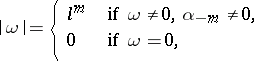
One introduces a non-Archimedean valuation,
| <img align="absmiddle" border="0" src="https://www.encyclopediaofmath.org/legacyimages/d/d032/d032600/d032600215.png" /> |
where <img align="absmiddle" border="0" src="https://www.encyclopediaofmath.org/legacyimages/d/d032/d032600/d032600216.png" /> is an arbitrary fixed number, in the field <img align="absmiddle" border="0" src="https://www.encyclopediaofmath.org/legacyimages/d/d032/d032600/d032600217.png" />. The field <img align="absmiddle" border="0" src="https://www.encyclopediaofmath.org/legacyimages/d/d032/d032600/d032600218.png" /> with the norm <img align="absmiddle" border="0" src="https://www.encyclopediaofmath.org/legacyimages/d/d032/d032600/d032600219.png" /> becomes a metric space. The study of "Diophantine" approximations is carried out in the usual way, with <img align="absmiddle" border="0" src="https://www.encyclopediaofmath.org/legacyimages/d/d032/d032600/d032600220.png" /> acting as the ring of integers: The approximating functions under consideration are functions, with values in <img align="absmiddle" border="0" src="https://www.encyclopediaofmath.org/legacyimages/d/d032/d032600/d032600221.png" />, of a finite number of variables with values in <img align="absmiddle" border="0" src="https://www.encyclopediaofmath.org/legacyimages/d/d032/d032600/d032600222.png" />, while the estimation is carried out with respect to the norm introduced. There is a certain similarity between results obtained in this manner and the case of Diophantine approximations in the field of real numbers, but if <img align="absmiddle" border="0" src="https://www.encyclopediaofmath.org/legacyimages/d/d032/d032600/d032600223.png" /> is replaced by the field <img align="absmiddle" border="0" src="https://www.encyclopediaofmath.org/legacyimages/d/d032/d032600/d032600224.png" /> of series of the form
| <img align="absmiddle" border="0" src="https://www.encyclopediaofmath.org/legacyimages/d/d032/d032600/d032600225.png" /> |
| <img align="absmiddle" border="0" src="https://www.encyclopediaofmath.org/legacyimages/d/d032/d032600/d032600226.png" /> |
the results are analogous to approximations in a <img align="absmiddle" border="0" src="https://www.encyclopediaofmath.org/legacyimages/d/d032/d032600/d032600227.png" />-adic number field [2], [9].
Diophantine approximations in a field of power series form a more concrete basis of certain analytic methods in the theory of transcendental numbers (specialization of <img align="absmiddle" border="0" src="https://www.encyclopediaofmath.org/legacyimages/d/d032/d032600/d032600228.png" />, explicit estimation of the accuracy of approximation, etc.).
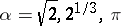
Three different approaches in the development of the theory of Diophantine approximations may be distinguished: global, metric and individual. The global approach involves the study of general laws of approximation, which apply to all numbers or to all numbers with "rare" exceptions. This is the case of the Dirichlet theorem on homogeneous approximations, Kronecker's theorem on inhomogeneous approximations, general theorems on the approximation of numbers by algebraic numbers, classifications of numbers by their approximation properties, etc. The corresponding methods are "global" (continued fractions, etc.). The metric approach involves the description of the approximation properties of numbers on the base of concepts of measure theory (cf. Diophantine approximation, metric theory of; Metric theory of numbers). The results thus obtained do not apply to all, but to almost-all (in the sense of a definite measure) numbers in the sets under consideration or else are described with the aid of some metric characteristic (the Hausdorff dimension, the capacity, etc.). The methods used are closely connected with measure theory, probability theory and related disciplines. The individual approach concerns the approximation properties of special numbers (algebraic numbers, <img align="absmiddle" border="0" src="https://www.encyclopediaofmath.org/legacyimages/d/d032/d032600/d032600229.png" />, <img align="absmiddle" border="0" src="https://www.encyclopediaofmath.org/legacyimages/d/d032/d032600/d032600230.png" />, <img align="absmiddle" border="0" src="https://www.encyclopediaofmath.org/legacyimages/d/d032/d032600/d032600231.png" />, etc.) or else involves the construction of numbers with specified approximation properties (Liouville numbers, Mahler <img align="absmiddle" border="0" src="https://www.encyclopediaofmath.org/legacyimages/d/d032/d032600/d032600232.png" />-numbers, etc.). The methods for solving such problems are specific and are often specially developed for a specific problem.
References
| [1] | J.W.S. Cassels, "An introduction to diophantine approximation" , Cambridge Univ. Press (1957) MR0087708 Template:ZBL |
| [2] | V.G. Sprindzhuk, "Mahler's problem in metric number theory" , Amer. Math. Soc. (1969) (Translated from Russian) |
| [3] | A. Baker, "On some Diophantine inequalities involving the exponential function" Canad. J. Math. , 17 (1965) pp. 616–626 MR0177946 Template:ZBL |
| [4] | H. Davenport, W. Schmidt, "Approximation to real numbers by quadratic irrationals" Acta Arithm. , 13 (1967) pp. 169–176 MR0219476 Template:ZBL |
| [5] | J.F. Koksma, "Diophantische Approximationen" , Springer (1936) MR0344200 MR0004857 MR1545368 Template:ZBL Template:ZBL |
| [6] | E. Lutz, "Sur les approximations diophantiennes linéaires <img align="absmiddle" border="0" src="https://www.encyclopediaofmath.org/legacyimages/d/d032/d032600/d032600233.png" />-adiques" , Hermann (1955) MR69224 Template:ZBL |
| [7] | K. Mahler, "Ueber Beziehungen zwischen der Zahl $e$ und Liouvilleschen Zahlen" Math. Z. , 31 (1930) pp. 729–732 |
| [8] | K. Mahler, "Ueber Diophantische Approximationen im Gebiete der <img align="absmiddle" border="0" src="https://www.encyclopediaofmath.org/legacyimages/d/d032/d032600/d032600235.png" />-adischen Zahlen" Jahresber. Deutsch. Math-Verein. , 44 (1934) pp. 250–255 |
| [9] | K. Mahler, "An analogue of Minkowski's theory of numbers in a field of series" Ann. of Math , 42 (1941) pp. 488–522 |
| [10] | K. Mahler, "Lectures on Diophantine approximations" , 1 , Univ. Notre Dame (1961) MR0142509 Template:ZBL |
| [11] | W. Schmidt, "Approximation to algebraic numbers" Enseign. Math. (2) , 17 : 3–4 (1971) pp. 187–253 MR0327672 Template:ZBL Template:ZBL |
| [12] | T. Schneider, "Einführung in die transzendenten Zahlen" , Springer (1957) MR0086842 Template:ZBL |
| [13] | E. Wirsing, "Approximation mit algebraischen Zahlen beschränkten Grades" J. Reine Angew. Math. , 206 : 1–2 (1961) pp. 67–77 MR0142510 Template:ZBL |
Comments
The most important developments in Diophantine approximations are in the direction of transcendental number theory, irrational number theory and distribution modulo one.
Concerning the problem of representing numbers by norm forms one has the following, [a2]. Let <img align="absmiddle" border="0" src="https://www.encyclopediaofmath.org/legacyimages/d/d032/d032600/d032600236.png" /> be an algebraic number field and let <img align="absmiddle" border="0" src="https://www.encyclopediaofmath.org/legacyimages/d/d032/d032600/d032600237.png" /> denote the norm map <img align="absmiddle" border="0" src="https://www.encyclopediaofmath.org/legacyimages/d/d032/d032600/d032600238.png" />. Let <img align="absmiddle" border="0" src="https://www.encyclopediaofmath.org/legacyimages/d/d032/d032600/d032600239.png" /> be a module in <img align="absmiddle" border="0" src="https://www.encyclopediaofmath.org/legacyimages/d/d032/d032600/d032600240.png" />, i.e., a finite dimensional <img align="absmiddle" border="0" src="https://www.encyclopediaofmath.org/legacyimages/d/d032/d032600/d032600241.png" />-module <img align="absmiddle" border="0" src="https://www.encyclopediaofmath.org/legacyimages/d/d032/d032600/d032600242.png" /> (also called an (incomplete) lattice). One speaks of a full module if <img align="absmiddle" border="0" src="https://www.encyclopediaofmath.org/legacyimages/d/d032/d032600/d032600243.png" />. Then a necessary and sufficient condition for there to exist an integer <img align="absmiddle" border="0" src="https://www.encyclopediaofmath.org/legacyimages/d/d032/d032600/d032600244.png" /> such that the equation <img align="absmiddle" border="0" src="https://www.encyclopediaofmath.org/legacyimages/d/d032/d032600/d032600245.png" /> has infinitely many solutions <img align="absmiddle" border="0" src="https://www.encyclopediaofmath.org/legacyimages/d/d032/d032600/d032600246.png" /> in <img align="absmiddle" border="0" src="https://www.encyclopediaofmath.org/legacyimages/d/d032/d032600/d032600247.png" /> is that <img align="absmiddle" border="0" src="https://www.encyclopediaofmath.org/legacyimages/d/d032/d032600/d032600248.png" /> be a full module in some subfield of <img align="absmiddle" border="0" src="https://www.encyclopediaofmath.org/legacyimages/d/d032/d032600/d032600249.png" /> that is neither the rational nor an imaginary quadratic field.
Let <img align="absmiddle" border="0" src="https://www.encyclopediaofmath.org/legacyimages/d/d032/d032600/d032600250.png" /> be a basis for a module <img align="absmiddle" border="0" src="https://www.encyclopediaofmath.org/legacyimages/d/d032/d032600/d032600251.png" />. Consider the linear form <img align="absmiddle" border="0" src="https://www.encyclopediaofmath.org/legacyimages/d/d032/d032600/d032600252.png" />. Let <img align="absmiddle" border="0" src="https://www.encyclopediaofmath.org/legacyimages/d/d032/d032600/d032600253.png" /> run through the imbeddings of <img align="absmiddle" border="0" src="https://www.encyclopediaofmath.org/legacyimages/d/d032/d032600/d032600254.png" /> into the complex numbers <img align="absmiddle" border="0" src="https://www.encyclopediaofmath.org/legacyimages/d/d032/d032600/d032600255.png" />. Let <img align="absmiddle" border="0" src="https://www.encyclopediaofmath.org/legacyimages/d/d032/d032600/d032600256.png" />. The product <img align="absmiddle" border="0" src="https://www.encyclopediaofmath.org/legacyimages/d/d032/d032600/d032600257.png" /> is a homogeneous form of degree <img align="absmiddle" border="0" src="https://www.encyclopediaofmath.org/legacyimages/d/d032/d032600/d032600258.png" /> over <img align="absmiddle" border="0" src="https://www.encyclopediaofmath.org/legacyimages/d/d032/d032600/d032600259.png" />. Such forms are called norm forms, and solving <img align="absmiddle" border="0" src="https://www.encyclopediaofmath.org/legacyimages/d/d032/d032600/d032600260.png" /> is of course the same as representing <img align="absmiddle" border="0" src="https://www.encyclopediaofmath.org/legacyimages/d/d032/d032600/d032600261.png" /> by the form <img align="absmiddle" border="0" src="https://www.encyclopediaofmath.org/legacyimages/d/d032/d032600/d032600262.png" /> (with entries from <img align="absmiddle" border="0" src="https://www.encyclopediaofmath.org/legacyimages/d/d032/d032600/d032600263.png" />).
References
| [a1] | A. Baker, "Transcendental number theory" , Cambridge Univ. Press (1975) MR0422171 Template:ZBL |
| [a2] | W.M. Schmidt, "Linearformen. II" Math. Ann. , 191 (1971) pp. 1–20 MR0308062 Template:ZBL |
| [a3] | W.M. Schmidt, "Diophantine Approximation" , Lect. notes in math. , 785 , Springer (1980) MR0568710 Template:ZBL |
 |  |