Earth:Sclerobiont
From HandWiki
Sclerobionts are collectively known as organisms living in or on any kind of hard substrate (Taylor and Wilson, 2003). A few examples of sclerobionts include Entobia borings, Gastrochaenolites borings, Talpina borings, serpulids, encrusting oysters, encrusting foraminiferans, Stomatopora bryozoans, and “Berenicea” bryozoans.
-
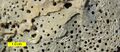 Entobia sponge borings and the cyclostome bryozoan Voigtopora thurni on an oyster valve from the Coon Creek Beds of the Ripley Formation (Upper Cretaceous) near Blue Springs, Mississippi.
 -
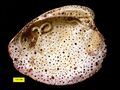 Another example of Entobia sponge borings and encrusting serpulid worms on a modern shell of the bivalve Mercenaria in North Carolina.
 -
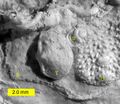 Thecideide brachiopod (T), sabellid worm tube (S) and bryozoans (B) on the shell of the bivalve Ctenostreon from the Upper Jurassic of Poland .
 -
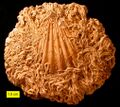 Serpulid worms enrusting Pecten; Duck Harbor Beach on Cape Cod Bay, Wellfleet, Massachusetts.
 -
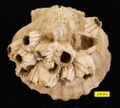 Chesapecten, barnacles and sponge borings (Entobia) from the Pliocene of York River, Virginia, USA.


See also
References
- Taylor, P. D.; Wilson, M. A. (2003). "Palaeoecology and evolution of marine hard substrate communities". Earth-Science Reviews 62 (1–2): 1–103. doi:10.1016/S0012-8252(02)00131-9. Bibcode: 2003ESRv...62....1T. Archived from the original on 2009-03-25. https://web.archive.org/web/20090325233234/http://www.wooster.edu/geology/Taylor%26Wilson2003.pdf.
 |  |


