Elliptic coordinates
Two numbers $ \sigma $ and $ \tau $ connected with rectangular Cartesian coordinates by the formulas
$$ x ^ {2} = \frac{( \sigma + a ^ {2} ) ( \tau + a ^ {2} ) }{a ^ {2} - b ^ {2} }
,
$$
$$ y ^ {2} = \frac{( \sigma + b ^ {2} ) ( \tau + b ^ {2} ) }{b ^ {2} - a ^ {2} }
,
$$
where $ - a ^ {2} < \tau < - b ^ {2} < \sigma < \infty $.
<img style="border:1px solid;" src="https://www.encyclopediaofmath.org/legacyimages/common_img/e035440a.gif" />
Figure: e035440a
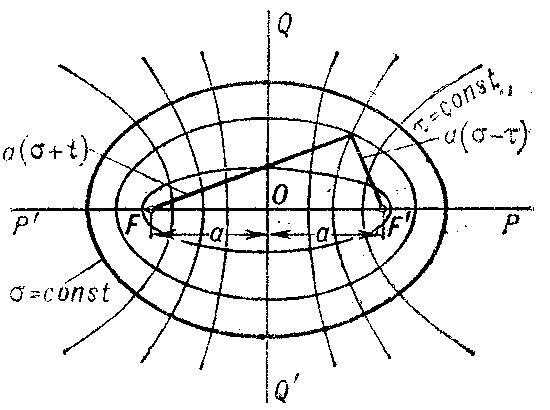
The coordinate lines are (see Fig.): confocal ellipses ( $ \sigma = \textrm{ const } $) and hyperbolas ( $ \tau = \textrm{ const } $) with foci ( $ - \sqrt {a ^ {2} - b ^ {2} } , 0 $) and ( $ \sqrt {a ^ {2} - b ^ {2} } , 0 $). The system of elliptic coordinates is orthogonal. To every pair of numbers $ \sigma $ and $ \tau $ correspond four points, one in each quadrant of the $ xy $- plane.
The Lamé coefficients are
$$ L _ \sigma = \frac{1}{2}
\sqrt {
\frac{\sigma - \tau }{( \sigma + a ^ {2} ) ( \tau + b ^ {2} ) }
} ,
$$
$$ L _ \tau = \frac{1}{2}
\sqrt {
\frac{\tau - \sigma }{( \sigma - a ^ {2} ) ( \tau + b ^ {2} ) }
} .
$$
In elliptic coordinates the Laplace equation allows separation of variables.
Degenerate elliptic coordinates are two numbers $ \widetilde \sigma $ and $ \widetilde \tau $ connected with $ \sigma $ and $ \tau $ by the formulas (for $ a = 1 $, $ b = 0 $):
$$ \sigma = \sinh ^ {2} \widetilde \sigma ,\ \ \tau = - \sin ^ {2} \widetilde \tau , $$
and with Cartesian coordinates $ x $ and $ y $ by
$$ x = \cosh \widetilde \sigma \cos \widetilde \tau ,\ \ y = \sinh \widetilde \sigma \sin \widetilde \tau , $$
where $ 0 \leq \widetilde \sigma < \infty $ and $ 0 \leq \widetilde \tau < 2 \pi $. Occasionally these coordinates are also called elliptic.
The Lamé coefficients are:
$$ L _ {\widetilde \sigma } = L _ {\widetilde \tau } = \ \sqrt {\cosh ^ {2} \widetilde \sigma - \cos ^ {2} \widetilde \tau } . $$
The area element is:
$$ d s = ( \cosh ^ {2} \widetilde \sigma - \cos ^ {2} \widetilde \tau ) d \widetilde \sigma d \widetilde \tau . $$
The Laplace operator is:
$$ \Delta \phi = \frac{1}{\cosh ^ {2} \widetilde \sigma - \cos ^ {2} \widetilde \tau }
\left (
\frac{\partial ^ {2} \phi }{\partial \widetilde \sigma ^ {2} }
+
\frac{\partial ^ {2} \phi }{\partial \widetilde \tau ^ {2} }
\right ) .
$$
Comments
References
| [a1] | G. Darboux, "Leçons sur la théorie générale des surfaces et ses applications géométriques du calcul infinitésimal" , 1 , Gauthier-Villars (1887) pp. 1–18 |
 |  |