Engineering:Animated cartoon

An animated cartoon is a film for the cinema, television or computer screen, which is made using sequential drawings, as opposed to animation in general, which include films made using clay, puppets, 3D modeling and other means. Animated cartoons are still created for entertainment, commercial, educational[1] and personal purposes.
History
Early years
Early examples of attempts to capture the phenomenon of motion into a still drawing can be found in paleolithic cave paintings, where animals are often depicted with multiple legs in superimposed positions, clearly attempting to convey the perception of motion.[2]
A 5,200-year old pottery bowl discovered in Shahr-e Sukhteh, Iran, has five sequential images painted around it that seem to show phases of a goat leaping up to nip at a tree.[3][4]
The phenakistoscope (1832), zoetrope (1834) and praxinoscope (1877), as well as the common flip book, were early animation devices to produce movement from sequential drawings using technological means, but did not develop further until the advent of motion picture film.
-
 An 1893 phenakistoscope disc by Eadweard Muybridge.
-
 Simulated mirror view of the disc
-
 An 1886 Flip book
-
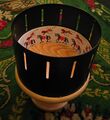 A modern replica of a Victorian zoetrope (1834)


The first person to make animated movies was a French science teacher named, Charles-Emile Reynaud.
Silent era
The first animated projection (screening) was created in France, by Charles-Émile Reynaud, who was a French science teacher. Reynaud created the Praxinoscope in 1877 and the Théâtre Optique in December 1888.[5] On 28 October 1892, he projected the first animation in public, Pauvre Pierrot, at the Musée Grévin in Paris. This film is also notable as the first known instance of film perforations being used. His films were not photographed, but drawn directly onto the transparent strip.[6] In 1900, more than 500,000 people had attended these screenings.
The first (photographed) animated projection was Humorous Phases of Funny Faces (1906) by newspaper cartoonist J. Stuart Blackton,[7] one of the co-founders of the Vitagraph Company arrived.[8] In the film, a cartoonist's line drawings of two faces were 'animated' (or came to life) on a blackboard. The two faces smiled and winked, and the cigar-smoking man blew smoke in the lady's face; also, a circus clown led a small dog to jump through a hoop.
The first animated projection in the traditional sense (i.e., on motion picture film) was Fantasmagorie by the French director Émile Cohl in 1908.[9]

The film largely consisted of a stick figure moving about and encountering all manner of morphing objects, such as a wine bottle that transforms into a flower. There were also sections of live action where the animator’s hands would enter the scene. The film was created by drawing each frame on paper and then shooting each frame onto negative film, which gave the picture a blackboard look.
This was followed by two more films, Le Cauchemar du fantoche [The Puppet's Nightmare,, now lost] and Un Drame chez les fantoches [A Puppet Drama, called The Love Affair in Toyland for American release and Mystical Love-Making for British release], all completed in 1908.
Cohl later went to Fort Lee, New Jersey near New York City in 1912, where he worked for French studio Éclair and spread its animation technique to the US.
One of the very first successful animated cartoons was Gertie the Dinosaur (1914) by Winsor McCay.[10] It is considered the first example of true character animation. At first, animated cartoons were black-and-white and silent. Felix the Cat and Oswald the Lucky Rabbit are notable examples of the silent age of animated cartoons from 1910s to 1920s.[11]
"Golden Age"
From the 1920s to 1960s, theatrical cartoons were produced in huge numbers, and usually shown before a feature film in a movie theater. Disney (distributed by Pat Powers, then Columbia, then United Artists, then RKO, then independently), Fleischer (distributed by Paramount), Warner Bros., MGM, and UPA (distributed by Columbia) were the largest studios producing these 5- to 10-minute "shorts." Other studios included Walter Lantz (distributed by Universal), DePatie-Freleng (distributed by United Artists), Van Beuren Studios (distributed by RKO Pictures), ComiColor Cartoons (distributed by Metro-Goldwyn-Mayer), Charles Mintz Studios (later Screen Gems) (distributed by Columbia), Famous Studios (distributed by Paramount), and Terrytoons (distributed by 20th Century Fox).
The first cartoon to use a soundtrack was in 1926 with Max Fleischer's My Old Kentucky Home. However the Fleischers used a De Forest sound system and the sound was not completely synchronized with the film.[12] Walt Disney's 1928 cartoon Steamboat Willie starring Mickey Mouse was the first to use a click track during the recording session, which produced better synchronism. "Mickey Mousing" became a term for any movie action (animated or live action) that was perfectly synchronized with music. The music used is original most of the time, but musical quotation is often employed. Animated characters usually performed the action in "loops," i.e., drawings were repeated over and over.
Although other producers had made films earlier using 2-strip color, Disney produced the first cartoon in 3-strip Technicolor, Flowers and Trees, in 1932. Technicians at the Fleischer studio invented rotoscoping, in which animators trace live action in order to make animation look more realistic. However, rotoscoping made the animation look stiff and the technique was later used more for studying human and animal movement, rather than directly tracing and copying filmed movements.[13] Later, other movie technologies were adapted for use in animation, such as multiplane cameras with The Old Mill (1937),[14] stereophonic sound in Fantasia (1940), widescreen processes with the feature-length Lady and the Tramp (1955), and even 3D with Lumber Jack-Rabbit.[15]
Today, traditional animation uses traditional methods, but is aided by computers in certain areas. This gives the animator new tools not available that could not be achieved using old techniques.
Feature films

In 1917, Italian-Argentine cartoonist Quirino Cristiani created the first animated feature ever made, El Apóstol, utilizing cutout animation; however, a fire that destroyed producer Federico Valle's film studio incinerated the only known copy of the film, and it is now considered lost.[16]
In 1937, Disney created the first sound and color animated feature film, Snow White and the Seven Dwarfs.[17]
The name "animated cartoon" is generally not used when referring to full-length animated productions, since the term more or less implies a "short." Huge numbers of animated feature films were, and are still, produced.
Television
Competition from television drew audiences away from movie theaters in the late 1950s, and the theatrical cartoon began its decline. Today, animated cartoons for American audiences are produced mostly for television.
American television animation of the 1950s featured quite limited animation styles, highlighted by the work of Jay Ward on Crusader Rabbit.[18] Chuck Jones coined the term "illustrated radio" to refer to the shoddy style of most television cartoons that depended more on their soundtracks than visuals.[19] Other notable 1950s programs include UPA's Gerald McBoing Boing,[20] Hanna-Barbera's Huckleberry Hound and Quick Draw McGraw,[18] and rebroadcast of many classic theatrical cartoons from Universal's Walter Lantz, Warner Bros., MGM, and Disney.
The Hanna-Barbera cartoon, The Flintstones, was the first successful primetime animated series in the United States, running from 1960 to 1966 (and in reruns since).[21] While many networks followed the show's success by scheduling other cartoons in the early 1960s, including Scooby-Doo, Where Are You!, The Jetsons, Top Cat, and The Alvin Show, none of these programs survived more than a year (save Scooby-Doo, which, despite not being a primetime cartoon, has managed to stay afloat for over four decades). However, networks found success by running these shows as Saturday morning cartoons, reaching smaller audiences with more demographic unity among children. Television animation for children flourished on Saturday morning, on cable channels like Nickelodeon, Disney Channel/Disney XD and Cartoon Network, PBS Kids, and in syndicated afternoon timeslots.
The scheduling constraints of the TV animation process, notably issues of resource management, led to the development of various techniques known now as limited animation. Full-frame animation ("on ones") became rare in its use outside of theatrical productions in the United States.
Primetime cartoons for mature audiences were virtually non-existent in the mainstream of the United States until the 1990s hit, when The Simpsons ushered in a new era of adult animation. Now, "adult animation" programs, such as, Beavis and Butt-head, South Park, King of the Hill, Family Guy, American Dad! and Futurama have increased the number of animated sitcoms on prime-time and evening American television. In addition, animated works from other countries (notably Japan) have had varying levels of airplay in the United States since the 1960s.
Commercial animation
Animation has been very popular in television commercials, both due to its graphic appeal, and the humour it can provide. Some animated characters in commercials have survived for decades, such as Snap, Crackle and Pop in advertisements for Kellogg's cereals.
The legendary animation director Tex Avery was the producer of the first Raid "Kills Bugs Dead" commercials in 1966, which were very successful for the company. The concept has been used in many countries since.
Genres of animated cartoons
Funny animals
The very first animated cartoons originally featured anthropomorphic animal characters in various different adventures over human characters. This originally was an common genre from the early 1900s until the 1930s, and the backbone of Walt Disney's series of animated cartoons which starred the most successful characters like Mickey Mouse, Donald Duck, and Goofy whose comedic styles led to their popularity.
Zany humor
Bugs Bunny and Daffy Duck of Warner Bros., and the various films of Tex Avery at Metro-Goldwyn-Mayer both originally introduced this popular widespread genre form of animated cartoons in the 1940s. It usually involves surreal acts such as cartoon characters getting crushed by the sudden apparition of anvils to be flattened before returning back to normal themselves, pulling out from behind back, 4th wall breaking, going over the edge of a cliff but suddenly floating in the mid-air roughly gravity themselves for a few seconds until to fall themselves, or even painting the wall that will later becomes an real door to enters inside into this in an absurd way. The Road Runner cartoons are great well-known famous successful examples of those features. The concepts Cartoon physics and Wild Takes describes the wacky typical antics of zany cartoon characters. Disney has an incredibly strong lesser interest with this genre, only applied this genre to some of their own cartoons, which their own cartoons generally always keep having all characters to follows of the same rules as the real life and keeping with an even much more realistic animation approach style than any cartoon studio during in this old era, although Disney always never mastered this genre, sadly.
Sophistication
As the animation medium matured, much more sophistication was unapologetically introduced, albeit keeping the humorous touch. Classical music was often pure spoofed by the comedic artists, a notable known example is Chuck Jones' 1957 cartoon "What's Opera, Doc".
Limited animation
In the 1950s, the other studios completely refined the art aspects of animation, by using extremely limited animation is a simpler easy way of increasing production and decreasing costs of animation by using "short cuts" with fewer less animated drawing frames in the animation process. This specific known method was originally first pioneered by United Productions of America and popularized (some say exploited) by Hanna-Barbera, adapted by other studios as cartoons moved from movie theaters to television in the late-1950s.
Modernism
Graphic styles continued to change in the late 1950s and 1960s. At this point, the design of the characters became more angular, while the quality of the character animation declined.
Adult animation
A specific animated work geared towards for older people and originally started in the early-1970s, Ralph Bakshi was originally the original piooner of adult animation in the 1970s, as much adult animation have been faded away like in the early-1980s, however, it was returned and popularized by The Simpsons in 1989, completely marking the resurgence of adult animation.
Animated music and bands
Popular with the advent of MTV and similar music channels, music videos often contain animation, sometimes rotoscoped (see: Take on Me), i.e., based on live action performers. Cartoons animated to music go at least as far back as Disney's 1929 The Skeleton Dance. These are now popular with the animated bands Gorillaz and Dethklok, the specific latter of which is based on a television show about the band.
Computer animation
Beginning in the 1990s, with the rise of computer animation, some cartoons implemented CGI and a few were done entirely in computer animation. Beast Wars and ReBoot were done entirely in CGI whereas Silver Surfer only partially implemented CGI. Donkey Kong Country also used CGI to make it look like the SNES game. CGI is common today, whether obvious such as in Tak and the Power of Juju.
A special important form of animation using Macromedia Flash to create pop culture influenced videos of independent, or (more rarely) mainstream music. The style was invented and popularized by Neil Cicierega. The style commonly involves cutting out and moving photographic images around.
See also
- Animation
- Computer animation
- Cartoon
- Traditional animation
- List of animated short series
- List of animated television series
- List of animated feature-length films
- List of animation studios
Notes
References
Citations
- ↑ Dalacostaa 2009, p. 1.
- ↑ Thomas 1958, p. 8.
- ↑ Cohn, Neil (15 February 2006). "The Visual Linguist: Burnt City animation VL". The Visual Linguist. http://www.thevisuallinguist.com/2006/02/burnt-city-animation-vl.html.
- ↑ Ball, Ryan (12 March 2008). "Oldest Animation Discovered In Iran". Animation Magazine. http://www.animationmagazine.net/article/8045.
- ↑ Bendazzi 1994, pp. 3–4.
- ↑ Bendazzi 1994, pp. 5–6.
- ↑ Bendazzi 1994, pp. 7–8.
- ↑ Bendazzi 1994, p. 16.
- ↑ Bendazzi 1994, p. 9.
- ↑ Bendazzi 1994, pp. 16–17.
- ↑ Bendazzi 1994, pp. 55, 59.
- ↑ Maltin 1980, p. 89.
- ↑ Thomas 1958, pp. 14.
- ↑ Maltin 1980, p. 51.
- ↑ Maltin 1980, p. 265.
- ↑ Bendazzi 1994, pp. 49–51.
- ↑ Bendazzi 1994, pp. 66–67.
- ↑ 18.0 18.1 Bendazzi 1994, p. 234.
- ↑ Bendazzi 1994, p. 231.
- ↑ Bendazzi 1994, pp. 131–132.
- ↑ Bendazzi 1994, p. 235.
Bibliography
- Barrier, J. Michael (1999). Hollywood Cartoons: American Animation in Its Golden Age. New York: Oxford University Press. ISBN 978-0-19-503759-3.
- Bendazzi, Giannalberto (1994). Cartoons: One Hundred Years of Cinema Animation. Bloomington, Indiana: Indiana University Press. ISBN 978-0-253-20937-5.
- Dalacostaa; Kamariotaki-Paparrigopouloub; Palyvosa; Spyrellisa (2009). "Multimedia application with animated cartoons for teaching science in elementary education". Computers & Education 52 (4): 741–748. doi:10.1016/j.compedu.2008.11.018. http://www.sciencedirect.com/science/article/pii/S0360131508001905.
- Maltin, Leonard (1980). Of Mice and Magic: A History of American Animated Cartoons. New York: Plume. ISBN 978-0-452-25993-5.
- Stabile, Carol (2003). Harrison, Mark. ed. Prime Time Animation: Television Animation and American Culture. London: Routledge. ISBN 978-0-415-28326-7.
- Stephenson, Ralph (1973). The Animated Film. London: Tantivity Press. ISBN 978-0-498-01202-0.
- Thomas, Bob (1958). Walt Disney, the Art of Animation: The Story of the Disney Studio Contribution to a New Art. Walt Disney Studios: Simon and Schuster. https://books.google.com/books?id=Pw3WAAAAMAAJ.
External links
- Animated Films
- The making of an animated cartoon
- The History of the Discovery of Cinematography
- Complete list of Soviet animated cartoons (in English, with descriptions. Also includes cartoons from all of the countries that the Soviet Union split up into)
- Why Does Mickey Mouse Have Only Three Fingers? Matthew Alice Straight From The Hip in the San Diego Reader
Animation topics | |||||||||||||||
|---|---|---|---|---|---|---|---|---|---|---|---|---|---|---|---|
| By country |
| ||||||||||||||
| Industry | |||||||||||||||
| Works | |||||||||||||||
| Techniques |
| ||||||||||||||
| Variants | |||||||||||||||
| Related topics | |||||||||||||||


 |  |


