Engineering:Hino Blue Ribbon
| Hino Blue Ribbon | |
|---|---|
 | |
| Overview | |
| Manufacturer | J-Bus[1] |
| Also called | Isuzu Erga |
| Production | 1982–present |
| Body and chassis | |
| Class | Complete bus Bus chassis |
| Body style | Single-decker bus Single-decker coach |
| Doors | 1 or 2 |
| Floor type | Low entry Low floor Step entrance |
| Related | Isuzu Erga |
| Powertrain | |
| Transmission | Hino (manual)/ZF (automatic) |
| Dimensions | |
| Length | 9.4m, 10.1m, 10.8m |
| Width | 2.55m |
| Height | 3.0m |
| Chronology | |
| Predecessor | Hino RE/RC Hino RS Skeleton (Tourist coach) |
| Successor | Hino S'elega (Tourist coach) |
The Hino Blue Ribbon (Japanese: 日野・ブルーリボン) is a heavy-duty single-decker bus produced by Hino Motors through the J-Bus joint venture. The model range is primarily available as a city bus and a tourist coach. It is manufactured by J-Bus either as a complete bus or as a bus chassis.[2]
RE/RC series (1960–1984)
- RB10-P (1960)
- RB10 (1961)
- RC10-P (1961)
- RC100-P (1962)
- RE100 (1967)
- RC300/320 (1967)
- RE101/121/141/161 (1977)
- RC301/321/381 (1977)
- RC701P/721P (1979)
- K-RE101/121/141/161 (1980)
- K-RC301/321/381 (1980)
-
 RE RE100
 -
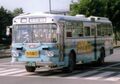 RC RC320P
 -
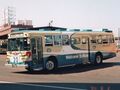 RC K-RC321
 -
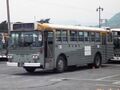 RC K-RC381


Blue Ribbon (1982–2000)
One-step and two-step models
The Blue Ribbon series was introduced in 1982.
- The RT/RU22 was equipped with the EM100, a 6-cylinder 9.4 L diesel engine producing 225 PS.
- The HT/HU22 was powered by the ER200, a 6-cylinder 11.6 L diesel engine rated at 225 PS.
- The HT/HT23 and HT/HU2M used the M10U, a 6-cylinder 9.9 L diesel engine with an output of 230 PS.
Model timeline:
- K-RT/RU22 (1982)
- P-HT/HU22 (1984)
- P-HT/HU23 (1985)
- U-HT/HU2MLAA/MMAA/MPAA (1990)
- KC-HT/HU2MLCA/MMCA/MPCA (1995)
Non-step models
The Blue Ribbon non-step (low-entry) city bus was introduced at the 1997 Tokyo Motor Show.
- The HU2P was powered by the P11C, a 6-cylinder 10.5 L turbocharged diesel engine producing 250 PS.
- It was equipped with a ZF Ecomat automatic transmission as standard.
Model timeline:
- HU2PM/PP (1997)
- KC-HU2PMCE/PPCE (1998)
-
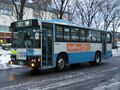 Blue Ribbon P-HU233BA
 -
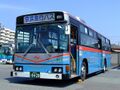 Blue Ribbon One-Step U-HT2MMAAkai
 -
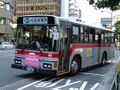 Blue Ribbon KC-HT2MLCA
 -
 Blue Ribbon KC-HU2MLCA
 -
 Blue Ribbon (FHI 7E body) U-HT2MMAAkai
 -
 Blue Ribbon HU2ML
(One-step low-floor prototype) -
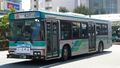 Blue Ribbon KC-HU2PPCE


.jpg)
Tourist coaches (1982–1990)
- K-RU60/63(1982)
- P-RU60/63(1985)
-
Blue Ribbon
(Tourist coach) -
 Blue Ribbon
(Tourist coach)
P-RU638BB -
 Blue Ribbon in Manila, Philippines
(Tourist coach)
P-RU638BB


Blue Ribbon HIMR (1991–2001)
The Blue Ribbon HIMR was a hybrid model introduced in 1991. It was equipped with an induction motor and batteries. During acceleration, the motor assisted the engine, while during braking, the motor functioned as an electric retarder, recovering energy and storing it in the batteries.
Model timeline:
- U-HU2MLA (1991)
- U-HU2MLAH (1994)
- KC-RU1JLCH (1995)
-
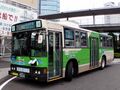 Blue Ribbon "HIMR" U-HU2MLAH

Blue Ribbon City (2000–2005)
- KL-HT/HU2PMEE/PEE/LEA/MEA/REA (2000)
- Engine: P11C turbocharged diesel (250 PS or 300 PS)
- Transmission: 5-speed manual or ZF Ecomat (standard or non-step models)
-
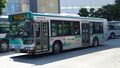 Blue Ribbon City KL-HU2PPEE
 -
Blue Ribbon City KL-HU2PMEA
.jpg)
Blue Ribbon City HIMR (2001–2005)
The HIMR version of the Blue Ribbon City was introduced in 2001. The HU1J was a one-step model, with the battery system updated to nickel–metal hydride (Ni-MH).
- HM-HU1JLEP/MEP (2001)
- Engine: J08C turbocharged diesel (177 kW / 240 PS) with motor assistance
-
 Blue Ribbon City HIMR HM-HU1JMEP

Blue Ribbon City Hybrid (2005–2015)
The Blue Ribbon City Hybrid was the only hybrid electric city bus produced by Hino Motors during this period. Most units were built on full-length chassis, with some produced on medium-length chassis. The HU8J was a non-step model, equipped with four Toyota Prius Ni-MH batteries mounted on the roof.
- ACG-HU8JLFP/MFP (2005)
- BJG-HU8JLFP/MFP (2007)
- Engine: J08E-1M turbocharged diesel (177 kW / 240 PS) with motor assistance
- LJG-HU8JLGP/MGP (2010)
- LNG-HU8JLGP/MGP (2012)
- Engine: J08E-1M turbocharged diesel (206 kW / 280 PS) with motor assistance
-
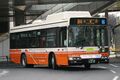 Blue Ribbon City Hybrid ACG-HU8JLFP

FCHV-BUS (2002–2005)
The Toyota FCHV-BUS was Japan's first fuel cell bus, based on the Hino KL-HU2PMEE chassis.
-
 FCHV-BUS (Version 2002)
 -
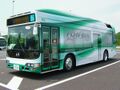 FCHV-BUS (Version 2005)


Blue Ribbon II (2004–2015)
The Hino Blue Ribbon II is a rebadged version of the Isuzu Erga. It features a rounded roof dome similar to the Hino Rainbow II, a double-curvature windscreen, and a separately mounted destination blind.
Model timeline:
- KL-KV280L1/N1 (2004)
- PJ-KV234L1/N1/Q1 (2004)
- PDG/PKG-KV234L2/N2/Q2 (2007)
- LKG/LDG-KV234L3/N3/Q3 (2010)
- QPG/QKG/QDG-KV234L3/N3/Q3 (2012)
-
 Blue Ribbon II
KL-KV280L1 -
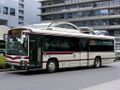 Blue Ribbon II
PJ-KV234N1 -
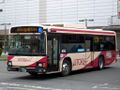 Blue Ribbon II
PKG-KV234L2 -
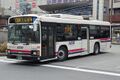 Blue Ribbon II
QPG-KV234L3 -
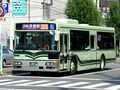 Blue Ribbon II (NSK 96MC body)
PJ-KV234N1


Blue Ribbon (2015–present)
The Blue Ribbon name was reintroduced in 2015. Model timeline:
- QRG/QPG/QKG/QDG-KV290N1/Q1 (2015)
- Engine: 4HK1 turbocharged diesel, 184 kW (250 PS)
- 2TG/2PG/2KG/2DG-KV290N2/Q2 (2017)
- Engine: 4HK1 turbocharged diesel, 177 kW (240 PS)
- 2TG/2PG/2KG/2DG-KV290N3/Q3 (2020)
- Engine: 4HK1 turbocharged diesel, 177 kW (240 PS)
- 2TG/2PG/2KG/2DG-KV290N4/Q4 (2023)
- Engine: 4HK1 turbocharged diesel, 177 kW (240 PS)
-
 Blue Ribbon QDG-KV290N1
 -
 Blue Ribbon 2PG-KV290Q2


Blue Ribbon Hybrid (2015–present)
The Blue Ribbon Hybrid has been produced at Hino's Utsunomiya Works since 2015. Model timeline:
- QSG-HL2ANAP/ASAP (2015)
- Engine: A05C turbocharged diesel, 184 kW (250 PS) with motor assistance
- 2SG-HL2ANBP/ASBP (2017)
- Engine: A05C turbocharged diesel, 191 kW (260 PS) with motor assistance
- 2SG-HL2ANBP/ASBP (2019)
- Engine: A05C turbocharged diesel, 191 kW (260 PS) with motor assistance (EDSS added)
-
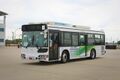 Blue Ribbon Hybrid Test Model (The body is based on Blue Ribbon City)
HU8JLGP(kai) -
 Blue Ribbon Hybrid
QSG-HL2ASAP


Blue Ribbon Hybrid Articulated
The Blue Ribbon Hybrid Articulated bus was launched on May 27, 2019, alongside the Isuzu Erga Duo. Its hybrid system is the same as that used in the HL series.
The model designation is LX525Z1. It was the first bus in the world to be equipped with the Emergency Driving Stop System (EDSS). The bus is powered by an A09C 6-cylinder engine producing 360 hp at 1,800 rpm, paired with a Hino 7-speed automated manual transmission (7AMT). As its gross vehicle weight exceeds 20 tonnes, the model is fitted with this heavy-duty drivetrain.
Like the Erga Duo, the Blue Ribbon Hybrid Articulated is the only domestically produced large bus in Japan equipped with disc brakes on all wheels.
On February 5, 2020, the first units were delivered to Yokohama City, operated by the Yokohama City Transportation Bureau under the service name Bayside Blue. This delivery marked the first domestically manufactured articulated bus in Japan.
On August 2, 2022, shipments were suspended—along with the Erga Hybrid—under the guidance of the Ministry of Land, Infrastructure, Transport and Tourism due to Hino Motors' engine data falsification scandal.
-
 Blue Ribbon Hybrid Articulated KX525Z1

Shinjin RC420TP
| Shinjin RC420TP | |
|---|---|
| Overview | |
| Manufacturer | Shinjin Motors |
| Production | February 1971 - June 1972 |
| Assembly | Busanjin, Busan, South Korea[3] |
| Body and chassis | |
| Class | Express Bus |
| Related | Hino Blue Ribbon RC Series |
| Powertrain | |
| Engine | Hino DK20-T Turbo-Diesel 260 PS |
| Dimensions | |
| Wheelbase | 5.67 m |
| Length | 11.1 m |
| Width | 2.49 m |
| Chronology | |
| Successor | GMK BU110[4] |
Shinjin RC420TP was a rear-engined, high-speed express bus manufactured under licence from the Hino Blue Ribbon RC Series. It was produced by Shinjin Motors in Busan, South Korea, between February 1971 and June 1972.
History
The RC420TP was introduced in February 1971 as part of Shinjin's express bus line. It used the body design of the Hino RC300P series but was built on the longer RC320P chassis. The model was equipped with Hino's DK20-T turbo-diesel engine.
Production ended in June 1972, with only 67 units completed before Shinjin Motors was taken over by General Motors Korea. A variant, the RC420 sub-series, was also produced with a leaf spring suspension system.
 Shinjin RC420TP - driver side : [1] Shinjin RC420TP - driver side : [1] | |
| Shinjin RC420TP - passenger side : [2] | |
| Larger picture of Shinjin RC020 : [3] |
See also
- Shinjin Motor (1955~1971) section at Daewoo Bus
- Buses section at Shinjin Motors
- List of buses
- Isuzu Erga, the J-bus product that look almost the same
- Mitsubishi Fuso Aero Star, its main competitor
References
- ↑ J-Bus website viewed 2014-08-19
- ↑ J-Bus website viewed 2014-08-19
- ↑ Daewoo Bus Global Corp.; Company; In Korea; Busan Plant
- ↑ Zyle Daewoo Bus Company: History of 1970S/1980S
External links
- Script error: The function "in_lang" does not exist. Hino Blue Ribbon and Rainbow Homepage
- Zyle Daewoo Bus Company: History Before 1970S (Shinjin RC420TP picture marquee)
- Script error: The function "in_lang" does not exist. 기업연혁: 신진자동차 (Production information)
- Script error: The function "in_lang" does not exist. 기업연혁: G.M코리아 (End date reason)
- Script error: The function "in_lang" does not exist. 버스와 트럭의 운전게임 마 이 티 M.I.G.H.T.Y
- Script error: The function "in_lang" does not exist. 신진 RC420 이 있었다? (Discussion on Shinjin RC420 bus)
- Script error: The function "in_lang" does not exist. 대우 자동차, 이름, 뜻,종류 (Successor of High Speed Bus Class)
- Script error: The function "in_lang" does not exist. 若松様から頂いた写真のうち、1986年に撮影したものです。 (1971 Hino RC300P)
- Script error: The function "in_lang" does not exist. RC420TP 고속버스 (Pictures of Shinjin RC420TP High Speed Bus)
- Script error: The function "in_lang" does not exist. 1971~72년에 생산된 신진히노 RC420TP의 원형을 찾아봤습니다 (Body/Chassis differences)
 |  |


_Nagasaki_Bus_4207_%E9%95%B7%E5%B4%8E200%E3%81%8B224_17_2024-11-12.jpg)
![[2]](http://aeroexpress.wo.to/신진%20고속버스%20RC420TP.jpg)
![[3]](http://www.betanews.net/imagedb/orig/2006/0704/3c93b964.jpg)