Engineering:Purvis Eureka
| Purvis Eureka | |
|---|---|
 | |
| Overview | |
| Manufacturer | Purvis Cars |
| Production | 1974–1991 |
| Designer | Allan Purvis |
| Body and chassis | |
| Class | Sports car Kit car |
| Body style | Coupé Targa coupe |
| Layout | Rear-engine, rear-wheel drive |
| Platform | Volkswagen Beetle |
| Related | Nova |
| Powertrain | |
| Engine |
|
| Transmission | Volkswagen four-speed[1] |
| Dimensions | |
| Wheelbase | 2,400 mm (94.5 in) |
| Length | 4,420 mm (174.0 in) |
| Width | 1,753 mm (69.0 in) |
| Height | 1,067 mm (42.0 in) |
| |uk|Kerb|Curb}} weight | 700 kg (1,543 lb)[2] |
The Purvis Eureka is a sports car which was produced by Purvis Cars from 1974 to 1991 in Dandenong, Victoria, Australia.[3][2]
It was first exhibited at the 1974 Melbourne International Motor Show, and was based on the British Nova kit car. The name was a tribute to the Eureka Stockade, with Purvis Cars also adopting the Eureka Flag as its logo. It utilised a Volkswagen Beetle chassis, and had a fibreglass body.[2] The Eureka was offered both as a kit car and as a fully assembled vehicle.[4]
The canopy model had no doors, with access being through a manually operated one-piece canopy, which was later replaced by a powered canopy.[5][1] A targa top version was also available from the 1980s onward.[6][2]
The Eureka was available with several engine options: a flat-four Volkswagen air-cooled engine, Ford straight-four engines, or Mazda Wankel engine.[7] The 1.6-litre Volkswagen engine produced 48 kW (64 hp),[1] the Volkswagen engines having a fuel economy of 8.8 L/100 km (32.1 mpg‑imp).[2]
Three models of the Eureka were produced:[6][1]
- Purvis Eureka Sport (1974–1975)
- Purvis Eureka PL30 (1975–1976)
- Purvis Eureka F4 (1976–1991)
A total of 683 units were produced.[8] Some 235 units of the Eureka Sports were produced.[9] New Zealand production started in 1977, ending in 1990.[2]
-
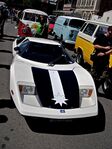 Purvis Eureka with bonnet flag
-
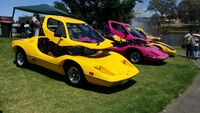 Purvis Eureka F4


References
- ↑ 1.0 1.1 1.2 1.3 Harriet, Edquist; Hurlston, David (13 May 2015). Shifting Gear: Design, Innovation and the Australian Car. https://www.ngv.vic.gov.au/wp-content/uploads/2014/08/ShiftingGearLabels-web.pdf. Retrieved 11 December 2025.
- ↑ 2.0 2.1 2.2 2.3 2.4 2.5 Tulk, Mitchell (25 March 2017). "Forgotten Cars of Australia: The Purvis Eureka". https://www.carsales.com.au/editorial/details/forgotten-cars-of-australia-the-purvis-eureka-106501/.
- ↑ "Purvis Eureka celebrates 50th anniversary at Lake Wendouree". 3 November 2024. https://www.thecourier.com.au/story/8809451/purvis-eureka-celebrates-50th-anniversary-at-lake-wendouree/.
- ↑ "45 years of Purvis Eureka". 25 October 2019. https://www.tradeuniquecars.com.au/45-years-of-purvis-eureka/.
- ↑ Tony Davis, Aussie Cars, 1987, p. 151.
- ↑ 6.0 6.1 "Purvis Eureka". https://www.uniquecarsandparts.com/car_info_purvis_eureka.htm.
- ↑ Leggatt, Joshua (31 December 2024). "Paul Patton’s Eureka is a rocket ship that should be handled with care". https://www.weeklytimesnow.com.au/machine/the-shed/paul-pattons-eureka-is-a-rocket-ship-that-should-be-handled-with-care/news-story/8748051ccc119257746500a7a4dbb7d6.
- ↑ Margeit, Rob (23 November 2023). "Eureka! Purvis was Australia’s “seventh-biggest car maker”". https://www.drive.com.au/caradvice/eureka-purvis-was-australias-seventh-biggest-car-maker-drive-flashback/.
- ↑ McCarthy, Mike (1987). Great Australian Sports Cars and Specials. pp. 110-115.
External links


 |  |


