Engineering:Tango-class submarine
 | This article includes a list of references, related reading or external links, but its sources remain unclear because it lacks inline citations. (January 2013) (Learn how and when to remove this template message) |
 A Tango-class submarine in the North Atlantic.
| |
| Class overview | |
|---|---|
| Name: | Tango class (Project 641B) |
| Builders: | Gorky |
| Operators: |
 Soviet Navy Soviet Navy |
| Preceded by: | Foxtrot class |
| Succeeded by: | Kilo class |
| In service: | 1972–2016 |
| In commission: | 1972 |
| Completed: | 18 |
| Active: | 0 |
| Retired: | 15 |
| Preserved: | 3 |
| General characteristics | |
| Type: | Submarine |
| Displacement: |
|
| Length: | 91 m (298 ft 7 in) |
| Beam: | 9.1 m (29 ft 10 in) |
| Draught: | 7.2 m (23 ft 7 in) |
| Propulsion: |
|
| Speed: |
|
| Complement: | 62 men (12 officers) |
| Armament: |
|
The Tango class was the NATO reporting name of a class of diesel-electric submarines that were built in the Soviet Union to replace the Foxtrot-class submarines assigned to the Black Sea and Northern Fleets. The Soviet designation of this class was Project 641B and it was also known as the Som (Catfish) class. The first of the class was completed in 1972 at Gorky. A total of 18 were built in two slightly different versions. The later type was several metres longer than the first, possibly because of the installation of ASW missile equipment.
The bow sonar installations appear to be similar to those fitted to Soviet nuclear attack submarines. The propulsion plant was the same as the last subgroup of the Foxtrot class. The Tango class had far more battery capacity, far higher than any previous conventional submarine class in the Soviet Navy; as a result, pressure hull volume increased. This allowed an underwater endurance in excess of a week before snorkeling was required.
Coupled with new armament and sensor fit, the Tango class was ideal for ambush operations against Western nuclear submarines at natural chokepoints.
Construction of this class has now stopped. The B-380 of the Black Sea Fleet was the last to be decommissioned in 2016 and the scrapping began in Inkerman in 2020.[1]
By October 2021, the sail of submarine B-380 had been installed, with the assistance of the Russian Maritime Tradition Club Association, at the Mistral Hotel & Spa, Intra district of Moscow.[1]
Museum ships
-
 Schematic of the Tango class
 -
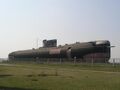 B-307, Togliatti
 -
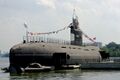 B-396, Moscow
 -
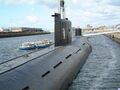 B-515, Hamburg
 -
 Tango B-396 torpedo room


Three 641B-class submarines operate as museum ships:
- B-307, fully raised on ground – AvtoVAZ Technical Museum, Tolyatti, Russia
- B-396, afloat in Tushino reservoir – Moscow Navy Museum
- B-515, afloat near Fischmarkt in Hamburg – museum in Hamburg
The conning towers of stricken B-319' and B-474 are on display in Polyarny and Ryazan.
References
- The Encyclopedia Of Warships From World War Two To The Present Day, General Editor Robert Jackson.
Further reading
- Conway's All the World's Fighting Ships 1947–1995. Annapolis: Naval Institute Press. 1995. ISBN 1-55750-132-7.
- Miller, David; Jordan, John (1987). Modern Submarine Warfare. New York: Military Press. ISBN 0-517-64647-1.
- Miller, David (1989). Modern Submarines. Combat Arms. New York: Prentice Hall Press. ISBN 0-13-589102-7.
External links
- RussianWarrior page about the Tango Class
- Russian Tango Class Submarines - Complete Ship List (English)
Template:Tango-class submarine Template:Soviet and Russian submarines after 1945
 |  |


