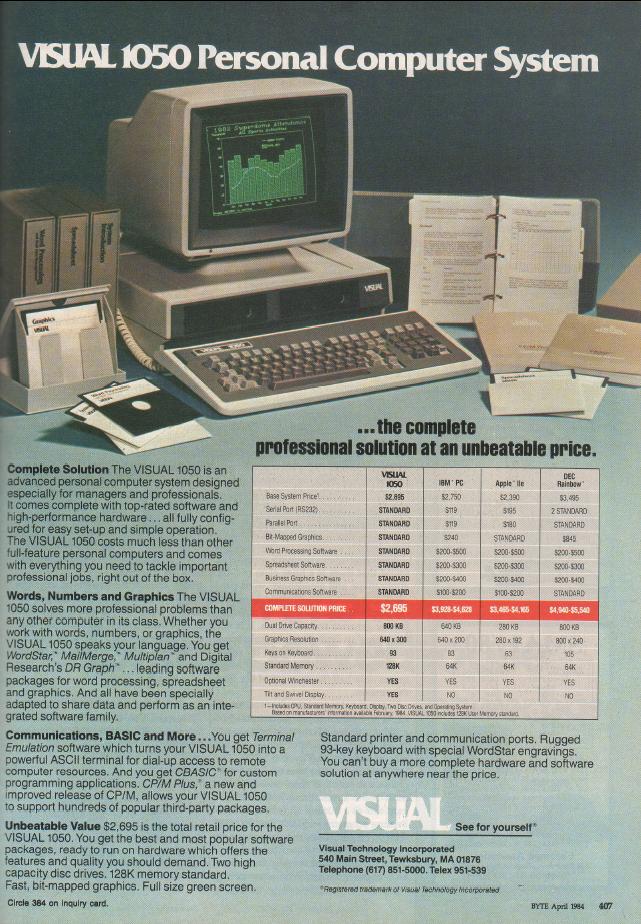
Engineering:Visual 1050
| Manufacturer | Visual Technology |
|---|---|
| Release date | 1983 |
| Media | 2 400kb 5¼-inch floppy disks |
| Operating system | CP/M Plus |
| CPU | Zilog Z80 clocked at 4 MHz with a MOS Technology 6502 graphics coprocessor |
| Memory | 128kB RAM, 8kb ROM |
| Display | monochrome 80 chars. × 25 lines, 640 × 300 pixels |
| Graphics | MOS Technology 6502 |
| Input | Keyboard Keytronic full stroke 93-key with numeric key pad & 17 function keys |
| Dimensions | CPU - 5H × 17W × 17Din |
| Mass | 15lbs |
The Visual 1050 was an 8-bit desktop computer sold by Visual Technology in the early 1980s.[1][2] The computer ran under the CP/M operating system and used 2 400KB, 5¼, SSDD, 96tpi floppy disk drives (TEAC FD-55E) for mass storage with an optional 10MB external Winchester hard disk drive. In addition to the Zilog Z80A processor clocked at 4 MHz, the Visual 1050 also included a MOS Technology 6502 used as a graphics coprocessor.[3][4]
Overview
The Visual 1050 featured a dual-processor architecture; Z80A processor as the main CPU and a 6502 to drive the display.[5]
In addition to the Z80 and 6502 chips, the system also included a Intel 8255A PIO, a Intel 8251A USART, a Intel 8214 Programmable Interrupt Controller, a Motorola 6845 CRT controller, a Western Digital 1793 floppy disk controller, and a OKI MSM5832 real time clock.[6]
160K of RAM was included with the system, with 128K of this programmable and 32K reserved for use by the display processor.[5]
The display was bit-mapped at a resolution of 640 × 300 pixels with 80 × 25 characters (at 8 × 12 pixel each) on a green monochrome CRT. The display offered programmable features which could be invoked from the main processing unit via a character-stream interface built in between the Z80 CPU and 6502 coprocessor.[7]
Two communication ports were available: an RS-232C serial port and a Centronics parallel port.[7]
The machine had a Keytronic full stroke 93-key keyboard with numeric keypad and 17 function keys.[7]
A standard Visual 1050 shipped with CP/M Plus operating system, a CP/M source disk, a copy of WordStar word processor with MailMerge software, Microsoft Multiplan spreadsheet, Digital Research DR Graph charting software, Digital Research CBASIC computer language, and an RS-232C communications program.[7] Optionally there was support for a 10MB Winchester hard-drive via a Xebec S1410 Disk Controller.[6]
See also
- Visual 50 - a video display terminal produced by Visual Technology
Sources
- ↑ "Visual Technology Visual 1050". http://v1050.classiccmp.org/index.html.
- ↑ "Visual 1050 Visual Technology". https://www.old-computers.com/museum/computer.asp?st=2&c=842.
- ↑ Wierzbicki, Barbara (1983-07-18). "Graphics-terminal firm promises 8-bit micro with lots of software". InfoWorld: pp. 14. https://books.google.com/books?id=xi8EAAAAMBAJ&q=Visual+1050.
- ↑ "Visual 1050 Personal Computer System". BYTE: pp. 407. April 1984. https://vintageapple.org/byte/pdf/198404_Byte_Magazine_Vol_09-04_Real-World_Interfacing.pdf.
- ↑ 5.0 5.1 Visual 1050 User's Guide. Visual Technology, Inc.. 1983. http://v1050.classiccmp.org/docs/v1050_UsersGuide.pdf.
- ↑ 6.0 6.1 Visual 1050 Programmer's Technical Document. Visual Technology Incorporated. 1984. http://v1050.classiccmp.org/docs/v1050_ProgTechDoc.pdf.
- ↑ 7.0 7.1 7.2 7.3 Visual 1050 Operating Manual
External links
- Pictures and Specifications
- April 1984 Sales Advertisement from BYTE Magazine
- Technical Information, Manuals, and general system information
 |  |