Engineering:Yakisugi
Yakisugi (Japanese: 焼 杉, lit. burnt Japanese cedar [1]) is a traditional Japanese method of wood preservation.[2][3][1] It is also referred to as Script error: The function "nihongo3" does not exist., a term which uses the same kanji characters, but an alternative pronunciation. The ban character means "plank". In the West, it is known as burnt timber cladding.
Early observations on wood preservation
A recent interdisciplinary study interprets a brief autographic note by Leonardo da Vinci in the Madrid Codex II (folio 87r) as describing a method of surface charring of debarked timber intended to improve durability. The authors transcribe the passage as stating that wood "will be better preserved if stripped of bark and burned on the surface than in any other way," and they propose that Leonardo's remark records an early practical observation about the benefits of treating stripped (debarked) wood with controlled surface burning. The paper frames this as a modern scholarly interpretation and does not claim a direct historical continuity between Renaissance European practice and later techniques elsewhere; it is presented as an early observation relevant to Wood preservation rather than proof of cultural transmission.[4][5]
Process and properties
By partially charring the surface of the wood without combusting the entire piece, the surface becomes water-resistant through carbonization, and its hygroscopy is reduced due to chemical cellular changes during the carbonization process, which results in increased durability.[6][7] It additionally protects the wood against insects, fungi and mold, as well as making the wood more fire-resistant.[8] This traditional technique has several similarities with the modern thermal wood modification[9] methods used in Europe and elsewhere.
However, some studies have shown that surface charring alone does not improve its durability or its resistance to fire or water.[10]
Contemporary applications
Contemporary architect Terunobu Fujimori employs yakisugi in his designs.[11][12] Japanese architect Kengo Kuma also incorporates this charred wood material in his architectural works.[13]
Gallery
In detail
-
 Surface detail showing charred texture
 -
 Close-up of yakisugi surface pattern
 -
 Yakisugi texture detail from Kyoto
 -
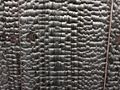 Charred wood surface showing carbonization


In use
-
 Yakisugi treated wood used in a box for sunglasses
 -
 Western garden room with yakisugi cladding


References
- ↑ 1.0 1.1 MacDonald, Deanna (9 February 2016) (in en). Eco Living Japan: Sustainable Ideas for Living Green. Tuttle Publishing. ISBN 978-1-4629-1845-4. https://books.google.com/books?id=d-INCwAAQBAJ&dq=%22yakisugi%22&pg=PA232.
- ↑ Ebner, David Hans; Barbu, Marius-Catalin; Klaushofer, Josef; Čermák, Petr (2021). "Surface Modification of Spruce and Fir Sawn-Timber by Charring in the Traditional Japanese Method—Yakisugi". Polymers 13 (10): 1662. doi:10.3390/polym13101662. PMID 34065260.
- ↑ Fortini, Amanda (19 September 2017). "The Latest Design Trend: Black and Burned Wood". https://www.nytimes.com/2017/09/19/t-magazine/shou-sugi-ban.html.
- ↑ da Montefeltro, Andrea; Di Maria, Annalisa; Bianchi, Lucica (2025-11-02). "Leonardo and the Secret of Indestructible Wood: The Renaissance Technique That Is Revolutionizing Bioarchitecture". Zenodo. https://doi.org/10.5281/zenodo.17506251. Retrieved 2026-05-15.
- ↑ GreenMe (2025-04-10). "Leonardo da Vinci e il legno indistruttibile". GreenMe. https://www.greenme.it/casa-e-giardino/bioedilizia-e-bioarchitettura/leonardo-da-vinci-e-il-legno-indistruttibile-il-segreto-rinascimentale-che-cambia-la-bioarchitettura/. Retrieved 2026-05-15.
- ↑ "Use This Incredible Technique to Waterproof Wood Furniture". 3 November 2017. https://www.architecturaldigest.com/story/shou-sugi-ban-black-waterproof-wood-furniture.
- ↑ Mehta, Geeta; MacDonald, Deanna (9 July 2012) (in en). New Japan Architecture: Recent Works by the World's Leading Architects. Tuttle Publishing. ISBN 978-1-4629-0850-9. https://books.google.com/books?id=TSlyAgAAQBAJ&dq=%22yakisugi%22&pg=PT85.
- ↑ Steele, James (16 March 2017) (in en). Contemporary Japanese Architecture: Tracing the Next Generation. Routledge. ISBN 978-1-317-37728-3. https://books.google.com/books?id=iw5dDgAAQBAJ&dq=%22yakisugi%22&pg=PT466.
- ↑ "Thermal Wood Modification". Springer Handbook of Wood Science and Technology. Springer Handbooks. Cham: Springer International Publishing. 2023. pp. 899–906. doi:10.1007/978-3-030-81315-4. ISBN 978-3-030-81314-7.
- ↑ Hasburgh, Laura E.; Zelinka, Samuel L.; Bishell, Amy B.; Kirker, Grant T. (16 September 2021). "Durability and Fire Performance of Charred Wood Siding (Shou Sugi Ban)". Forests 12 (9): 1262. doi:10.3390/f12091262. Bibcode: 2021Fore...12.1262H.
- ↑ Wilton, Megan (11 March 2009). "Yakisugi House by Terunobu Fujimori". https://www.dezeen.com/2009/03/11/yakisugi-house-by-terunobu-fujimori/.
- ↑ Sumner, Yuki (28 August 2009). "Interiors: A Japanese Charred-Timber House Inspired by a Cave Dwelling". https://www.telegraph.co.uk/lifestyle/interiors/6104653/Interiors-A-Japanese-charred-timber-house-inspired-by-a-cave-dwelling.html.
- ↑ Kuma, Kengo (3 June 2022). "Yakisugi Forest". https://kkaa.co.jp/en/project/yakisugi-forest/.
External links
Japan articles | |||||||
|---|---|---|---|---|---|---|---|
| History |
|  | |||||
| Geography | |||||||
| Politics |
| ||||||
| Economy | |||||||
| Society |
| ||||||


 |  |


