Evolutionarily stable strategy
Conflicts between organisms are often modelled as games (cf. also Games, theory of). Here, attention is confined to conflicts between con-specifics, which are also symmetric in the sense that each player has available the same set of strategies (cf. Strategy (in game theory)) and the same pay-off function. (Important texts in this area are [a5], [a8], [a15], [a17], [a22].)
Consider first two-player conflicts (cf. also Two-person zero-sum game). Suppose there exists a set of possible strategies <img align="absmiddle" border="0" src="https://www.encyclopediaofmath.org/legacyimages/e/e110/e110130/e1101301.png" />, and a pay-off function <img align="absmiddle" border="0" src="https://www.encyclopediaofmath.org/legacyimages/e/e110/e110130/e1101302.png" />, where <img align="absmiddle" border="0" src="https://www.encyclopediaofmath.org/legacyimages/e/e110/e110130/e1101303.png" />, the pay-off to a player who plays <img align="absmiddle" border="0" src="https://www.encyclopediaofmath.org/legacyimages/e/e110/e110130/e1101304.png" /> against one who plays <img align="absmiddle" border="0" src="https://www.encyclopediaofmath.org/legacyimages/e/e110/e110130/e1101305.png" />. One extends the set of available strategies to some <img align="absmiddle" border="0" src="https://www.encyclopediaofmath.org/legacyimages/e/e110/e110130/e1101306.png" />, where each <img align="absmiddle" border="0" src="https://www.encyclopediaofmath.org/legacyimages/e/e110/e110130/e1101307.png" /> is a weight function defined on the elements of <img align="absmiddle" border="0" src="https://www.encyclopediaofmath.org/legacyimages/e/e110/e110130/e1101308.png" />; e.g. a probability function if <img align="absmiddle" border="0" src="https://www.encyclopediaofmath.org/legacyimages/e/e110/e110130/e1101309.png" /> is discrete. One supposes that the extension of the pay-off function is linear, i.e. for <img align="absmiddle" border="0" src="https://www.encyclopediaofmath.org/legacyimages/e/e110/e110130/e11013010.png" />,
| <img align="absmiddle" border="0" src="https://www.encyclopediaofmath.org/legacyimages/e/e110/e110130/e11013011.png" /> |
where <img align="absmiddle" border="0" src="https://www.encyclopediaofmath.org/legacyimages/e/e110/e110130/e11013012.png" /> denotes summation or integration (as appropriate) and <img align="absmiddle" border="0" src="https://www.encyclopediaofmath.org/legacyimages/e/e110/e110130/e11013013.png" /> is the weight attached to <img align="absmiddle" border="0" src="https://www.encyclopediaofmath.org/legacyimages/e/e110/e110130/e11013014.png" /> by <img align="absmiddle" border="0" src="https://www.encyclopediaofmath.org/legacyimages/e/e110/e110130/e11013015.png" />.
A concept of solution of an evolutionarily stable strategy was introduced in [a19]. Such a strategy, if adopted by the whole of the (infinite) population (see [a21] for the finite case), cannot be invaded by any alternate strategy introduced at low frequency.
A strategy <img align="absmiddle" border="0" src="https://www.encyclopediaofmath.org/legacyimages/e/e110/e110130/e11013016.png" /> is said to be evolutionarily stable with respect to <img align="absmiddle" border="0" src="https://www.encyclopediaofmath.org/legacyimages/e/e110/e110130/e11013017.png" /> if:
1) <img align="absmiddle" border="0" src="https://www.encyclopediaofmath.org/legacyimages/e/e110/e110130/e11013018.png" />;
2) <img align="absmiddle" border="0" src="https://www.encyclopediaofmath.org/legacyimages/e/e110/e110130/e11013019.png" /> implies <img align="absmiddle" border="0" src="https://www.encyclopediaofmath.org/legacyimages/e/e110/e110130/e11013020.png" />.
A strategy <img align="absmiddle" border="0" src="https://www.encyclopediaofmath.org/legacyimages/e/e110/e110130/e11013021.png" /> is said to be evolutionarily stable if <img align="absmiddle" border="0" src="https://www.encyclopediaofmath.org/legacyimages/e/e110/e110130/e11013022.png" /> is evolutionarily stable with respect to <img align="absmiddle" border="0" src="https://www.encyclopediaofmath.org/legacyimages/e/e110/e110130/e11013023.png" /> for all <img align="absmiddle" border="0" src="https://www.encyclopediaofmath.org/legacyimages/e/e110/e110130/e11013024.png" />. For a discussion of the definition see also [a5] and [a23]. Let <img align="absmiddle" border="0" src="https://www.encyclopediaofmath.org/legacyimages/e/e110/e110130/e11013025.png" /> denote the support of <img align="absmiddle" border="0" src="https://www.encyclopediaofmath.org/legacyimages/e/e110/e110130/e11013026.png" />. If <img align="absmiddle" border="0" src="https://www.encyclopediaofmath.org/legacyimages/e/e110/e110130/e11013027.png" /> is such that <img align="absmiddle" border="0" src="https://www.encyclopediaofmath.org/legacyimages/e/e110/e110130/e11013028.png" /> for all <img align="absmiddle" border="0" src="https://www.encyclopediaofmath.org/legacyimages/e/e110/e110130/e11013029.png" /> while <img align="absmiddle" border="0" src="https://www.encyclopediaofmath.org/legacyimages/e/e110/e110130/e11013030.png" /> for all <img align="absmiddle" border="0" src="https://www.encyclopediaofmath.org/legacyimages/e/e110/e110130/e11013031.png" />, then <img align="absmiddle" border="0" src="https://www.encyclopediaofmath.org/legacyimages/e/e110/e110130/e11013032.png" /> is a strict Nash equilibrium (cf. also Nash theorem (in game theory)). It follows that <img align="absmiddle" border="0" src="https://www.encyclopediaofmath.org/legacyimages/e/e110/e110130/e11013033.png" />, so <img align="absmiddle" border="0" src="https://www.encyclopediaofmath.org/legacyimages/e/e110/e110130/e11013034.png" /> is evolutionarily stable against <img align="absmiddle" border="0" src="https://www.encyclopediaofmath.org/legacyimages/e/e110/e110130/e11013035.png" /> for all <img align="absmiddle" border="0" src="https://www.encyclopediaofmath.org/legacyimages/e/e110/e110130/e11013036.png" /> such that <img align="absmiddle" border="0" src="https://www.encyclopediaofmath.org/legacyimages/e/e110/e110130/e11013037.png" />, <img align="absmiddle" border="0" src="https://www.encyclopediaofmath.org/legacyimages/e/e110/e110130/e11013038.png" /> being the empty set. Thus, in the generic case an evolutionarily stable strategy is a strict Nash equilibrium with the additional condition that for all <img align="absmiddle" border="0" src="https://www.encyclopediaofmath.org/legacyimages/e/e110/e110130/e11013039.png" /> such that <img align="absmiddle" border="0" src="https://www.encyclopediaofmath.org/legacyimages/e/e110/e110130/e11013040.png" /> one requires that <img align="absmiddle" border="0" src="https://www.encyclopediaofmath.org/legacyimages/e/e110/e110130/e11013041.png" />, or, equivalently, that for all <img align="absmiddle" border="0" src="https://www.encyclopediaofmath.org/legacyimages/e/e110/e110130/e11013042.png" /> such that <img align="absmiddle" border="0" src="https://www.encyclopediaofmath.org/legacyimages/e/e110/e110130/e11013043.png" /> one requires that <img align="absmiddle" border="0" src="https://www.encyclopediaofmath.org/legacyimages/e/e110/e110130/e11013044.png" />, with equality if and only if <img align="absmiddle" border="0" src="https://www.encyclopediaofmath.org/legacyimages/e/e110/e110130/e11013045.png" />.
For conditions for <img align="absmiddle" border="0" src="https://www.encyclopediaofmath.org/legacyimages/e/e110/e110130/e11013046.png" /> to be an evolutionarily stable strategy in the finite (i.e. matrix) case, see [a10] (generic) and [a1] (non-generic). If <img align="absmiddle" border="0" src="https://www.encyclopediaofmath.org/legacyimages/e/e110/e110130/e11013047.png" /> is an evolutionarily stable strategy and <img align="absmiddle" border="0" src="https://www.encyclopediaofmath.org/legacyimages/e/e110/e110130/e11013048.png" /> is such that <img align="absmiddle" border="0" src="https://www.encyclopediaofmath.org/legacyimages/e/e110/e110130/e11013049.png" />, then <img align="absmiddle" border="0" src="https://www.encyclopediaofmath.org/legacyimages/e/e110/e110130/e11013050.png" /> is not an evolutionarily stable strategy (the Bishop–Cannings theorem, [a4]).
The war of attrition was introduced in [a16], where <img align="absmiddle" border="0" src="https://www.encyclopediaofmath.org/legacyimages/e/e110/e110130/e11013051.png" /> and <img align="absmiddle" border="0" src="https://www.encyclopediaofmath.org/legacyimages/e/e110/e110130/e11013052.png" /> and <img align="absmiddle" border="0" src="https://www.encyclopediaofmath.org/legacyimages/e/e110/e110130/e11013053.png" /> if <img align="absmiddle" border="0" src="https://www.encyclopediaofmath.org/legacyimages/e/e110/e110130/e11013054.png" />, <img align="absmiddle" border="0" src="https://www.encyclopediaofmath.org/legacyimages/e/e110/e110130/e11013055.png" /> if <img align="absmiddle" border="0" src="https://www.encyclopediaofmath.org/legacyimages/e/e110/e110130/e11013056.png" /> and <img align="absmiddle" border="0" src="https://www.encyclopediaofmath.org/legacyimages/e/e110/e110130/e11013057.png" /> if <img align="absmiddle" border="0" src="https://www.encyclopediaofmath.org/legacyimages/e/e110/e110130/e11013058.png" />. Thus, individuals contest for a reward <img align="absmiddle" border="0" src="https://www.encyclopediaofmath.org/legacyimages/e/e110/e110130/e11013059.png" /> by choosing a single value, perhaps display time, the winner being the one choosing the larger value but the cost to each only being the lesser; i.e. the contest ends immediately when the first individual retreats. In this case there is a unique evolutionarily stable strategy, given by <img align="absmiddle" border="0" src="https://www.encyclopediaofmath.org/legacyimages/e/e110/e110130/e11013060.png" />, <img align="absmiddle" border="0" src="https://www.encyclopediaofmath.org/legacyimages/e/e110/e110130/e11013061.png" />, where <img align="absmiddle" border="0" src="https://www.encyclopediaofmath.org/legacyimages/e/e110/e110130/e11013062.png" />. This follows since <img align="absmiddle" border="0" src="https://www.encyclopediaofmath.org/legacyimages/e/e110/e110130/e11013063.png" />, <img align="absmiddle" border="0" src="https://www.encyclopediaofmath.org/legacyimages/e/e110/e110130/e11013064.png" />, <img align="absmiddle" border="0" src="https://www.encyclopediaofmath.org/legacyimages/e/e110/e110130/e11013065.png" /> with equality if and only if <img align="absmiddle" border="0" src="https://www.encyclopediaofmath.org/legacyimages/e/e110/e110130/e11013066.png" />, which ensures that <img align="absmiddle" border="0" src="https://www.encyclopediaofmath.org/legacyimages/e/e110/e110130/e11013067.png" /> is an evolutionarily stable strategy, and this is unique by the Bishop–Cannings theorem. If <img align="absmiddle" border="0" src="https://www.encyclopediaofmath.org/legacyimages/e/e110/e110130/e11013068.png" />, i.e. individuals essentially commit themselves irrevocable to their choice, as might occur for a choice of size, then there is no evolutionarily stable strategy [a18]. A hybrid model with <img align="absmiddle" border="0" src="https://www.encyclopediaofmath.org/legacyimages/e/e110/e110130/e11013069.png" /> has been treated by [a12].
Finite conflicts.
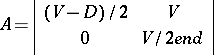
As stated above, [a10] gives conditions in the finite (i.e. matrix) case for <img align="absmiddle" border="0" src="https://www.encyclopediaofmath.org/legacyimages/e/e110/e110130/e11013070.png" /> to be an evolutionarily stable strategy. Suppose <img align="absmiddle" border="0" src="https://www.encyclopediaofmath.org/legacyimages/e/e110/e110130/e11013071.png" /> and <img align="absmiddle" border="0" src="https://www.encyclopediaofmath.org/legacyimages/e/e110/e110130/e11013072.png" />. For <img align="absmiddle" border="0" src="https://www.encyclopediaofmath.org/legacyimages/e/e110/e110130/e11013073.png" />, an evolutionarily stable strategy with <img align="absmiddle" border="0" src="https://www.encyclopediaofmath.org/legacyimages/e/e110/e110130/e11013074.png" /> exists if and only if <img align="absmiddle" border="0" src="https://www.encyclopediaofmath.org/legacyimages/e/e110/e110130/e11013075.png" /> and <img align="absmiddle" border="0" src="https://www.encyclopediaofmath.org/legacyimages/e/e110/e110130/e11013076.png" />. See, in particular, [a19] for the hawk–dove scenario, where there is a reward <img align="absmiddle" border="0" src="https://www.encyclopediaofmath.org/legacyimages/e/e110/e110130/e11013077.png" /> for winning, a hawk always beats a dove, doves share the reward, while hawks share the reward but also incur damage (cost <img align="absmiddle" border="0" src="https://www.encyclopediaofmath.org/legacyimages/e/e110/e110130/e11013078.png" />). Thus,
| <img align="absmiddle" border="0" src="https://www.encyclopediaofmath.org/legacyimages/e/e110/e110130/e11013079.png" /> |
and there is an evolutionarily stable strategy with both hawk and dove if <img align="absmiddle" border="0" src="https://www.encyclopediaofmath.org/legacyimages/e/e110/e110130/e11013080.png" />, demonstrating that organisms need not adopt aggressive strategies. On the other hand, if <img align="absmiddle" border="0" src="https://www.encyclopediaofmath.org/legacyimages/e/e110/e110130/e11013081.png" />, then <img align="absmiddle" border="0" src="https://www.encyclopediaofmath.org/legacyimages/e/e110/e110130/e11013082.png" /> is an evolutionarily stable strategy, while if <img align="absmiddle" border="0" src="https://www.encyclopediaofmath.org/legacyimages/e/e110/e110130/e11013083.png" />, then <img align="absmiddle" border="0" src="https://www.encyclopediaofmath.org/legacyimages/e/e110/e110130/e11013084.png" /> is an evolutionarily stable strategy. Thus there is always at least one evolutionarily stable strategy.
For <img align="absmiddle" border="0" src="https://www.encyclopediaofmath.org/legacyimages/e/e110/e110130/e11013085.png" />, [a10] has given examples of the possible sets of evolutionarily stable strategies, it being possible that there be no evolutionarily stable strategy. More generally, suppose that <img align="absmiddle" border="0" src="https://www.encyclopediaofmath.org/legacyimages/e/e110/e110130/e11013086.png" />, where <img align="absmiddle" border="0" src="https://www.encyclopediaofmath.org/legacyimages/e/e110/e110130/e11013087.png" />, <img align="absmiddle" border="0" src="https://www.encyclopediaofmath.org/legacyimages/e/e110/e110130/e11013088.png" /> denoting the power set. Then <img align="absmiddle" border="0" src="https://www.encyclopediaofmath.org/legacyimages/e/e110/e110130/e11013089.png" /> is called a pattern. If there exists an <img align="absmiddle" border="0" src="https://www.encyclopediaofmath.org/legacyimages/e/e110/e110130/e11013090.png" />-matrix <img align="absmiddle" border="0" src="https://www.encyclopediaofmath.org/legacyimages/e/e110/e110130/e11013091.png" /> with <img align="absmiddle" border="0" src="https://www.encyclopediaofmath.org/legacyimages/e/e110/e110130/e11013092.png" /> evolutionarily stable strategies with supports <img align="absmiddle" border="0" src="https://www.encyclopediaofmath.org/legacyimages/e/e110/e110130/e11013093.png" />, then <img align="absmiddle" border="0" src="https://www.encyclopediaofmath.org/legacyimages/e/e110/e110130/e11013094.png" /> is said to be attainable on <img align="absmiddle" border="0" src="https://www.encyclopediaofmath.org/legacyimages/e/e110/e110130/e11013095.png" />. The Bishop–Cannings theorem ensures that an attainable pattern is a Sperner family. Various restrictions on the set of attainable patterns have been derived in [a24]; in it, it is conjectured that if <img align="absmiddle" border="0" src="https://www.encyclopediaofmath.org/legacyimages/e/e110/e110130/e11013096.png" /> is attainable and <img align="absmiddle" border="0" src="https://www.encyclopediaofmath.org/legacyimages/e/e110/e110130/e11013097.png" />, then <img align="absmiddle" border="0" src="https://www.encyclopediaofmath.org/legacyimages/e/e110/e110130/e11013098.png" /> is also attainable on <img align="absmiddle" border="0" src="https://www.encyclopediaofmath.org/legacyimages/e/e110/e110130/e11013099.png" />. This conjecture is still (1996) open, although in [a6] it has been proved that <img align="absmiddle" border="0" src="https://www.encyclopediaofmath.org/legacyimages/e/e110/e110130/e110130100.png" /> is attainable for some <img align="absmiddle" border="0" src="https://www.encyclopediaofmath.org/legacyimages/e/e110/e110130/e110130101.png" />.
Dynamics.
A major criticisism of the evolutionarily stable strategy solution concept is that it is a static, rather than a dynamic concept. However, for the continuous replicator dynamics, if there is an interior evolutionarily stable strategy <img align="absmiddle" border="0" src="https://www.encyclopediaofmath.org/legacyimages/e/e110/e110130/e110130102.png" />, then convergence to that evolutionarily stable strategy is assured, where <img align="absmiddle" border="0" src="https://www.encyclopediaofmath.org/legacyimages/e/e110/e110130/e110130103.png" /> [a26], and, more generally, if <img align="absmiddle" border="0" src="https://www.encyclopediaofmath.org/legacyimages/e/e110/e110130/e110130104.png" /> is such that <img align="absmiddle" border="0" src="https://www.encyclopediaofmath.org/legacyimages/e/e110/e110130/e110130105.png" /> is a convex combination of some subset of its elements, then convergence is assured to the linear manifold defined by <img align="absmiddle" border="0" src="https://www.encyclopediaofmath.org/legacyimages/e/e110/e110130/e110130106.png" /> [a2]. If the players can choose <img align="absmiddle" border="0" src="https://www.encyclopediaofmath.org/legacyimages/e/e110/e110130/e110130107.png" /> itself, then convergence is assured even for more general dynamics [a7]. For further discussion of dynamics see [a14], which uses a covariance approach and for an examination of the embedding of such dynamics within a genetic system, and a discussion of whether evolution can find the evolutionarily stable strategy, see [a9], [a13], [a25].
Iterated conflicts, spatial conflicts and cooperation.
The classic paradigm for examining the evolution of cooperation is the prisoner dilemma [a3] (see [a22] for an excellent overview). Here the defect strategy dominates the cooperate strategy (<img align="absmiddle" border="0" src="https://www.encyclopediaofmath.org/legacyimages/e/e110/e110130/e110130108.png" />). However, if the conflict consists not of a single play, but of a series of random (geometrically distributed) length, then cooperation can evolve. A series of strategies (tit-for-tat, i.e. imitate the opponent's last play, two-tits-for-tat, generous-tit-for-tat, etc.) has been developed, and although none of these is an evolutionarily stable strategy, studies suggest that cooperation, in some form, may evolve. In a related way, spatial structure (players are located at the points of a grid, interact with some set of neighbours and imitate the best local strategy in the next round) may lead to the persistence of both strategies [a20].
Multi-player conflicts.
A multi-player war of attrition model is discussed in [a11]. This necessitates the extension of the notion of an evolutionarily stable strategy to <img align="absmiddle" border="0" src="https://www.encyclopediaofmath.org/legacyimages/e/e110/e110130/e110130109.png" /> players. Assume that the pay-off for playing <img align="absmiddle" border="0" src="https://www.encyclopediaofmath.org/legacyimages/e/e110/e110130/e110130110.png" /> against <img align="absmiddle" border="0" src="https://www.encyclopediaofmath.org/legacyimages/e/e110/e110130/e110130111.png" /> opponents depends only on the membership of the set of strategies and not on any ordering within the set. Thus, the pay-off to an individual who plays <img align="absmiddle" border="0" src="https://www.encyclopediaofmath.org/legacyimages/e/e110/e110130/e110130112.png" /> while <img align="absmiddle" border="0" src="https://www.encyclopediaofmath.org/legacyimages/e/e110/e110130/e110130113.png" /> of the <img align="absmiddle" border="0" src="https://www.encyclopediaofmath.org/legacyimages/e/e110/e110130/e110130114.png" /> opponents play <img align="absmiddle" border="0" src="https://www.encyclopediaofmath.org/legacyimages/e/e110/e110130/e110130115.png" /> and <img align="absmiddle" border="0" src="https://www.encyclopediaofmath.org/legacyimages/e/e110/e110130/e110130116.png" /> play <img align="absmiddle" border="0" src="https://www.encyclopediaofmath.org/legacyimages/e/e110/e110130/e110130117.png" /> can be written as <img align="absmiddle" border="0" src="https://www.encyclopediaofmath.org/legacyimages/e/e110/e110130/e110130118.png" />. A strategy <img align="absmiddle" border="0" src="https://www.encyclopediaofmath.org/legacyimages/e/e110/e110130/e110130119.png" /> is said to be evolutionarily stable with respect to <img align="absmiddle" border="0" src="https://www.encyclopediaofmath.org/legacyimages/e/e110/e110130/e110130120.png" /> in a <img align="absmiddle" border="0" src="https://www.encyclopediaofmath.org/legacyimages/e/e110/e110130/e110130121.png" />-player conflict if there exists a <img align="absmiddle" border="0" src="https://www.encyclopediaofmath.org/legacyimages/e/e110/e110130/e110130122.png" /> such that
1) <img align="absmiddle" border="0" src="https://www.encyclopediaofmath.org/legacyimages/e/e110/e110130/e110130123.png" />, for <img align="absmiddle" border="0" src="https://www.encyclopediaofmath.org/legacyimages/e/e110/e110130/e110130124.png" />;
2) <img align="absmiddle" border="0" src="https://www.encyclopediaofmath.org/legacyimages/e/e110/e110130/e110130125.png" />. An evolutionarily stable strategy is then defined as for the two-player conflict in terms of evolutionary stability. Note that the definition, while only referring to two strategies, implicitly deals with the case of several strategies. There are then situations in which no evolutionarily stable strategy exists in the war of attrition, e.g. if players are allowed to re-assess their play when some other player quits. It is clear that the study of multi-player conflicts and their application to the establishment and maintenance of dominance hierarchies, to mate selection, etc., is an area of considerable importance.
References
| [a1] | A. Abakucs, "Conditions for evolutionarily stable strategies" J. Appl. Probab. , 17 (1980) pp. 559–562 |
| [a2] | E. Akin, "Exponential families and game dynamics" Canadian J. Math. , 34 (1982) pp. 374–405 |
| [a3] | R. Axelrod, "Further evolution of co-operation" Science , 242 (1988) pp. 1385–1390 |
| [a4] | D.T. Bishop, C. Cannings, "A generalised war of attrition" J. Theor. Biol , 70 (1978) pp. 85–124 doi:10.1016/0022-5193(78)90304-1 |
| [a5] | I.M. Bomze, B.M. Potschner, "Game theoretical foundations of evolutionary stability" , Lecture Notes Econom. and Math. Systems , Springer (1998) |
| [a6] | M. Broom, C. Cannings, G.T. Vickers, "Sequential methods in patterns of ESS's" J. Math. Biol. , 22 (1994) pp. 597–615 |
| [a7] | C. Cannings, "Topics in the theory of ESS's" S. Lessard (ed.) , Proc. NATO Advanced Study Institute (Montreal, 1987) , Kluwer Acad. Publ. (1990) |
| [a8] | R. Cressman, "The stability concept of evolutionary game theory" , Springer (1992) |
| [a9] | I. Eshel, M.W. Feldman, "Initial increase of new mutants and continuity properties of ESS in two-locus systems" Amer. Nat. , 124 (1984) pp. 631–640 |
| [a10] | J. Haigh, "Game theory and evolution" Advances Appl. Probab. , 7 (1975) pp. 8–10 |
| [a11] | J. Haigh, C. Cannings, "The $n$-person war of attrition" Acta Applic. Math. , 14 (1989) pp. 59–74 |
| [a12] | J. Haigh, M.R. Rose, "Evolutionary game auctions" J. Theor. Biol. , 85 (1980) pp. 381–397 |
| [a13] | P. Hammerstein, "Darwinian adaptation, population genetics and the streetcar theory of evolution" J. Math. Biol. , 34 (1996) pp. 511–532 |
| [a14] | W.G.S. Hines, D. Anfossi, "A discusson of evolutionarily stable strategies" S. Lessard (ed.) , Proc. NATO Adv. Study Inst. (Montreal, 1987) , Kluwer Acad. Publ. (1990) |
| [a15] | J. Hofbauer, K. Sigmund, "The theory of evolution and dynamical systems" , Cambridge Univ. Press (1988) |
| [a16] | J. Maynard Smith, "The theory of games and the evolution of animal conflicts" J. Theor. Biol. , ,47 (1974) pp. 209–221 doi:10.1016/0022-5193(74)90110-6 |
| [a17] | J. Maynard Smith, "Evolution and the theory of games" , Cambridge Univ. Press (1982) |
| [a18] | J. Maynard Smith, G.E. Parker, "The logic of asymmetric conflicts" Animal Behavior , 24 (1976) pp. 159–175 |
| [a19] | J. Maynard Smith, G.R. Price, "The logic of animal conflict" Nature , 246 (1973) pp. 15–18 |
| [a20] | M.A. Nowak, R.M. May, "Evolutionary games and spatial chaos" Nature , 359 (1992) pp. 826–829 |
| [a21] | J.G. Riley, "Evolutionary equilibrium strategies" J. Theor. Biol. , 76 (1979) pp. 109–123 doi:10.1016/0022-5193(79)90365-5 |
| [a22] | K. Sigmund, "Games of life" , Oxford Univ. Press (1993) |
| [a23] | G.T. Vickers, C. Cannings, "On the definition of an evolutionarily stable strategy" J. Theor. Biol. , 129 (1987) pp. 349–353 |
| [a24] | G.T. Vickers, C. Cannings, "Patterns of ESS's 1" J. Theor. Biol. , 132 (1988) pp. 387–408 |
| [a25] | F.J. Weissing, "Genetic versus phenotypic models of selection: Can genetics be neglected in a long term perspective?" J. Math. Biol. , 34 (1996) pp. 533–555 |
| [a26] | E.C. Zeeman, "Population dynamics from game theory" A. Nitecki (ed.) C. Robinson (ed.) , Global Theory of Dynamical Systems , Springer (1980) |
 |  |