Galilean spiral
From HandWiki
A plane curve whose equation in polar coordinates is
$$\rho=a\phi^2-l,\quad l\geq0.$$
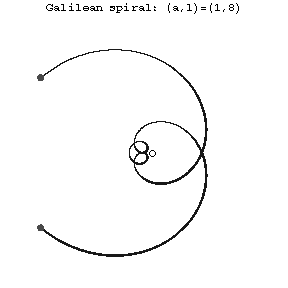
The spiral is symmetric with respect to the polar axis (see Fig.) and has a double point at the pole with tangents forming angles equal to $\pm\sqrt{l/a}$ with the polar axis.
<img style="border:1px solid;" src="https://www.encyclopediaofmath.org/legacyimages/common_img/g043080a.gif" />
Figure: g043080a
The polar axis of a Galilean spiral contains infinitely many double points, for which $\rho=ak^2\pi^2-l$, where $k=1,2,\ldots$. The Galilean spiral is a so-called algebraic spiral (cf. Spirals). Named after G. Galilei (1683) in connection with his studies on the free fall of solids.
References
| [1] | A.A. Savelov, "Planar curves" , Moscow (1960) (In Russian) |
 |  |