Hardy classes
<img align="absmiddle" border="0" src="https://www.encyclopediaofmath.org/legacyimages/h/h046/h046320/h0463201.png" />, <img align="absmiddle" border="0" src="https://www.encyclopediaofmath.org/legacyimages/h/h046/h046320/h0463202.png" />
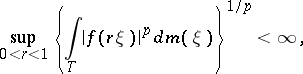
Classes of analytic functions <img align="absmiddle" border="0" src="https://www.encyclopediaofmath.org/legacyimages/h/h046/h046320/h0463203.png" /> in the disc <img align="absmiddle" border="0" src="https://www.encyclopediaofmath.org/legacyimages/h/h046/h046320/h0463204.png" /> for which
| <img align="absmiddle" border="0" src="https://www.encyclopediaofmath.org/legacyimages/h/h046/h046320/h0463205.png" /> | (*) |
where <img align="absmiddle" border="0" src="https://www.encyclopediaofmath.org/legacyimages/h/h046/h046320/h0463206.png" /> is the normalized Lebesgue measure on the circle <img align="absmiddle" border="0" src="https://www.encyclopediaofmath.org/legacyimages/h/h046/h046320/h0463207.png" />; this is equivalent to the condition that the subharmonic function <img align="absmiddle" border="0" src="https://www.encyclopediaofmath.org/legacyimages/h/h046/h046320/h0463208.png" /> has a harmonic majorant in <img align="absmiddle" border="0" src="https://www.encyclopediaofmath.org/legacyimages/h/h046/h046320/h0463209.png" />. Among the Hardy classes one also reckons the class <img align="absmiddle" border="0" src="https://www.encyclopediaofmath.org/legacyimages/h/h046/h046320/h04632010.png" /> of bounded analytic functions in <img align="absmiddle" border="0" src="https://www.encyclopediaofmath.org/legacyimages/h/h046/h046320/h04632011.png" />. The Hardy classes, which were introduced by F. Riesz in [1] and named by him in honour of G.H. Hardy, who first studied properties of <img align="absmiddle" border="0" src="https://www.encyclopediaofmath.org/legacyimages/h/h046/h046320/h04632012.png" />-means under the condition (*), play an important role in various problems of boundary properties of functions, in harmonic analysis, in the theory of power series, linear operators, random processes, and in the theory of extremal and approximation problems.
For any <img align="absmiddle" border="0" src="https://www.encyclopediaofmath.org/legacyimages/h/h046/h046320/h04632013.png" /> the inclusions <img align="absmiddle" border="0" src="https://www.encyclopediaofmath.org/legacyimages/h/h046/h046320/h04632014.png" /> are strict, where <img align="absmiddle" border="0" src="https://www.encyclopediaofmath.org/legacyimages/h/h046/h046320/h04632015.png" /> is the Nevanlinna class of functions of bounded characteristic (cf. Function of bounded characteristic); in particular, the functions of the Hardy classes have almost-everywhere on <img align="absmiddle" border="0" src="https://www.encyclopediaofmath.org/legacyimages/h/h046/h046320/h04632016.png" /> angular boundary values (cf. Angular boundary value) <img align="absmiddle" border="0" src="https://www.encyclopediaofmath.org/legacyimages/h/h046/h046320/h04632017.png" />, from which the original functions <img align="absmiddle" border="0" src="https://www.encyclopediaofmath.org/legacyimages/h/h046/h046320/h04632018.png" /> in <img align="absmiddle" border="0" src="https://www.encyclopediaofmath.org/legacyimages/h/h046/h046320/h04632019.png" /> can be uniquely recovered. If <img align="absmiddle" border="0" src="https://www.encyclopediaofmath.org/legacyimages/h/h046/h046320/h04632020.png" />, then <img align="absmiddle" border="0" src="https://www.encyclopediaofmath.org/legacyimages/h/h046/h046320/h04632021.png" /> (the converse is not true for an arbitrary analytic function <img align="absmiddle" border="0" src="https://www.encyclopediaofmath.org/legacyimages/h/h046/h046320/h04632022.png" />), and
| <img align="absmiddle" border="0" src="https://www.encyclopediaofmath.org/legacyimages/h/h046/h046320/h04632023.png" /> |
The classes <img align="absmiddle" border="0" src="https://www.encyclopediaofmath.org/legacyimages/h/h046/h046320/h04632024.png" />, <img align="absmiddle" border="0" src="https://www.encyclopediaofmath.org/legacyimages/h/h046/h046320/h04632025.png" />, are precisely the classes of analytic functions <img align="absmiddle" border="0" src="https://www.encyclopediaofmath.org/legacyimages/h/h046/h046320/h04632026.png" /> in <img align="absmiddle" border="0" src="https://www.encyclopediaofmath.org/legacyimages/h/h046/h046320/h04632027.png" /> that have boundary values <img align="absmiddle" border="0" src="https://www.encyclopediaofmath.org/legacyimages/h/h046/h046320/h04632028.png" /> and that can be recovered from them by means of the Cauchy integral. But functions that can be represented in <img align="absmiddle" border="0" src="https://www.encyclopediaofmath.org/legacyimages/h/h046/h046320/h04632029.png" /> by an integral of Cauchy or Cauchy–Stieltjes type belong, generally speaking, only to the classes <img align="absmiddle" border="0" src="https://www.encyclopediaofmath.org/legacyimages/h/h046/h046320/h04632030.png" />, <img align="absmiddle" border="0" src="https://www.encyclopediaofmath.org/legacyimages/h/h046/h046320/h04632031.png" /> (the converse is not true). Univalent functions in <img align="absmiddle" border="0" src="https://www.encyclopediaofmath.org/legacyimages/h/h046/h046320/h04632032.png" /> belong to all the classes <img align="absmiddle" border="0" src="https://www.encyclopediaofmath.org/legacyimages/h/h046/h046320/h04632033.png" />, <img align="absmiddle" border="0" src="https://www.encyclopediaofmath.org/legacyimages/h/h046/h046320/h04632034.png" />. The condition <img align="absmiddle" border="0" src="https://www.encyclopediaofmath.org/legacyimages/h/h046/h046320/h04632035.png" /> is necessary and sufficient for an analytic function <img align="absmiddle" border="0" src="https://www.encyclopediaofmath.org/legacyimages/h/h046/h046320/h04632036.png" /> to be continuous in <img align="absmiddle" border="0" src="https://www.encyclopediaofmath.org/legacyimages/h/h046/h046320/h04632037.png" /> and absolutely continuous on <img align="absmiddle" border="0" src="https://www.encyclopediaofmath.org/legacyimages/h/h046/h046320/h04632038.png" />. If <img align="absmiddle" border="0" src="https://www.encyclopediaofmath.org/legacyimages/h/h046/h046320/h04632039.png" /> maps the disc <img align="absmiddle" border="0" src="https://www.encyclopediaofmath.org/legacyimages/h/h046/h046320/h04632040.png" /> conformally onto a Jordan domain <img align="absmiddle" border="0" src="https://www.encyclopediaofmath.org/legacyimages/h/h046/h046320/h04632041.png" />, then the condition <img align="absmiddle" border="0" src="https://www.encyclopediaofmath.org/legacyimages/h/h046/h046320/h04632042.png" /> is equivalent to the contour <img align="absmiddle" border="0" src="https://www.encyclopediaofmath.org/legacyimages/h/h046/h046320/h04632043.png" /> being rectifiable (see [2], [5]).
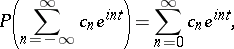
The existence of a one-to-one correspondence between the functions of Hardy classes and their boundary values makes it possible to regard, when this is convenient, functions <img align="absmiddle" border="0" src="https://www.encyclopediaofmath.org/legacyimages/h/h046/h046320/h04632044.png" /> as functions on <img align="absmiddle" border="0" src="https://www.encyclopediaofmath.org/legacyimages/h/h046/h046320/h04632045.png" />, and then the classes <img align="absmiddle" border="0" src="https://www.encyclopediaofmath.org/legacyimages/h/h046/h046320/h04632046.png" /> become closed subspaces of the Banach spaces <img align="absmiddle" border="0" src="https://www.encyclopediaofmath.org/legacyimages/h/h046/h046320/h04632047.png" /> (these are complete linear metric spaces if <img align="absmiddle" border="0" src="https://www.encyclopediaofmath.org/legacyimages/h/h046/h046320/h04632048.png" />). For <img align="absmiddle" border="0" src="https://www.encyclopediaofmath.org/legacyimages/h/h046/h046320/h04632049.png" /> these subspaces coincide with the closures in <img align="absmiddle" border="0" src="https://www.encyclopediaofmath.org/legacyimages/h/h046/h046320/h04632050.png" /> of the polynomials in <img align="absmiddle" border="0" src="https://www.encyclopediaofmath.org/legacyimages/h/h046/h046320/h04632051.png" />, and for <img align="absmiddle" border="0" src="https://www.encyclopediaofmath.org/legacyimages/h/h046/h046320/h04632052.png" /> with the collections of those functions in <img align="absmiddle" border="0" src="https://www.encyclopediaofmath.org/legacyimages/h/h046/h046320/h04632053.png" /> with vanishing Fourier coefficients of negative indices. The M. Riesz theorem asserts that the mapping <img align="absmiddle" border="0" src="https://www.encyclopediaofmath.org/legacyimages/h/h046/h046320/h04632054.png" /> that can be expressed in terms of Fourier series by
| <img align="absmiddle" border="0" src="https://www.encyclopediaofmath.org/legacyimages/h/h046/h046320/h04632055.png" /> |
is a bounded projection of the Banach space <img align="absmiddle" border="0" src="https://www.encyclopediaofmath.org/legacyimages/h/h046/h046320/h04632056.png" /> onto <img align="absmiddle" border="0" src="https://www.encyclopediaofmath.org/legacyimages/h/h046/h046320/h04632057.png" /> for every <img align="absmiddle" border="0" src="https://www.encyclopediaofmath.org/legacyimages/h/h046/h046320/h04632058.png" />, but not for <img align="absmiddle" border="0" src="https://www.encyclopediaofmath.org/legacyimages/h/h046/h046320/h04632059.png" /> or <img align="absmiddle" border="0" src="https://www.encyclopediaofmath.org/legacyimages/h/h046/h046320/h04632060.png" />. This implies that the real spaces <img align="absmiddle" border="0" src="https://www.encyclopediaofmath.org/legacyimages/h/h046/h046320/h04632061.png" /> and <img align="absmiddle" border="0" src="https://www.encyclopediaofmath.org/legacyimages/h/h046/h046320/h04632062.png" />, <img align="absmiddle" border="0" src="https://www.encyclopediaofmath.org/legacyimages/h/h046/h046320/h04632063.png" />, are the same; for other values of <img align="absmiddle" border="0" src="https://www.encyclopediaofmath.org/legacyimages/h/h046/h046320/h04632064.png" /> these spaces are essentially distinct, both in their approximation characteristics, in the structure of the dual spaces and (for <img align="absmiddle" border="0" src="https://www.encyclopediaofmath.org/legacyimages/h/h046/h046320/h04632065.png" />) in relation to the properties of the Fourier coefficients (see [7], [9]).
The zero sets <img align="absmiddle" border="0" src="https://www.encyclopediaofmath.org/legacyimages/h/h046/h046320/h04632066.png" /> of non-trivial functions of the Hardy classes are completely characterized by the condition <img align="absmiddle" border="0" src="https://www.encyclopediaofmath.org/legacyimages/h/h046/h046320/h04632067.png" />, which guarantees the uniform convergence on compacta inside <img align="absmiddle" border="0" src="https://www.encyclopediaofmath.org/legacyimages/h/h046/h046320/h04632068.png" /> of a canonical Blaschke product
| <img align="absmiddle" border="0" src="https://www.encyclopediaofmath.org/legacyimages/h/h046/h046320/h04632069.png" /> |
For every function <img align="absmiddle" border="0" src="https://www.encyclopediaofmath.org/legacyimages/h/h046/h046320/h04632070.png" />, <img align="absmiddle" border="0" src="https://www.encyclopediaofmath.org/legacyimages/h/h046/h046320/h04632071.png" />, <img align="absmiddle" border="0" src="https://www.encyclopediaofmath.org/legacyimages/h/h046/h046320/h04632072.png" />, there is an F. Riesz factorization <img align="absmiddle" border="0" src="https://www.encyclopediaofmath.org/legacyimages/h/h046/h046320/h04632073.png" />, where <img align="absmiddle" border="0" src="https://www.encyclopediaofmath.org/legacyimages/h/h046/h046320/h04632074.png" /> is the Blaschke product constructed from the zeros of <img align="absmiddle" border="0" src="https://www.encyclopediaofmath.org/legacyimages/h/h046/h046320/h04632075.png" />, <img align="absmiddle" border="0" src="https://www.encyclopediaofmath.org/legacyimages/h/h046/h046320/h04632076.png" /> and <img align="absmiddle" border="0" src="https://www.encyclopediaofmath.org/legacyimages/h/h046/h046320/h04632077.png" /> in <img align="absmiddle" border="0" src="https://www.encyclopediaofmath.org/legacyimages/h/h046/h046320/h04632078.png" />. The function <img align="absmiddle" border="0" src="https://www.encyclopediaofmath.org/legacyimages/h/h046/h046320/h04632079.png" />, in turn, decomposes into the product <img align="absmiddle" border="0" src="https://www.encyclopediaofmath.org/legacyimages/h/h046/h046320/h04632080.png" /> of the outer function
| <img align="absmiddle" border="0" src="https://www.encyclopediaofmath.org/legacyimages/h/h046/h046320/h04632081.png" /> |
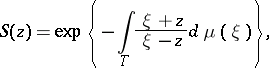
and the singular inner function
| <img align="absmiddle" border="0" src="https://www.encyclopediaofmath.org/legacyimages/h/h046/h046320/h04632082.png" /> |
where <img align="absmiddle" border="0" src="https://www.encyclopediaofmath.org/legacyimages/h/h046/h046320/h04632083.png" />, <img align="absmiddle" border="0" src="https://www.encyclopediaofmath.org/legacyimages/h/h046/h046320/h04632084.png" /> and <img align="absmiddle" border="0" src="https://www.encyclopediaofmath.org/legacyimages/h/h046/h046320/h04632085.png" /> is a non-negative singular measure on <img align="absmiddle" border="0" src="https://www.encyclopediaofmath.org/legacyimages/h/h046/h046320/h04632086.png" />. The conditions
| <img align="absmiddle" border="0" src="https://www.encyclopediaofmath.org/legacyimages/h/h046/h046320/h04632087.png" /> |
are equivalent, and <img align="absmiddle" border="0" src="https://www.encyclopediaofmath.org/legacyimages/h/h046/h046320/h04632088.png" /> almost-everywhere on <img align="absmiddle" border="0" src="https://www.encyclopediaofmath.org/legacyimages/h/h046/h046320/h04632089.png" />. Functions <img align="absmiddle" border="0" src="https://www.encyclopediaofmath.org/legacyimages/h/h046/h046320/h04632090.png" /> of the form <img align="absmiddle" border="0" src="https://www.encyclopediaofmath.org/legacyimages/h/h046/h046320/h04632091.png" /> are called inner functions; they are completely characterized by the conditions <img align="absmiddle" border="0" src="https://www.encyclopediaofmath.org/legacyimages/h/h046/h046320/h04632092.png" /> in <img align="absmiddle" border="0" src="https://www.encyclopediaofmath.org/legacyimages/h/h046/h046320/h04632093.png" /> and <img align="absmiddle" border="0" src="https://www.encyclopediaofmath.org/legacyimages/h/h046/h046320/h04632094.png" /> almost-everywhere on <img align="absmiddle" border="0" src="https://www.encyclopediaofmath.org/legacyimages/h/h046/h046320/h04632095.png" />. Frequently one uses the decomposition <img align="absmiddle" border="0" src="https://www.encyclopediaofmath.org/legacyimages/h/h046/h046320/h04632096.png" /> of an arbitrary function <img align="absmiddle" border="0" src="https://www.encyclopediaofmath.org/legacyimages/h/h046/h046320/h04632097.png" /> into the product of two functions in <img align="absmiddle" border="0" src="https://www.encyclopediaofmath.org/legacyimages/h/h046/h046320/h04632098.png" /> (see [4], [5]).
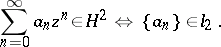
The class <img align="absmiddle" border="0" src="https://www.encyclopediaofmath.org/legacyimages/h/h046/h046320/h04632099.png" /> occupies a special place among the Hardy classes, since it is a Hilbert space with a reproducing kernel and has a simple description in terms of the Taylor coefficients:
| <img align="absmiddle" border="0" src="https://www.encyclopediaofmath.org/legacyimages/h/h046/h046320/h046320100.png" /> |
The study of the operator of multiplication by <img align="absmiddle" border="0" src="https://www.encyclopediaofmath.org/legacyimages/h/h046/h046320/h046320101.png" />, or the shift operator, in <img align="absmiddle" border="0" src="https://www.encyclopediaofmath.org/legacyimages/h/h046/h046320/h046320102.png" /> has played an important role; it turned out that all invariant subspaces of this operator are generated by inner functions <img align="absmiddle" border="0" src="https://www.encyclopediaofmath.org/legacyimages/h/h046/h046320/h046320103.png" />, that is, are of the form <img align="absmiddle" border="0" src="https://www.encyclopediaofmath.org/legacyimages/h/h046/h046320/h046320104.png" /> (see [4]).
Under pointwise multiplication and the <img align="absmiddle" border="0" src="https://www.encyclopediaofmath.org/legacyimages/h/h046/h046320/h046320105.png" />-norm the class <img align="absmiddle" border="0" src="https://www.encyclopediaofmath.org/legacyimages/h/h046/h046320/h046320106.png" /> is a Banach algebra and the space of maximal ideals <img align="absmiddle" border="0" src="https://www.encyclopediaofmath.org/legacyimages/h/h046/h046320/h046320107.png" /> and the Shilov boundary have a very complicated structure (see [4]); the problem of the density of the ideals <img align="absmiddle" border="0" src="https://www.encyclopediaofmath.org/legacyimages/h/h046/h046320/h046320108.png" />, <img align="absmiddle" border="0" src="https://www.encyclopediaofmath.org/legacyimages/h/h046/h046320/h046320109.png" />, in the space <img align="absmiddle" border="0" src="https://www.encyclopediaofmath.org/legacyimages/h/h046/h046320/h046320110.png" /> with the usual Gel'fand topology (the so-called Corona problem) was solved affirmatively on the basis of a description of the universal interpolation sequences, that is, sequences <img align="absmiddle" border="0" src="https://www.encyclopediaofmath.org/legacyimages/h/h046/h046320/h046320111.png" />, <img align="absmiddle" border="0" src="https://www.encyclopediaofmath.org/legacyimages/h/h046/h046320/h046320112.png" />, such that <img align="absmiddle" border="0" src="https://www.encyclopediaofmath.org/legacyimages/h/h046/h046320/h046320113.png" /> (see [5], [9]).
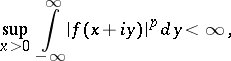
The Hardy classes <img align="absmiddle" border="0" src="https://www.encyclopediaofmath.org/legacyimages/h/h046/h046320/h046320114.png" />, <img align="absmiddle" border="0" src="https://www.encyclopediaofmath.org/legacyimages/h/h046/h046320/h046320115.png" />, of analytic functions <img align="absmiddle" border="0" src="https://www.encyclopediaofmath.org/legacyimages/h/h046/h046320/h046320116.png" /> in domains <img align="absmiddle" border="0" src="https://www.encyclopediaofmath.org/legacyimages/h/h046/h046320/h046320117.png" /> other than the disc can be defined (non-equivalently, in general) by starting out either from the condition that the functions <img align="absmiddle" border="0" src="https://www.encyclopediaofmath.org/legacyimages/h/h046/h046320/h046320118.png" /> have harmonic majorants in <img align="absmiddle" border="0" src="https://www.encyclopediaofmath.org/legacyimages/h/h046/h046320/h046320119.png" /> or from the condition of boundedness of the integrals <img align="absmiddle" border="0" src="https://www.encyclopediaofmath.org/legacyimages/h/h046/h046320/h046320120.png" /> over families of contours <img align="absmiddle" border="0" src="https://www.encyclopediaofmath.org/legacyimages/h/h046/h046320/h046320121.png" />, <img align="absmiddle" border="0" src="https://www.encyclopediaofmath.org/legacyimages/h/h046/h046320/h046320122.png" />, that in a certain sense approximate the boundary of <img align="absmiddle" border="0" src="https://www.encyclopediaofmath.org/legacyimages/h/h046/h046320/h046320123.png" />. The first method also makes it possible to define Hardy classes on Riemann surfaces. The second method leads to classes that are better adapted for the solution of extremal and approximation problems; in the case of Jordan domains <img align="absmiddle" border="0" src="https://www.encyclopediaofmath.org/legacyimages/h/h046/h046320/h046320124.png" /> with a rectifiable boundary the latter classes are called Smirnov classes and are denoted by <img align="absmiddle" border="0" src="https://www.encyclopediaofmath.org/legacyimages/h/h046/h046320/h046320126.png" /> (see [2] and Smirnov class). For a half-plane, for example <img align="absmiddle" border="0" src="https://www.encyclopediaofmath.org/legacyimages/h/h046/h046320/h046320127.png" />, the classes <img align="absmiddle" border="0" src="https://www.encyclopediaofmath.org/legacyimages/h/h046/h046320/h046320128.png" />, <img align="absmiddle" border="0" src="https://www.encyclopediaofmath.org/legacyimages/h/h046/h046320/h046320129.png" />, defined by the condition
| <img align="absmiddle" border="0" src="https://www.encyclopediaofmath.org/legacyimages/h/h046/h046320/h046320130.png" /> |
are closely related in their properties to the Hardy classes for the disc, however, their applications in harmonic analysis are connected not with the theory of Fourier series, but with Fourier transforms.
The Hardy classes of analytic functions <img align="absmiddle" border="0" src="https://www.encyclopediaofmath.org/legacyimages/h/h046/h046320/h046320131.png" /> in the unit ball <img align="absmiddle" border="0" src="https://www.encyclopediaofmath.org/legacyimages/h/h046/h046320/h046320132.png" /> and the unit polydisc <img align="absmiddle" border="0" src="https://www.encyclopediaofmath.org/legacyimages/h/h046/h046320/h046320133.png" /> of the space <img align="absmiddle" border="0" src="https://www.encyclopediaofmath.org/legacyimages/h/h046/h046320/h046320134.png" /> are defined by the condition (*), where the circle <img align="absmiddle" border="0" src="https://www.encyclopediaofmath.org/legacyimages/h/h046/h046320/h046320135.png" /> is replaced by the sphere <img align="absmiddle" border="0" src="https://www.encyclopediaofmath.org/legacyimages/h/h046/h046320/h046320136.png" /> or the distinguished boundary <img align="absmiddle" border="0" src="https://www.encyclopediaofmath.org/legacyimages/h/h046/h046320/h046320137.png" /> of the polydisc. The specific nature of the higher-dimensional case becomes manifest, first of all, in the absence of a simple characterization of the zero sets and of a factorization of functions in the Hardy classes (see [6], [10]). Hardy classes can also be defined in various ways for other domains in <img align="absmiddle" border="0" src="https://www.encyclopediaofmath.org/legacyimages/h/h046/h046320/h046320138.png" /> (see [10]).
The higher-dimensional analogues of the Hardy classes (see [3]) are the so-called Hardy spaces, that is, spaces <img align="absmiddle" border="0" src="https://www.encyclopediaofmath.org/legacyimages/h/h046/h046320/h046320139.png" />, <img align="absmiddle" border="0" src="https://www.encyclopediaofmath.org/legacyimages/h/h046/h046320/h046320140.png" />, of Riesz systems: real-valued vector functions <img align="absmiddle" border="0" src="https://www.encyclopediaofmath.org/legacyimages/h/h046/h046320/h046320141.png" />, <img align="absmiddle" border="0" src="https://www.encyclopediaofmath.org/legacyimages/h/h046/h046320/h046320142.png" />, <img align="absmiddle" border="0" src="https://www.encyclopediaofmath.org/legacyimages/h/h046/h046320/h046320143.png" />, satisfying the generalized Cauchy–Riemann conditions
| <img align="absmiddle" border="0" src="https://www.encyclopediaofmath.org/legacyimages/h/h046/h046320/h046320144.png" /> |
for which
| <img align="absmiddle" border="0" src="https://www.encyclopediaofmath.org/legacyimages/h/h046/h046320/h046320145.png" /> |
The definition of these spaces can also be given in terms of only the "real parts" <img align="absmiddle" border="0" src="https://www.encyclopediaofmath.org/legacyimages/h/h046/h046320/h046320146.png" /> of the systems <img align="absmiddle" border="0" src="https://www.encyclopediaofmath.org/legacyimages/h/h046/h046320/h046320147.png" /> by requiring that the function <img align="absmiddle" border="0" src="https://www.encyclopediaofmath.org/legacyimages/h/h046/h046320/h046320148.png" /> be harmonic and that its maximal function
| <img align="absmiddle" border="0" src="https://www.encyclopediaofmath.org/legacyimages/h/h046/h046320/h046320149.png" /> |
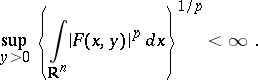
There are other characterizations of real-variable <img align="absmiddle" border="0" src="https://www.encyclopediaofmath.org/legacyimages/h/h046/h046320/h046320150.png" /> spaces. <img align="absmiddle" border="0" src="https://www.encyclopediaofmath.org/legacyimages/h/h046/h046320/h046320151.png" /> spaces can also be defined on homogeneous groups, i.e. Lie groups with underlying manifold <img align="absmiddle" border="0" src="https://www.encyclopediaofmath.org/legacyimages/h/h046/h046320/h046320152.png" /> and dilations <img align="absmiddle" border="0" src="https://www.encyclopediaofmath.org/legacyimages/h/h046/h046320/h046320153.png" /> (see [11]).
For <img align="absmiddle" border="0" src="https://www.encyclopediaofmath.org/legacyimages/h/h046/h046320/h046320154.png" /> the transition from the function <img align="absmiddle" border="0" src="https://www.encyclopediaofmath.org/legacyimages/h/h046/h046320/h046320155.png" /> to its boundary values yields an identification of the spaces <img align="absmiddle" border="0" src="https://www.encyclopediaofmath.org/legacyimages/h/h046/h046320/h046320156.png" /> and <img align="absmiddle" border="0" src="https://www.encyclopediaofmath.org/legacyimages/h/h046/h046320/h046320157.png" />; therefore, of interest is only the case <img align="absmiddle" border="0" src="https://www.encyclopediaofmath.org/legacyimages/h/h046/h046320/h046320158.png" />. It was just within the framework of the spaces <img align="absmiddle" border="0" src="https://www.encyclopediaofmath.org/legacyimages/h/h046/h046320/h046320159.png" /> that fundamental results of the theory of Hardy classes such as the realization of the dual space <img align="absmiddle" border="0" src="https://www.encyclopediaofmath.org/legacyimages/h/h046/h046320/h046320160.png" /> as the space of functions of bounded mean oscillation (see [8], [9]) and the atomic decomposition of the classes <img align="absmiddle" border="0" src="https://www.encyclopediaofmath.org/legacyimages/h/h046/h046320/h046320161.png" />, <img align="absmiddle" border="0" src="https://www.encyclopediaofmath.org/legacyimages/h/h046/h046320/h046320162.png" /> (see [7]), were first established. The characterization of Hardy classes in terms of the maximal function requires in a number of cases a recourse to probability concepts connected with Brownian motion (see [8]).
Abstract Hardy classes arise in the theory of uniform algebras (cf. Uniform algebra) and are not directly connected with analytic functions. Let a closed algebra <img align="absmiddle" border="0" src="https://www.encyclopediaofmath.org/legacyimages/h/h046/h046320/h046320163.png" /> of continuous functions on a compact set <img align="absmiddle" border="0" src="https://www.encyclopediaofmath.org/legacyimages/h/h046/h046320/h046320164.png" /> and a certain homomorphism <img align="absmiddle" border="0" src="https://www.encyclopediaofmath.org/legacyimages/h/h046/h046320/h046320165.png" /> be fixed; there exists a positive measure <img align="absmiddle" border="0" src="https://www.encyclopediaofmath.org/legacyimages/h/h046/h046320/h046320166.png" /> on <img align="absmiddle" border="0" src="https://www.encyclopediaofmath.org/legacyimages/h/h046/h046320/h046320167.png" /> representing <img align="absmiddle" border="0" src="https://www.encyclopediaofmath.org/legacyimages/h/h046/h046320/h046320168.png" />: <img align="absmiddle" border="0" src="https://www.encyclopediaofmath.org/legacyimages/h/h046/h046320/h046320169.png" />, <img align="absmiddle" border="0" src="https://www.encyclopediaofmath.org/legacyimages/h/h046/h046320/h046320170.png" />. By definition, the classes <img align="absmiddle" border="0" src="https://www.encyclopediaofmath.org/legacyimages/h/h046/h046320/h046320171.png" />, <img align="absmiddle" border="0" src="https://www.encyclopediaofmath.org/legacyimages/h/h046/h046320/h046320172.png" />, are the closures (the weak closure for <img align="absmiddle" border="0" src="https://www.encyclopediaofmath.org/legacyimages/h/h046/h046320/h046320173.png" />) of the algebra <img align="absmiddle" border="0" src="https://www.encyclopediaofmath.org/legacyimages/h/h046/h046320/h046320174.png" /> in the spaces <img align="absmiddle" border="0" src="https://www.encyclopediaofmath.org/legacyimages/h/h046/h046320/h046320175.png" />; the study of the classes <img align="absmiddle" border="0" src="https://www.encyclopediaofmath.org/legacyimages/h/h046/h046320/h046320176.png" /> makes it possible to obtain additional information on <img align="absmiddle" border="0" src="https://www.encyclopediaofmath.org/legacyimages/h/h046/h046320/h046320177.png" /> (see [12]).
References
| [1] | F. Riesz, "Ueber die Randwerte einer analytischen Funktion" Math. Z. , 18 (1923) pp. 87–95 |
| [2] | I.I. [I.I. Privalov] Priwalow, "Randeigenschaften analytischer Funktionen" , Deutsch. Verlag Wissenschaft. (1956) (Translated from Russian) |
| [3] | E. Stein, G. Weiss, "On the theory of harmonic functions of several variables" Acta Math. , 103 (1960) pp. 25–62 |
| [4] | K. Hoffman, "Banach spaces of analytic functions" , Prentice-Hall (1962) |
| [5] | P.L. Duren, "Theory of <img align="absmiddle" border="0" src="https://www.encyclopediaofmath.org/legacyimages/h/h046/h046320/h046320178.png" /> spaces" , Acad. Press (1970) |
| [6] | W. Rudin, "Function theory in polydiscs" , Benjamin (1969) |
| [7] | R.R. Coifman, G. Weiss, "Extensions of Hardy spaces and their use in analysis" Bull. Amer. Math. Soc. , 83 : 4 (1977) pp. 569–645 |
| [8] | K.E. Petersen, "Brownian motion, Hardy spaces, and bounded mean oscillation" , Cambridge Univ. Press (1977) |
| [9] | P. Koosis, "Introduction to <img align="absmiddle" border="0" src="https://www.encyclopediaofmath.org/legacyimages/h/h046/h046320/h046320179.png" />-spaces. With an appendix on Wolff's proof of the corona theorem" , Cambridge Univ. Press (1980) |
| [10] | W. Rudin, "Function theory in the unit ball in <img align="absmiddle" border="0" src="https://www.encyclopediaofmath.org/legacyimages/h/h046/h046320/h046320180.png" />" , Springer (1980) |
| [11] | G.B. Folland, E.M. Stein, "Hardy spaces on homogeneous groups" , Princeton Univ. Press (1982) |
| [12] | T.W. Gamelin, "Uniform algebras" , Prentice-Hall (1969) |
Comments
The result concerning the shift operator is commonly known as Beurling's theorem. The indicated solution of the corona problem in this article is due to L. Carleson. There is another, more recent, proof by T. Wolff based on the existence of good solutions of the inhomogeneous Cauchy–Riemann equations. The result about the dual of <img align="absmiddle" border="0" src="https://www.encyclopediaofmath.org/legacyimages/h/h046/h046320/h046320181.png" /> being BMO, the functions of bounded mean oscillation, is due to C. Fefferman. It is usually stated for <img align="absmiddle" border="0" src="https://www.encyclopediaofmath.org/legacyimages/h/h046/h046320/h046320182.png" />, because otherwise one has to introduce an unusual complex multiplication on real BMO, see [a1].
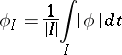
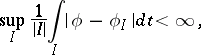
A measurable <img align="absmiddle" border="0" src="https://www.encyclopediaofmath.org/legacyimages/h/h046/h046320/h046320183.png" /> on <img align="absmiddle" border="0" src="https://www.encyclopediaofmath.org/legacyimages/h/h046/h046320/h046320184.png" /> is called a BMO-function, or function of class BMO, if <img align="absmiddle" border="0" src="https://www.encyclopediaofmath.org/legacyimages/h/h046/h046320/h046320185.png" /> is locally integrable (i.e. <img align="absmiddle" border="0" src="https://www.encyclopediaofmath.org/legacyimages/h/h046/h046320/h046320186.png" /> is integrable over any compact subset) and if, putting
| <img align="absmiddle" border="0" src="https://www.encyclopediaofmath.org/legacyimages/h/h046/h046320/h046320187.png" /> |
(the average of <img align="absmiddle" border="0" src="https://www.encyclopediaofmath.org/legacyimages/h/h046/h046320/h046320188.png" /> over the bounded interval <img align="absmiddle" border="0" src="https://www.encyclopediaofmath.org/legacyimages/h/h046/h046320/h046320189.png" />), one has
| <img align="absmiddle" border="0" src="https://www.encyclopediaofmath.org/legacyimages/h/h046/h046320/h046320190.png" /> |
where the supremum is over all bounded intervals <img align="absmiddle" border="0" src="https://www.encyclopediaofmath.org/legacyimages/h/h046/h046320/h046320191.png" />.
There are BMO-spaces on other domains, e.g. the unit circle <img align="absmiddle" border="0" src="https://www.encyclopediaofmath.org/legacyimages/h/h046/h046320/h046320192.png" /> (<img align="absmiddle" border="0" src="https://www.encyclopediaofmath.org/legacyimages/h/h046/h046320/h046320193.png" /> an arc, integration with respect to Lebesgue (or Haar) measure).
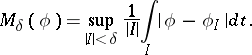
An important subclass is the class of VMO-functions, the class of functions of vanishing mean oscillation. Let <img align="absmiddle" border="0" src="https://www.encyclopediaofmath.org/legacyimages/h/h046/h046320/h046320194.png" />, <img align="absmiddle" border="0" src="https://www.encyclopediaofmath.org/legacyimages/h/h046/h046320/h046320195.png" /> be as above. Write, for <img align="absmiddle" border="0" src="https://www.encyclopediaofmath.org/legacyimages/h/h046/h046320/h046320196.png" />,
| <img align="absmiddle" border="0" src="https://www.encyclopediaofmath.org/legacyimages/h/h046/h046320/h046320197.png" /> |
Then <img align="absmiddle" border="0" src="https://www.encyclopediaofmath.org/legacyimages/h/h046/h046320/h046320198.png" /> if <img align="absmiddle" border="0" src="https://www.encyclopediaofmath.org/legacyimages/h/h046/h046320/h046320199.png" /> and <img align="absmiddle" border="0" src="https://www.encyclopediaofmath.org/legacyimages/h/h046/h046320/h046320200.png" /> as <img align="absmiddle" border="0" src="https://www.encyclopediaofmath.org/legacyimages/h/h046/h046320/h046320201.png" />. (See [a1].)
For <img align="absmiddle" border="0" src="https://www.encyclopediaofmath.org/legacyimages/h/h046/h046320/h046320202.png" /> spaces of several variables see also [a2].
In addition to the numerous application areas already mentioned, the Hardy classes, especially <img align="absmiddle" border="0" src="https://www.encyclopediaofmath.org/legacyimages/h/h046/h046320/h046320203.png" />, are important in control theory, cf. <img align="absmiddle" border="0" src="https://www.encyclopediaofmath.org/legacyimages/h/h046/h046320/h046320204.png" /> control theory.
References
| [a1] | J.-B. Garnett, "Bounded analytic functions" , Acad. Press (1981) |
| [a2] | C. Fefferman, E.M. Stein, "<img align="absmiddle" border="0" src="https://www.encyclopediaofmath.org/legacyimages/h/h046/h046320/h046320205.png" /> spaces of several variables" Acta Math. , 129 (1972) pp. 137–193 |
 |  |