Integral exponential function
The special function defined for real $ x \neq 0 $ by the equation
$$
\mathop{\rm Ei} ( x) = \
\int\limits _ {- \infty } ^ { x }
\frac{e ^ {t} }{t}
d t = -
\int\limits _ { - x} ^ \infty
\frac{e ^ {-t} }{t}
d t .
$$
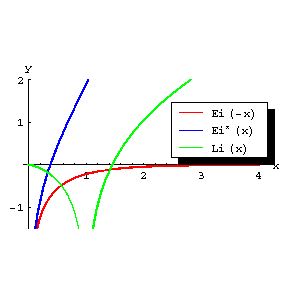
The graph of the integral exponential function is illustrated in Fig..
<img style="border:1px solid;" src="https://www.encyclopediaofmath.org/legacyimages/common_img/i051440a.gif" />
Figure: i051440a
Graphs of the functions $ y = \mathop{\rm Ei} ( - x ) $, $ y = \mathop{\rm Ei} ^ {*} ( x) $ and $ y = \mathop{\rm Li} ( x) $.
For $ x > 0 $, the function $ e ^ {t} / t $ has an infinite discontinuity at $ t = 0 $, and the integral exponential function is understood in the sense of the principal value of this integral:
$$
\mathop{\rm Ei} ( x) = \
\lim\limits _ {\epsilon \rightarrow + 0 } \ \left \{ \int\limits _ {- \infty } ^ \epsilon
\frac{e ^ {t} }{t}
d t +
\int\limits _ \epsilon ^ { x }
\frac{e ^ {t} }{t}
d t
\right \} . $$
The integral exponential function can be represented by the series
$$ \tag{1 }
\mathop{\rm Ei} ( x) = \
c + \mathop{\rm ln} ( - x ) + \sum_{k=1}^ \infty
\frac{x ^ {k} }{k!k}
,\ \
x < 0 , $$
and
$$ \tag{2 }
\mathop{\rm Ei} ( x)  =  c +
\mathop{\rm ln} ( x) +
\sum_{k=1}^ \infty
\frac{x ^ {k} }{k!k}
,\ \
x > 0 , $$
where $ c = 0.5772 \dots $ is the Euler constant.
There is an asymptotic representation:
$$
\mathop{\rm Ei} ( - x ) \approx \frac{e ^ {- x} }{x}
\left ( 1 - \frac{1!}{x} + \frac{2!} {x ^ {2} } - \frac{3!} {x ^ {3} } + \dots \right ) ,\ \ x \rightarrow + \infty . $$
As a function of the complex variable $ z $, the integral exponential function
$$
\mathop{\rm Ei} ( z) = \
C + \mathop{\rm ln} ( - z ) + \sum_{k=1}^ \infty
\frac{z ^ {k} }{k!k}
,\ \
| \mathop{\rm arg} ( - z ) | < \pi , $$
is a single-valued analytic function in the $ z $- plane slit along the positive real semi-axis $ ( 0 < \mathop{\rm arg} z < 2 \pi ) $; here the value of $ \mathop{\rm ln} ( - z) $ is chosen such that $ - \pi < { \mathop{\rm Im} \mathop{\rm ln} } (- z) < \pi $. The behaviour of $ \mathop{\rm Ei} ( z) $ close to the slit is described by the limiting relations:
$$ \left . \begin{array}{c} \lim\limits _ {\eta \downarrow 0 } \
\mathop{\rm Ei} ( z + i \eta )  = \
\mathop{\rm Ei} ( z) - i \pi ,  \\
\lim\limits _ {\eta \downarrow 0 } \
\mathop{\rm Ei} ( z - i \eta )  = \
\mathop{\rm Ei} ( z) + i \pi ,  \\
\end{array}
\right \} \ \
z = x + i y. $$
The asymptotic representation in the region $ 0 < \mathop{\rm arg} z < 2 \pi $ is:
$$
\mathop{\rm Ei} ( z) \sim \
\frac{e ^ {z} }{z}
\left ( \frac{1!}{z} + \frac{2!}{z ^ {2} } + \dots \frac{k!} {z ^ {k} } + \dots \right ) ,\ \ | z | \rightarrow \infty . $$
The integral exponential function is related to the integral logarithm $ \mathop{\rm li} ( x) $ by the formulas
$$
\mathop{\rm Ei} ( x)  = \
\mathop{\rm li} ( e  ^ {x} ) ,\ \
x < 0 , $$
$$
\mathop{\rm Ei} ( \mathop{\rm ln} x ) = \mathop{\rm li} ( x) ,\ x < 1 ;
$$
and to the integral sine $ \mathop{\rm Si} ( x) $ and the integral cosine $ \mathop{\rm Ci} ( x) $ by the formulas:
$$
\mathop{\rm Ei} ( \pm  i x )  = \
\mathop{\rm Ci} ( x) \pm  i  \mathop{\rm Si} ( x) \mps
\frac{\pi i }{2}
,\ \
x > 0 . $$
The differentiation formula is:
$$
\frac{d ^ {n} \mathop{\rm Ei} ( - x ) }{d x ^ {n} }
= \
( - 1 ) ^ {n-1} ( n - 1 ) ! x ^ {- x} e ^ {-x} e _ {n-1} ( x) ,\ \ n = 1 , 2 , . . . . $$
The following notations are sometimes used:
$$
\operatorname{\rm Ei}^+ ( z)  = \
\mathop{\rm Ei} ( z + i 0 ) ,\ \
\operatorname{\rm Ei}^- ( z)  = \
\mathop{\rm Ei} ( z - i 0 ) ,
$$
$$
\operatorname{\rm Ei} ^ {*} ( z) = { \mathop{\rm Ei} ( z) } bar = \mathop{\rm Ei} ( z) + \pi i .
$$
References
| [1] | H. Bateman (ed.) A. Erdélyi (ed.) et al. (ed.) , Higher transcendental functions , 2. Bessel functions, parabolic cylinder functions, orthogonal polynomials , McGraw-Hill (1953) |
| [2] | E. Jahnke, F. Emde, "Tables of functions with formulae and curves" , Dover, reprint (1945) (Translated from German) |
| [3] | A. Krazer, W. Franz, "Transzendente Funktionen" , Akademie Verlag (1960) |
| [4] | N.N. Lebedev, "Special functions and their applications" , Prentice-Hall (1965) (Translated from Russian) |
Comments
The function $\mathop{\rm Ei}$ is usually called the exponential integral.
Instead of by the series representation, for complex values of $ z $( $ x $ not positive real) the function $ \mathop{\rm Ei} ( z) $ can be defined by the integal (as for real $ x \neq 0 $); since the integrand is analytic, the integral is path-independent in $ \mathbf C \setminus \{ {x \in \mathbf R } : {x \geq 0 } \} $.
Formula (1) with $ x $ replaced by $ z $ then holds for $ | \mathop{\rm arg} ( - z ) | < \pi $, and the function defined by (2) (for $ x > 0 $) is also known as the modified exponential integral.
 | This file was uploaded by a maintenance script before the file upload log existed. Therefore, it may incorrectly attribute the owner of the image and will not have a normal file history. Further questions should be addressed to the Media Copyright Helpdesk. |
 |  |