Lituus
From HandWiki
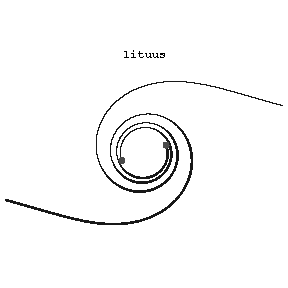
A plane transcendental curve whose equation in polar coordinates is
$$\rho=\frac{a}{\sqrt\phi}.$$
<img style="border:1px solid;" src="https://www.encyclopediaofmath.org/legacyimages/common_img/l059750a.gif" />
Figure: l059750a
To every value of $\phi$ correspond two values of $\rho$, one positive and one negative. The curve consists of two branches, that both approach the pole asymptotically (see Fig.). The line $\phi=0,\phi=\pi$ is an asymptote at $\rho=\pm\infty$, and $(1/2,a\sqrt2)$ and $(-1/2,-a\sqrt2)$ are points of inflection. The lituus is related to the so-called algebraic spirals.
References
| [1] | A.A. Savelov, "Planar curves" , Moscow (1960) (In Russian) |
Comments
References
| [a1] | K. Fladt, "Analytische Geometrie spezieller ebener Kurven" , Akad. Verlagsgesell. (1962) |
| [a2] | F. Gomes Teixeira, "Traité des courbes" , 1–3 , Chelsea, reprint (1971) |
 |  |