Organization:Barcelona Supercomputing Center
 | |
| Location | Barcelona, Spain |
|---|---|
| Coordinates | [ ⚑ ] : 41°23′22″N 2°6′58″E / 41.38944°N 2.11611°E |
| Website | https://www.bsc.es/ |
The Barcelona Supercomputing Center (Spanish: Centro Nacional de Supercomputación) is a public research center located in Barcelona, Catalonia, Spain. It hosts MareNostrum, a 13.7 Petaflops, Intel Xeon Platinum-based supercomputer, which also includes clusters of emerging technologies. In June 2017[update], it ranked 13th in the world.[1][2] As of November 2022[update], it dropped to 88th.[3] It is expected to host one of Europe's first quantum computers.[4]
Location and management
The Center is located in a former chapel named Torre Girona, at the Polytechnic University of Catalonia (UPC), and was established on April 1, 2005. It is managed by a consortium composed of the Spanish Ministry of Science and Innovation (60%), the Government of Catalonia (30%) and the UPC (10%). Professor Mateo Valero is its main administrator. The MareNostrum supercomputer is contained inside an enormous glass box in a former chapel.
Budget
The Barcelona Supercomputing Center had an initial operational budget of €5.5 million/year (about US$7 million/year) to cover the period of 2005–2011. The center has had a very rapid growth and in 2018 had a workforce of around 600 workers and an annual global budget of more than 34 million euros.[5]
The Center has contributed to the development of the IBM cell microprocessor architecture.[6]
-
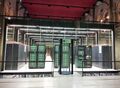 MareNostrum 4 supercomputer at Barcelona Supercomputing Center (2017)
 -
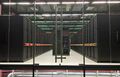 MareNostrum 4 supercomputer at Barcelona Supercomputing Center (2017)


Staff
- Director: Mateo Valero[7]
- Computer Sciences director: Jesús Labarta[8]
- Computer Sciences associate director: Eduard Ayguadé[9]
- Life Sciences director: Alfonso Valencia
- Earth Sciences director:[10]
- Computer Applications for Science and Engineering director: José María Cela[11]
Artificial intelligence and language technologies
The Barcelona Supercomputing Center has participated in the development of public artificial-intelligence infrastructure for Spanish and Spain's co-official languages. The ALIA initiative, launched under Spain's national artificial intelligence strategy, provides open language models and related resources for Spanish, Catalan, Valencian, Basque and Galician.[12]
The project uses the MareNostrum 5 supercomputer, located and managed by BSC, for training and deploying generative AI models.[13] In 2025, the Aina project announced the Salamandra family of models, developed by BSC, including 2B, 7B and 40B parameter versions. According to the project, Salamandra was trained from scratch using MareNostrum 5 and includes training data covering 35 European languages.[14]
A 2025 agreement published in the Boletín Oficial del Estado identified BSC-CNS as the beneficiary and coordinator of the ALIA project, whose work programme includes the development of high-quality corpora, foundation language models, evaluation datasets and secure training infrastructure for language technologies.[15]
BSC's Language Technologies Unit has published research on multilingual and translation-oriented language models, including the Salamandra and SalamandraTA model families.
In popular culture
The Barcelona Supercomputing Center appears in Dan Brown's 2017 science fiction mystery thriller novel Origin, as the home of the E-Wave device.
Notes
- ↑ "MareNostrum 4 begins operation" (in en). https://www.bsc.es/news/bsc-news/marenostrum-4-begins-operation.
- ↑ "Top500 List - Supercomputer Sites". https://www.top500.org/list/2017/06/.
- ↑ "TOP500 List - November 2022 | TOP500". https://www.top500.org/lists/top500/list/2022/11/.
- ↑ Granger, Gemma Garrido (2021-10-30). "Barcelona will be southern Europe's first quantum computing hub" (in en). https://en.ara.cat/society/barcelona-will-be-southern-europe-s-first-quantum-computing-hub_1_4166573.html.
- ↑ "BSC-CNS in Numbers". https://www.bsc.es/discover-bsc/the-centre/bsc-cns-in-numbers.
- ↑ "Barcelona Supercomputer Center (BSC)". Bsc.es. Archived from the original on 2007-03-08. https://web.archive.org/web/20070308121821/http://www.bsc.es/projects/deepcomputing/linuxoncell/. Retrieved 2011-09-03.
- ↑ "1. Summary" (in en). https://www.bsc.es/mateo-valero.
- ↑ "Jesús Labarta". Barcelona Supercomputing Center.
- ↑ "Eduard Ayguade home page (Technical University of Catalonia - Barcelona)". https://personals.ac.upc.edu/eduard/.
- ↑ "ICREA". https://www.icrea.cat/Web/ScientificStaff/francisco-javier-doblas-reyes-499.
- ↑ "José María Cela". Barcelona Supercomputing Center.
- ↑ "ALIA: The public AI infrastructure in Spanish and co-official languages". Government of Spain. https://alia.gob.es/eng.
- ↑ "ALIA: The public AI infrastructure in Spanish and co-official languages". Government of Spain. https://alia.gob.es/eng.
- ↑ "Introducing the Salamandra family of models". Aina Tech Project. 29 May 2025. https://projecteaina.cat/tech/en/introducing-the-salamandra-family-of-models/.
- ↑ "Resolución de 3 de junio de 2025, del Consorcio Barcelona Supercomputing Center-Centro Nacional de Supercomputación" (in es). 14 June 2025. https://www.boe.es/diario_boe/txt.php?id=BOE-A-2025-12053.
External links
 |  |


