Probability integral
error integral
The function
$$
\mathop{\rm erf} ( x) = \
\frac{2}{\sqrt \pi }
\int\limits _ { 0 } ^ { x } e ^ {- t ^ {2} } d t ,\ \ | x | < \infty . $$
In probability theory one mostly encounters not the probability integral, but the normal distribution function
$$ \Phi ( x) = \
\frac{1}{\sqrt {2 \pi } }
\int\limits _ {- \infty } ^ { x } e ^ {- t ^ {2} / 2 } d t = \frac{1}{2}
\left [ 1 + \mathop{\rm erf} \left ( \frac{x}{\sqrt 2 }
\right ) \right ] ,
$$
which is the so-called Gaussian probability integral. For a random variable $ X $ having the normal distribution with mathematical expectation 0 and variance $ \sigma ^ {2} $, the probability that $ | X | \leq t $ is equal to $ \mathop{\rm erf} ( t / \sqrt 2 ) $. For real $ x $, the probability integral takes real values; in particular,
$$
\mathop{\rm erf} ( 0) = 0 ,\ \
\lim\limits _ {x \rightarrow + \infty } \mathop{\rm erf} ( x) = 1 . $$
<img style="border:1px solid;" src="https://www.encyclopediaofmath.org/legacyimages/common_img/p074920a.gif" />
Figure: p074920a
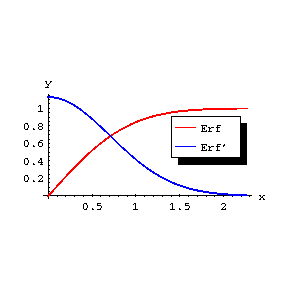
The graph of the probability integral and its derivatives are illustrated in the figure. Regarded as a function of the complex variable $ z $, the probability integral $ \mathop{\rm erf} ( z) $ is an entire function of $ z $.
The asymptotic representation for large $ z $, $ \mathop{\rm Re} z > 0 $, is given by:
$$ 1 - \mathop{\rm erf} ( z) \sim \
\frac{e ^ {- z ^ {2} } }{\sqrt {\pi z } }
\left ( 1 + \sum_{k=1} ^ \infty ( - 1 ) ^ {k}
\frac{1 \cdot 3 \dots ( 2 k - 1 ) }{2 ^ {k} }
\frac{1}{z ^ {2k} }
\right ) . $$
In a neighbourhood of $ z = 0 $ the probability integral can be represented by the series
$$
\mathop{\rm erf} ( z) = \
\frac{2}{\sqrt \pi }
\left ( z - \frac{z ^ {3} }{1!3}
+ \dots + \frac{( - 1 ) ^ {k} }{k ! ( 2 k + 1 ) }
z ^ {2k+1} + \dots \right ) . $$
The probability integral is related to the Fresnel integrals $ C ( z) $ and $ S ( z) $ by the formulas
$$ 1+ \frac{i}{2}
\
\mathop{\rm erf} \left ( 1-
\frac{i}{\sqrt 2}
z \right ) = \
C ( z) + i S ( z) , $$
$$ 1- \frac{i}{2}
\mathop{\rm erf} \left ( 1+
\frac{i}{\sqrt 2}
z \right ) = C ( z) - i S ( z) .
$$
The derivative of the probability integral is given by:
$$ [ \mathop{\rm erf} ( z) ] ^ \prime = \
\frac{2}{\sqrt \pi}
e ^ {- z ^ {2} } . $$
The following notations are sometimes used:
$$ \Theta ( x) = H ( x) = \ \Phi ( x) = \mathop{\rm erf} ( x) , $$
$$
\mathop{\rm Erf} ( x) =
\frac{\sqrt \pi }{2}
\mathop{\rm erf} ( x) ,
$$
$$
\mathop{\rm Erfi} ( x) = - i
\frac{\sqrt \pi }{2}
\mathop{\rm erf} ( i x
) = \int\limits _ { 0 } ^ { x } e ^ {t ^ {2} } d t , $$
$$
\mathop{\rm Erfc} ( x) =
\frac{\sqrt \pi }{2}
- \mathop{\rm Erf} x = \int\limits
_ { x } ^ \infty e ^ {- t ^ {2} } d t , $$
$$ \alpha ( x) = \frac{2}{\sqrt \pi}
\int\limits _ {- \infty } ^ { x } e ^
{- t ^ {2} } d t - 1 = \frac{2} \pi
\mathop{\rm Erf} \left (
\frac{x}{\sqrt 2}
\right ) .
$$
References
| [1] | H. Bateman (ed.) A. Erdélyi (ed.) et al. (ed.) , Higher transcendental functions , 2. Bessel functions, parabolic cylinder functions, orthogonal polynomials , McGraw-Hill (1953) |
| [2] | E. Jahnke, F. Emde, "Tables of functions with formulae and curves" , Dover, reprint (1945) (Translated from German) |
| [3] | A. Krazer, W. Franz, "Transzendente Funktionen" , Akademie Verlag (1960) |
| [4] | N.N. Lebedev, "Special functions and their applications" , Prentice-Hall (1965) (Translated from Russian) |
Comments
The series representation of the probability integral around $ z= 0 $ takes the form of a confluent hypergeometric function:
$$
\mathop{\rm erf} ( z)=
\frac{2}{\sqrt \pi }
z \Phi ( 1/2; 3/2; - z ^ {2} ) .
$$
 | This file was uploaded by a maintenance script before the file upload log existed. Therefore, it may incorrectly attribute the owner of the image and will not have a normal file history. Further questions should be addressed to the Media Copyright Helpdesk. |
 |  |