Rational tangles
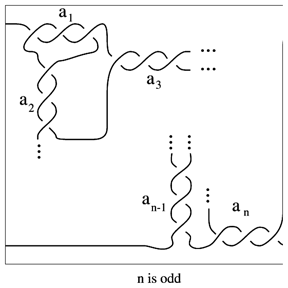
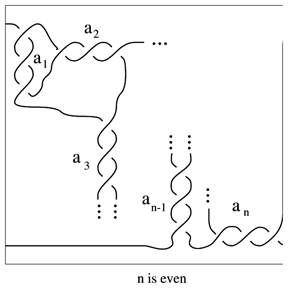
A family of $2$-tangles (cf. Tangle) classified by J.H. Conway. The $2$-tangle of Fig. a1 is called a rational tangle with Conway notation $T ( a _ { 1 } , \dots , a _ { n } )$. It is a rational $p / q$-tangle if
\begin{equation*} \frac { p } { q } = a _ { n } + \frac { 1 } { a _ { n - 1} + \ldots + \frac { 1 } { a_ { 1 } } }. \end{equation*}
The fraction $p / q$ is called the slope of the tangle and can be identified with the slope of the meridian disc of the solid torus that is the branched double covering of the rational tangle.
<img src="https://www.encyclopediaofmath.org/legacyimages/common_img/r130030a.gif" style="border:1px solid;"/>
Figure: r130030a
<img src="https://www.encyclopediaofmath.org/legacyimages/common_img/r130030b.gif" style="border:1px solid;"/>
Figure: r130030b
Conway proved that two rational tangles are ambient isotopic (with boundary fixed) if and only if their slopes are equal. A rational $n$-tangle (also called an $n$-bridge $n$-tangle) is an $n$-tangle that can be obtained from the identity tangle by a finite number of additions of a single crossing.
References
- [1] J.H. Conway, "An enumeration of knots and links" J. Leech (ed.), Computational Problems in Abstract Algebra, Pergamon Press (1969) pp. 329–358 Template:ZBL
- [2] A. Kawauchi, "A survey of knot theory", Birkhäuser (1996) Template:ZBL
 | This file was uploaded by a maintenance script before the file upload log existed. Therefore, it may incorrectly attribute the owner of the image and will not have a normal file history. Further questions should be addressed to the Media Copyright Helpdesk. |
 |  |