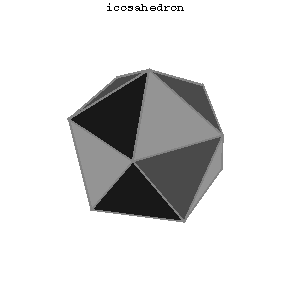
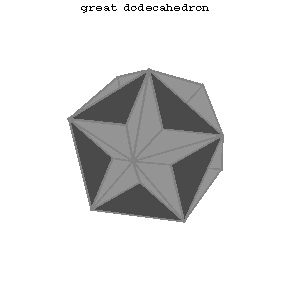
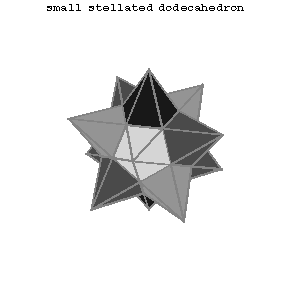
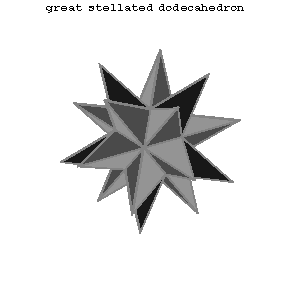
Regular polyhedra
Platonic solids
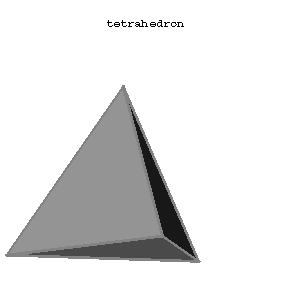
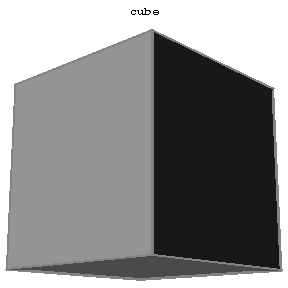
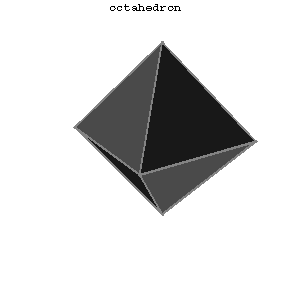
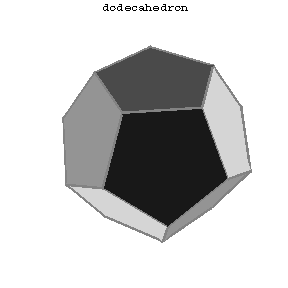
Convex polyhedra such that all faces are congruent regular polygons and such that all polyhedral angles at the vertices are regular and equal (Fig.1a–Fig.1e).
<img style="border:1px solid;" src="https://www.encyclopediaofmath.org/legacyimages/common_img/r080790a.gif" />
Figure: r080790a
<img style="border:1px solid;" src="https://www.encyclopediaofmath.org/legacyimages/common_img/r080790b.gif" />
Figure: r080790b
<img style="border:1px solid;" src="https://www.encyclopediaofmath.org/legacyimages/common_img/r080790c.gif" />
Figure: r080790c
<img style="border:1px solid;" src="https://www.encyclopediaofmath.org/legacyimages/common_img/r080790d.gif" />
Figure: r080790d
<img style="border:1px solid;" src="https://www.encyclopediaofmath.org/legacyimages/common_img/r080790e.gif" />
Figure: r080790e
In the Euclidean space <img align="absmiddle" border="0" src="https://www.encyclopediaofmath.org/legacyimages/r/r080/r080790/r0807901.png" /> there are five regular polyhedra, the data of which are given in Table 1, where the Schläfli symbol <img align="absmiddle" border="0" src="https://www.encyclopediaofmath.org/legacyimages/r/r080/r080790/r0807902.png" /> (cf. Polyhedron group) denotes the regular polyhedron with <img align="absmiddle" border="0" src="https://www.encyclopediaofmath.org/legacyimages/r/r080/r080790/r0807903.png" />-gonal faces and <img align="absmiddle" border="0" src="https://www.encyclopediaofmath.org/legacyimages/r/r080/r080790/r0807904.png" />-hedral angles'
<tbody> </tbody>
|
Dual polyhedra, or reciprocal polyhedra, <img align="absmiddle" border="0" src="https://www.encyclopediaofmath.org/legacyimages/r/r080/r080790/r08079011.png" /> and <img align="absmiddle" border="0" src="https://www.encyclopediaofmath.org/legacyimages/r/r080/r080790/r08079012.png" /> are, by definition, those which transform into each other upon reciprocation with respect to any concentric sphere. The tetrahedron is dual to itself, the hexahedron to the octahedron and the dodecahedron to the icosahedron.
Polyhedra in spaces of more than three dimensions are called polytopes.
In <img align="absmiddle" border="0" src="https://www.encyclopediaofmath.org/legacyimages/r/r080/r080790/r08079013.png" /> there are six regular polytopes, the data of which are given in Table 2.'
In <img align="absmiddle" border="0" src="https://www.encyclopediaofmath.org/legacyimages/r/r080/r080790/r08079023.png" />, <img align="absmiddle" border="0" src="https://www.encyclopediaofmath.org/legacyimages/r/r080/r080790/r08079024.png" />, there are three regular polytopes: the analogues of the tetrahedron, the cube and the octahedron; their Schläfli symbols are: <img align="absmiddle" border="0" src="https://www.encyclopediaofmath.org/legacyimages/r/r080/r080790/r08079025.png" />, <img align="absmiddle" border="0" src="https://www.encyclopediaofmath.org/legacyimages/r/r080/r080790/r08079026.png" /> and <img align="absmiddle" border="0" src="https://www.encyclopediaofmath.org/legacyimages/r/r080/r080790/r08079027.png" />.
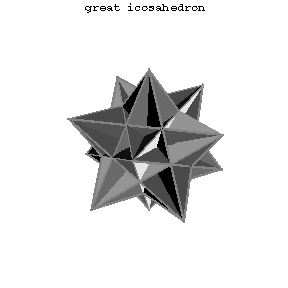
If one permits self-intersection, then there are <img align="absmiddle" border="0" src="https://www.encyclopediaofmath.org/legacyimages/r/r080/r080790/r08079028.png" /> more regular polyhedra, namely the Kepler–Poinsot solids or regular star polyhedra. In these polyhedra, either the faces intersect each other or the faces are self-intersecting polygons (Fig.2a–Fig.2d). The data of these solids are listed in Table 3.
<img style="border:1px solid;" src="https://www.encyclopediaofmath.org/legacyimages/common_img/r080790f.gif" />
Figure: r080790f
<img style="border:1px solid;" src="https://www.encyclopediaofmath.org/legacyimages/common_img/r080790g.gif" />
Figure: r080790g
<img style="border:1px solid;" src="https://www.encyclopediaofmath.org/legacyimages/common_img/r080790h.gif" />
Figure: r080790h
<img style="border:1px solid;" src="https://www.encyclopediaofmath.org/legacyimages/common_img/r080790i.gif" />
Figure: r080790i
'
<tbody> </tbody>
|
References
| [1] | P.S. Alexandroff [P.S. Aleksandrov] (ed.) et al. (ed.) , Enzyklopaedie der Elementarmathematik , 4. Geometrie , Deutsch. Verlag Wissenschaft. (1967) (Translated from Russian) |
| [2] | L.A. Lyusternik, "Convex figures and polyhedra" , Moscow (1956) (In Russian) |
| [3] | D.O. Shklyarskii, N.N. Chentsov, I.M. Yaglom, "The USSR Olympiad book: selected problems and theorems of elementary mathematics" , Freeman (1962) (Translated from Russian) |
| [4] | H.S.M. Coxeter, "Regular complex polytopes" , Cambridge Univ. Press (1990) |
Comments
At least 2 of the 4 Kepler–Poinsot solids were discovered long before Kepler and Poinsot's times: The small stellated dodecahedron by P. Uccello (around 1420) and the great dodecahedron in 1958 by W. Jamnitzer (cf. [a2], [a3]).
References
| [a1] | B. Grünbaum, "Regular polyhedra - old and new" Aequat. Math. , 16 (1970) pp. 1–20 |
| [a2] | G. Flede (ed.) , Shaping space , Birkhäuser (1988) |
| [a3] | L. Saffaro, "Dai cinqui poliedri platonici all'infinito" Encicl. Sci. e Tecn. Mondadori , 76 (1976) pp. 474–484 |
| [a4] | L. Fejes Toth, "Regular figures" , Pergamon (1964) (Translated from German) |
 |  |