Reidemeister theorem
This category corresponds roughly to MSC {{{id}}} {{{title}}}; see {{{id}}} at MathSciNet and {{{id}}} at zbMATH.
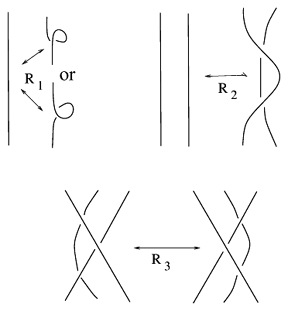
Two link diagrams represent the same ambient isotopy class of a link in $S^3$ if and only if they are related by a finite number of Reidemeister moves (see Fig. a1) and a plane isotopy.
<img style="border:1px solid;" src="https://www.encyclopediaofmath.org/legacyimages/common_img/r130060a.gif" />
Figure: r130060a
Proofs of the theorem were published in 1927 by K. Reidemeister , and by J.W. Alexander and G.B. Briggs .
The theorem also holds for oriented links and oriented diagrams, provided that Reidemeister moves observe the orientation of diagrams. It holds also for links in a manifold $M=F\times[0,1]$, where $F$ is a surface.
The first formalization of knot theory was obtained by M. Dehn and P. Heegaard by introducing lattice knots and lattice moves . Every knot has a lattice knot representation and two knots are lattice equivalent if and only if they are ambient isotopic. The Reidemeister approach was to consider polygonal knots up to $\Delta$-moves. (A $\Delta$-move replaces one side of a triangle by two other sides or vice versa. A regular projection of a $\Delta$-move can be decomposed into Reidemeister moves.) This approach was taken by Reidemeister to prove his theorem.
References
- [1] J.W. Alexander, G.B. Briggs, "On types of knotted curves" Ann. of Math. , 28 : 2 (1927/28) pp. 563–586 Template:ZBL
- [2] M. Dehn, P. Heegaard, "Analysis situs" , Encykl. Math. Wiss. , III AB3 , Leipzig (1907) pp. 153–220 Template:ZBL
- [3] K. Reidemeister, "Elementare Begrundung der Knotentheorie" Abh. Math. Sem. Univ. Hamburg , 5 (1927) pp. 24–32 Template:ZBL
 |  |