Saint symbolism

Symbolism of Christian saints has been used from the very beginnings of the religion.[1] Each saint is said to have led an exemplary life and symbols have been used to tell these stories throughout the history of the Church.[2] A number of Christian saints are traditionally represented by a symbol or iconic motif associated with their life, termed an attribute or emblem, in order to identify them. The study of these forms part of iconography in art history.[3] They were particularly used so that the illiterate could recognize a scene, and to give each of the Saints something of a personality in art.[2] They are often carried in the hand by the Saint.
Attributes often vary with either time or geography, especially between Eastern Christianity and the West. Orthodox images more often contained inscriptions with the names of saints, so the Eastern repertoire of attributes is generally smaller than the Western.[c] Many of the most prominent saints, like Saint Peter and Saint John the Evangelist can also be recognised by a distinctive facial type. Some attributes are general, such as the martyr's palm.[4] The use of a symbol in a work of art depicting a Saint reminds people who is being shown and of their story. The following is a list of some of these attributes.
Four Evangelists

| Saint | Symbol[5] |
|---|---|
| Matthew | winged man or angel |
| Mark | winged lion |
| Luke | winged bull |
| John | eagle |
The Apostles
-
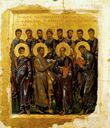 The Synaxis of the Twelve Apostles. Russian, 14th century, Moscow Museum.
 -
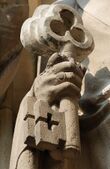 The key as symbol of St. Peter
 -
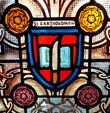 Stained glass window showing flaying knife, symbol of St. Bartholomew
 -
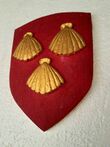 Scallop Shells, St. James the Great
.jpg)


.jpg)
| Apostle | Symbol |
|---|---|
| Andrew the Apostle | St. Andrew's cross,[a] discalced, with fish or a rope |
| Bartholomew the Apostle | knife, bears his own skin in hand[a] |
| James, son of Zebedee | pilgrim's staff, scallop shell, key, sword, pilgrim's hat, astride a white charger, Cross of Saint James[a] |
| James, son of Alphaeus/James the Just | square rule, halberd, club, saw[a] |
| John | evangelistary, a serpent in a chalice, cauldron, eagle[a] |
| Jude | sword, square rule, club, ship[a] |
| Judas Iscariot | thirty pieces of silver[a] |
| Matthew | angel, evangelistary[a] |
| Peter | Keys of Heaven, boat, fish, rooster, pallium, papal vestments; crucified head downwards on an inverted cross, holding a book or scroll, with a bushy beard and hair.[a] |
| Philip | column; holding a basket of loaves and a Tau Cross[a] |
| Simon | boat; cross and saw; fish (or two fishes); lance; being sawn in two longitudinally; oar[a] |
| Thomas | placing his finger in the side of Christ, axe, spear, carpentry tools [a] |
Mary, mother of Jesus
-
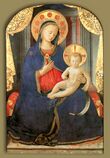 A traditional depiction of Mary, by Fra Angelico, wearing a blue mantle
 -
Our Lady of Perpetual Help
-
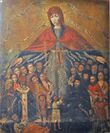 Virgin of Mercy
 -
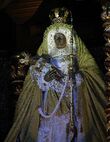 Our Lady of Candelaria


Mary is often portrayed wearing blue. Her attributes include amongst many others a mantle (often in blue or very large to cover the faithful), crown of 12 stars, serpent, sun and/or moon, heart pierced by sword, Madonna lily, roses, and rosary beads.[6]
| Title | Symbol |
|---|---|
| Black Madonna of Częstochowa | Black Madonna in Hodegetria form, Infant Jesus, fleur-de-lis robes, slashes on right cheek[7] |
| Immaculate Heart of Mary | Burning bloodied heart, pierced with a sword, banded with roses, and lily flowers |
| Our Lady of Perpetual Help | Hodegetria with saints Michael and Gabriel holding instruments of the passion.[8] |
| Our Lady of Aparecida | In traditional form of Immaculate Conception[9] |
| Our Lady of Fátima | dressed in white, giving out rays of clear and intense light[10] |
| Our Lady of Good Counsel | with the Infant Jesus, in their touching halo appear the words SS. Mater Boni consilii, ora pro nobis Jesum filium tuum |
| Our Lady of Guadalupe | eyes downcast, hands clasped in prayer, clothed in a pink tunic robe covered by a cerulean mantle with a black sash, emblazoned with eight-point stars; eclipsing a blazing sun while standing atop a darkened crescent moon, a cherubic angel carrying her train |
| Our Lady of Humility | Mary seated low to the ground, usually holding the baby Jesus[11] |
| Our Lady of Lourdes | dressed in a flowing white robe, with a blue sash around her waist[12] |
| Our Lady of Peace | Virgin MaryInfant Jesus; she holds an olive branch and dove[13] |
| Our Lady of Sorrows | in mournful state, tears, bleeding heart pierced by seven swords [b] |
| Queen of Heaven | with a crown of stars, flowers[a] |
| Virgin of Mercy | sheltering people under her mantle[14] |
| Virgin of Miracles | Gothic alabaster carving of Mary with a baby[15] |
| Virgin of Montserrat | Madonna and child seated in the Throne of Wisdom pose[16] |
| Our Lady of Mount Carmel | dressed in the colors of the Carmelite habit, wearing the mantle of the Carmelite habit, holding a brown scapular, sometimes handing it to Saint Simon Stock |
Saints listed by name
Saints (A–H)
Saints (I–P)
Saints (Q–Z)
See also
- Christian symbolism
- Arma Christi
- Animals in Christian art
- Plants in Christian iconography
Notes
- "List of saints". Catholic Online. Your Catholic Voice Foundation. http://www.catholic.org/saints/stindex.php.
- Stracke, Richard (2015-10-20). "Iconography". https://www.christianiconography.info/about.html.
- Rabenstein, Katherine (April 1999). "Saint of the Day Master Index". St. Patrick Catholic Church. http://www.saintpatrickdc.org/ss/saint_a.shtml.
References
- ↑
 This article incorporates text from a publication now in the public domain: Herbermann, Charles, ed (1913). "Symbolism". Catholic Encyclopedia. New York: Robert Appleton.
- ↑ 2.0 2.1 Mayernik, David T. (2018). "A Vast, Immeasurable Sanctuary: Iconography for Churches". Sacred Architecture Journal 5: 22. http://www.sacredarchitecture.org/articles/a_vast_immeasurable_sanctuary_iconography_for_churches.
- ↑ "Eastern Orthodox and Catholic teaching about Icons.". http://www.ikonograph.com/teaching-about-icons.
- ↑ Hassett, M. (1911). "Palm in Christian Symbolism". The Catholic Encyclopedia. https://www.newadvent.org/cathen/11432a.htm.
- ↑ Saint Jerome; St. Jerome (December 2008). Commentary on Matthew (The Fathers of the Church, Volume 117). CUA Press. p. 55. ISBN 978-0-8132-0117-7. https://books.google.com/books?id=j0UmWBivNJgC&pg=PA55.
- ↑ Kugeares, Sophia Manoulian (1991). Images Of The Annunciation Of The Virgin Mary Of The 13th, 14th And 15th Century.
- ↑ Duricy, Michael P (2008-03-26). "Black Madonnas: Our Lady of Czestochowa". The Marian Library/International Marian Research Institute, Dayton, Ohio - University of Dayton. https://udayton.edu/imri/mary/c/czestochowa-black-madonna.php.
- ↑ Maginer, John (1913). "Our Lady of Perpetual Succour". in Herbermann, Charles. Catholic Encyclopedia. New York: Robert Appleton Company.
- ↑ "Beata Virgo Maria Immaculata Sub Titulo Apparecida – Principalis Patrona Brasiliae Constituitur", Acta Apostolica Sedis, 1931, p. 7
- ↑ Arcement, Katherine (2017-10-13). "Our Lady of Fatima: The Virgin Mary promised three kids a miracle that 70,000 gathered to see". Washington Post. https://www.washingtonpost.com/news/retropolis/wp/2017/10/13/our-lady-of-fatima-the-virgin-mary-promised-three-kids-a-miracle-that-70000-gathered-to-see/.
- ↑ Earls, Irene. Renaissance art: a topical dictionary, 1987 ISBN 0-313-24658-0 p. 174
- ↑ Harris, Ruth (1999). Lourdes: Body and Spirit in the Secular Age. Penguin Books. p. 43. ISBN 0-71-399186-0. https://books.google.com/books?id=06UWAQAAMAAJ.
- ↑ "The Saga of Our Lady of Peace". July 4, 2014. https://hawaiicatholicherald.com/2014/07/04/the-saga-of-our-lady-of-peace/,%20https://www.hawaiicatholicherald.com/2014/07/04/the-saga-of-our-lady-of-peace/.
- ↑ Hall, James, 1983. A History of Ideas and Images in Italian Art, John Murray, London, ISBN 0-7195-3971-4
- ↑ Garcia, Sebastián (1998). "La Rábida, pórtico del nuevo mundo." Síntesis histórico-artística.. Comunidad Franciscana del Convento de Santa María de la Rábida.. pp. Chapter VII., La imagen de Santa María de la Rábida. Págs. 147–171. (). ISBN 84-604-1032-3.
- ↑ Roccosalvo C.S.J., Joan L. (Spring 2012). "Elegance Personified: The Black Madonna of Montserrat". Sacred Architecture Journal. http://www.sacredarchitecture.org/articles/elegance_personified.

Further reading
- Delaney, John P. (1980). Dictionary of Saints (Second ed.). Garden City, NY: Doubleday. ISBN 0-385-13594-7. https://archive.org/details/dictionaryofsain00dela.
- Greene, E. A. (1909). Saints and their symbols : a companion in the churches and picture galleries of Europe. London : Whittaker & Co.. https://archive.org/details/saintstheirsymbo00greeuoft.Greene, E. A. (1909). Saints and their symbols : a companion in the churches and picture galleries of Europe. London : Whittaker & Co.. https://archive.org/details/saintstheirsymbo00greeuoft.
- Lanzi, Fernando; Lanzi, Gioia (2004-09-01). Saints and their Symbols: Recognizing Saints in Art and in Popular Images. Liturgical Press. ISBN 9780814629703.
- Post, W. Ellwood (1975). Saints, Signs and Symbols (2 ed.). SPCK Publishing. ISBN 9780281028948.
- Schiller, Gertrud (1971). Iconography of Christian Art. 1. Arnoldo Mondadori. ISBN 978-0821203651.
- Walsh, Michael (2007). A New Dictionary of Saints: East and West. Liturgical Press. ISBN 978-0-8146-3186-7.
- Whittemore, Carroll E. (1980). Symbols of the Church. Abingdon Press. ISBN 0687183014. https://archive.org/details/symbolsofchurch0000whit.
- Rabenstein, Katherine (April 1999). "Bibliography on Saints and Sainthood". St. Patrick Catholic Church. http://www.saintpatrickdc.org/ss/reference.shtml.
External links


- "Christian Iconography". Augusta State University. http://www.aug.edu/augusta/iconography/.
- "Hagiographies, hymnography, and icons for many Orthodox saints". Orthodox Church in America. http://www.oca.org/FSlives.asp?SID=4.
- "Saints' Badges or Shields". https://www.angelfire.com/me4/saints/index.html.
 |  |


