Shannon multigraph
In the mathematical discipline of graph theory, Shannon multigraphs, named after Claude Shannon by (Vizing 1965),[1] are a special type of triangle graphs, which are used in the field of edge coloring in particular.
- A Shannon multigraph is multigraph with 3 vertices for which either of the following conditions holds:
- a) all 3 vertices are connected by the same number of edges.
- b) as in a) and one additional edge is added.
More precisely one speaks of Shannon multigraph Sh(n), if the three vertices are connected by , and edges respectively. This multigraph has maximum degree n. Its multiplicity (the maximum number of edges in a set of edges that all have the same endpoints) is .[2][3]
Examples
- Shannon multigraphs
-
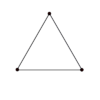 Sh(2)
Sh(2) -
 Sh(3)
Sh(3) -
 Sh(4)
Sh(4) -
 Sh(5)
Sh(5) -
 Sh(6)
Sh(6) -
 Sh(7)
Sh(7)


Edge coloring

According to a theorem of (Shannon 1949), every multigraph with maximum degree has an edge coloring that uses at most colors.[4] When is even, the example of the Shannon multigraph with multiplicity shows that this bound is tight: the vertex degree is exactly , but each of the edges is adjacent to every other edge, so it requires colors in any proper edge coloring.[3]
A version of Vizing's theorem states that every multigraph with maximum degree and multiplicity may be colored using at most colors.[5] Again, this bound is tight for the Shannon multigraphs.[3]
References
- ↑ Vizing, V. G. (1965), "The chromatic class of a multigraph", Kibernetika 1965 (3): 29–39
- ↑ Fiorini, S.; Wilson, Robin James (1977), Edge-colourings of graphs, Research Notes in Mathematics, 16, London: Pitman, p. 34, ISBN 0-273-01129-4
- ↑ 3.0 3.1 3.2 Volkmann, Lutz (1996) (in German), Fundamente der Graphentheorie, Wien: Springer, p. 289, ISBN 3-211-82774-9
- ↑ "A theorem on coloring the lines of a network", J. Math. Physics 28: 148–151, 1949, doi:10.1002/sapm1949281148
- ↑ "On an estimate of the chromatic class of a p-graph", Diskret. Analiz. 3: 25–30
External links
- Lutz Volkmann: Graphen an allen Ecken und Kanten. Lecture notes 2006, p. 244 (German)
 |  |


