Surface of the second order
A set of points in the three-dimensional real or complex space whose coordinates in a Cartesian coordinate system satisfy an algebraic equation of degree two:
| <img align="absmiddle" border="0" src="https://www.encyclopediaofmath.org/legacyimages/s/s091/s091390/s0913901.png" /> | (*) |
| <img align="absmiddle" border="0" src="https://www.encyclopediaofmath.org/legacyimages/s/s091/s091390/s0913902.png" /> |
Equation (*) need not define a real geometric image, and in such cases one says that (*) defines an imaginary second-order surface. Depending on the coefficients in the general equation (*), one may transform it by parallel translation and rotation in the coordinate system to one of the 17 canonical forms given below, each of which corresponds to a certain class of surfaces. Precisely, the non-singular irreducible surfaces:
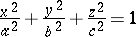
<img align="absmiddle" border="0" src="https://www.encyclopediaofmath.org/legacyimages/s/s091/s091390/s0913903.png" /> (an ellipsoid),
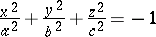
<img align="absmiddle" border="0" src="https://www.encyclopediaofmath.org/legacyimages/s/s091/s091390/s0913904.png" /> (an imaginary ellipsoid),
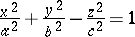
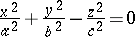
<img align="absmiddle" border="0" src="https://www.encyclopediaofmath.org/legacyimages/s/s091/s091390/s0913905.png" /> (a one-sheet hyperboloid),
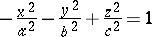
<img align="absmiddle" border="0" src="https://www.encyclopediaofmath.org/legacyimages/s/s091/s091390/s0913906.png" /> (a two-sheet hyperboloid),
<img align="absmiddle" border="0" src="https://www.encyclopediaofmath.org/legacyimages/s/s091/s091390/s0913907.png" />, <img align="absmiddle" border="0" src="https://www.encyclopediaofmath.org/legacyimages/s/s091/s091390/s0913908.png" /> (an elliptic paraboloid),
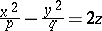
<img align="absmiddle" border="0" src="https://www.encyclopediaofmath.org/legacyimages/s/s091/s091390/s0913909.png" />, <img align="absmiddle" border="0" src="https://www.encyclopediaofmath.org/legacyimages/s/s091/s091390/s09139010.png" /> (a hyperbolic paraboloid);
the singular irreducible surfaces: the cylindrical surfaces (cf. Cylindrical surface (cylinder)) —
<img align="absmiddle" border="0" src="https://www.encyclopediaofmath.org/legacyimages/s/s091/s091390/s09139011.png" /> (an elliptic cylinder),
<img align="absmiddle" border="0" src="https://www.encyclopediaofmath.org/legacyimages/s/s091/s091390/s09139012.png" /> (an imaginary elliptic cylinder),
<img align="absmiddle" border="0" src="https://www.encyclopediaofmath.org/legacyimages/s/s091/s091390/s09139013.png" /> (a hyperbolic cylinder),
<img align="absmiddle" border="0" src="https://www.encyclopediaofmath.org/legacyimages/s/s091/s091390/s09139014.png" /> (a parabolic cylinder);
the conical surfaces (cf. Conical surface) —
<img align="absmiddle" border="0" src="https://www.encyclopediaofmath.org/legacyimages/s/s091/s091390/s09139015.png" /> (a conical surface),
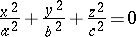
<img align="absmiddle" border="0" src="https://www.encyclopediaofmath.org/legacyimages/s/s091/s091390/s09139016.png" /> (an imaginary conical surface);
the singular reducible surfaces:
<img align="absmiddle" border="0" src="https://www.encyclopediaofmath.org/legacyimages/s/s091/s091390/s09139017.png" /> (a pair of intersecting planes),
<img align="absmiddle" border="0" src="https://www.encyclopediaofmath.org/legacyimages/s/s091/s091390/s09139018.png" /> (a pair of imaginary intersecting planes),
<img align="absmiddle" border="0" src="https://www.encyclopediaofmath.org/legacyimages/s/s091/s091390/s09139019.png" /> (a pair of parallel planes),
<img align="absmiddle" border="0" src="https://www.encyclopediaofmath.org/legacyimages/s/s091/s091390/s09139020.png" /> (a pair of imaginary parallel planes),
<img align="absmiddle" border="0" src="https://www.encyclopediaofmath.org/legacyimages/s/s091/s091390/s09139021.png" /> (a pair of coincident planes).
A second-order surface having a unique centre of symmetry (the centre of the surface) is called a central surface. The coordinates of the centre are defined as the solution to the system
| <img align="absmiddle" border="0" src="https://www.encyclopediaofmath.org/legacyimages/s/s091/s091390/s09139022.png" /> |
| <img align="absmiddle" border="0" src="https://www.encyclopediaofmath.org/legacyimages/s/s091/s091390/s09139023.png" /> |
| <img align="absmiddle" border="0" src="https://www.encyclopediaofmath.org/legacyimages/s/s091/s091390/s09139024.png" /> |
A second-order surface without a centre of symmetry or with an indeterminate centre is called a non-central surface.
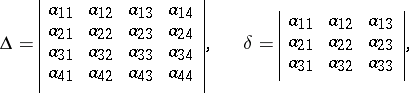
One can examine second-order surfaces without reducing the general equation to a canonical form by the joint consideration of the so-called basic invariants of second-order surfaces. These are expressions made up from the coefficients of (*) whose values do not alter under parallel translation and rotation of the coordinate system:
| <img align="absmiddle" border="0" src="https://www.encyclopediaofmath.org/legacyimages/s/s091/s091390/s09139025.png" /> |
| <img align="absmiddle" border="0" src="https://www.encyclopediaofmath.org/legacyimages/s/s091/s091390/s09139026.png" /> |
| <img align="absmiddle" border="0" src="https://www.encyclopediaofmath.org/legacyimages/s/s091/s091390/s09139027.png" /> |
together with the semi-invariants <img align="absmiddle" border="0" src="https://www.encyclopediaofmath.org/legacyimages/s/s091/s091390/s09139028.png" /> and <img align="absmiddle" border="0" src="https://www.encyclopediaofmath.org/legacyimages/s/s091/s091390/s09139029.png" />, which are invariant under rotation of the coordinate system:
| <img align="absmiddle" border="0" src="https://www.encyclopediaofmath.org/legacyimages/s/s091/s091390/s09139030.png" /> |
where <img align="absmiddle" border="0" src="https://www.encyclopediaofmath.org/legacyimages/s/s091/s091390/s09139031.png" /> is the algebraic complement of <img align="absmiddle" border="0" src="https://www.encyclopediaofmath.org/legacyimages/s/s091/s091390/s09139032.png" /> in <img align="absmiddle" border="0" src="https://www.encyclopediaofmath.org/legacyimages/s/s091/s091390/s09139033.png" />, and
| <img align="absmiddle" border="0" src="https://www.encyclopediaofmath.org/legacyimages/s/s091/s091390/s09139034.png" /> |
'
<tbody> </tbody>
|
The invariants, in general, define a second-order surface up to a motion in Euclidean space; if corresponding invariants for two surfaces are equal, these surfaces may be brought to coincide by a motion. In other words, these surfaces are equivalent in relation to the group of spatial motions (are metrically equivalent).'
There is a classification of second-order surfaces from the point of view of other transformation groups. For example, with respect to the group of affine transformations, equivalence applies for any two surfaces defined by equations of the same canonical form, e.g. two similar second-order surfaces are equivalent.
The relationships between the various affine classes of second-order surfaces enable one to establish a classification from the point of view of projective geometry. Here one takes as equivalent those surfaces that can be mapped onto another by means of projective transformations. For example, ellipsoids, elliptic paraboloids and two-sheet hyperboloids are real oval surfaces from the point of view of projective geometry. Their projective equivalence manifests itself in that there is a certain system of projective coordinates in which the equations for these surfaces are identical in form:
| <img align="absmiddle" border="0" src="https://www.encyclopediaofmath.org/legacyimages/s/s091/s091390/s09139054.png" /> |
i.e. the corresponding quadratic forms <img align="absmiddle" border="0" src="https://www.encyclopediaofmath.org/legacyimages/s/s091/s091390/s09139055.png" /> have identical rank
and identical signature . Their affine difference appears in the type of the line of intersection with the improper plane: an ellipsoid intersects it in an imaginary oval, a hyperboloid in a real oval and an elliptic paraboloid in a pair of imaginary intersecting straight lines. In all, there are eight projective equivalence classes for second-order surfaces:
<img align="absmiddle" border="0" src="https://www.encyclopediaofmath.org/legacyimages/s/s091/s091390/s09139056.png" /> (an imaginary oval surface),
<img align="absmiddle" border="0" src="https://www.encyclopediaofmath.org/legacyimages/s/s091/s091390/s09139057.png" /> (a real oval surface),
<img align="absmiddle" border="0" src="https://www.encyclopediaofmath.org/legacyimages/s/s091/s091390/s09139058.png" /> (an annular surface),
<img align="absmiddle" border="0" src="https://www.encyclopediaofmath.org/legacyimages/s/s091/s091390/s09139059.png" /> (an imaginary conical surface),
<img align="absmiddle" border="0" src="https://www.encyclopediaofmath.org/legacyimages/s/s091/s091390/s09139060.png" /> (a real conical surface),
<img align="absmiddle" border="0" src="https://www.encyclopediaofmath.org/legacyimages/s/s091/s091390/s09139061.png" /> (a pair of imaginary planes),
<img align="absmiddle" border="0" src="https://www.encyclopediaofmath.org/legacyimages/s/s091/s091390/s09139062.png" /> (a pair of real planes),
<img align="absmiddle" border="0" src="https://www.encyclopediaofmath.org/legacyimages/s/s091/s091390/s09139063.png" /> (a pair of coincident planes).
For references see Second-order curve.
Comments
Similar classifications are possible over other fields, such as <img align="absmiddle" border="0" src="https://www.encyclopediaofmath.org/legacyimages/s/s091/s091390/s09139064.png" />, finite fields and <img align="absmiddle" border="0" src="https://www.encyclopediaofmath.org/legacyimages/s/s091/s091390/s09139065.png" />-adic fields.
References
| [a1] | M. Berger, "Geometry" , II , Springer (1987) MR0903026 MR0895392 MR0882916 MR0882541 Template:ZBL Template:ZBL Template:ZBL |
| [a2] | D. Hilbert, S.E. Cohn-Vossen, "Geometry and the imagination" , Chelsea (1952) (Translated from German) MR0046650 Template:ZBL |
| [a3] | R.W. Brink, "Analytic geometry" , Appleton-Century (1935) MR1523468 Template:ZBL |
| [a4] | A.V. Pogorelov, "Geometry" , Moscow (1987) (In Russian) MR1440529 MR0804808 MR0760631 MR0467543 MR0346714 MR0268787 MR0244909 MR0239488 MR1534647 MR0203551 MR0203550 MR1530777 MR0121692 MR0114163 MR0097836 Template:ZBL Template:ZBL Template:ZBL Template:ZBL Template:ZBL Template:ZBL Template:ZBL Template:ZBL |
| [a5] | A.V. Pogorelov, "Analytical geometry" , Moscow (1980) (In Russian) |
 |  |