Astronomy:URAN
URAN (Ukrainian Radio Interferometer of NASU)[1] (Ukrainian: Український Радіоіонтеферометр Академії Наук - УРАН) is an array of radio-telescopes, spread across Ukraine and used for long-baseline interferometry in the 8–40 MHz range. The most sensitive of the telescopes is UTR-2. URAN-1 was built in 1975 in Zmiiv, Kharkiv oblast. URAN-2 was constructed starting in 1979 in Stepanivka village near Poltava. URAN-3 is near Shatsk, in the north-west, near the border with Poland and Belarus. URAN-4 was built in 1975 and is in the south-west, west of Odesa, by the Moldovan border.
Auxiliary telescopes are: URAN-1, with 96 dipoles in a 178 by 28 metres (584 ft × 92 ft) array; URAN-2, with 512 dipoles in a 238 by 118 metres (781 ft × 387 ft) array; URAN-3, with 256 dipoles in a 238 by 58 metres (781 ft × 190 ft) array; and URAN-4, with 128 dipoles in a 238 by 28 metres (781 ft × 92 ft) array. Because of the small number of baselines, images from URAN tend to be produced by model-fitting to sums of Gaussians rather than by direct synthesis.[citation needed]
-
 URAN low-frequency VLBI system, UTR-2 and GURT radio telescopes on the map of Ukraine.
 -
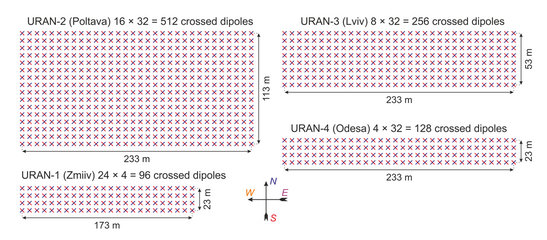 Geometrical configurations of the individual dipole antennas of the four URAN radio telescopes


References
- ↑ Konovalenko, A.; Sodin, L.; Zakharenko, V.; Zarka, P.; Ulyanov, O.; Sidorchuk, M.; Stepkin, S.; Tokarsky, P. et al. (2016-04-28). "The modern radio astronomy network in Ukraine: UTR-2, URAN and GURT" (in en). Experimental Astronomy 42 (1): 11–48. doi:10.1007/s10686-016-9498-x. ISSN 0922-6435. Bibcode: 2016ExA....42...11K.
Most of the information in this article comes from Valeriy Shepelev's presentation http://www.lofar.org/workshop/26Apr07_Thursday03/LOFARWorkshop_Apr07_ValeriyShepelev.pdf at an April 2007 LOFAR workshop.
Further reading
- S. Y. Braude; B. A. Dubinskii; N. L. Kaidanovskii; N. S. Kardashev; M. M. Kobrin; A. D. Kuzmin; A. P. Molchanov; Yu. N. Pariiskii et al. (2012). A Brief History of Radio Astronomy in the USSR: A Collection of Scientific Essays. Springer Science & Business Media. p. 193. ISBN 978-94-007-2834-9. https://books.google.com/books?id=e6NDa-5VHNYC&pg=PA193.
 |  |


