Biology:Acanthophoenix rubra
| Acanthophoenix rubra | |
|---|---|

| |
Scientific classification 
| |
| Kingdom: | Plantae |
| Clade: | Tracheophytes |
| Clade: | Angiosperms |
| Clade: | Monocots |
| Clade: | Commelinids |
| Order: | Arecales |
| Family: | Arecaceae |
| Genus: | Acanthophoenix |
| Species: | A. rubra
|
| Binomial name | |
| Acanthophoenix rubra (Bory) H.Wendl.
| |
| Synonyms[2] | |
| |
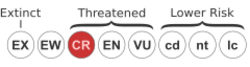
Acanthophoenix rubra, the barbel palm, is a critically endangered palm endemic to Mauritius, Rodrigues, and Réunion that is prized for its edible palm hearts.
Naming and description

It is also known as the red- or yellow- Barbel palm, red palm, Mascarene Islands cabbage palm, and palmiste rouge, palmiste bourre, palmiste des bois, palmiste des hauts, palmiste épineux, palmiste zépines, palmiste piquant in French.[3]
This palm was first described as Areca rubra by French naturalist Jean Baptiste Bory de Saint-Vincent in 1804 and classified by German botanist Hermann Wendland in its own genus Acanthophoenix in 1867. It can reach a height of 25 m. The trunk is slender, with a diameter of 18 cm. The crown contents of about 10 leaves approximately 3 m in size which are arranged convoluted.
In his 1995 checklist of seed plants, Rafaël Govaerts considered A. crinita to be a synonym of Acanthophoenix rubra, as did Govaerts and John Dransfield in their 2005 checklist of palms. However, in his revision of the genus, N. Ludwig recognised A. crinita as a separate species.[4]
Threats
The Barbel palm is endangered due to habitat destruction to make way for sugarcane plantations, and its high value as edible and medicinal plant. The palm heart is a delicacy. About 150 individuals occur in the wild on Mauritius. It is widely grown in cultivation.
Synonyms
- Areca rubra Bory (1804).[3]
References
- ↑ Page, W. (1998). "Acanthophoenix rubra". IUCN Red List of Threatened Species 1998. doi:10.2305/IUCN.UK.1998.RLTS.T38181A10098570.en. https://www.iucnredlist.org/species/38181/10098570.
- ↑ "Acanthophoenix rubra (Bory) H.Wendl.". Royal Botanic Gardens, Kew. https://powo.science.kew.org/taxon/urn:lsid:ipni.org:names:663892-1.
- ↑ 3.0 3.1 Grubben, G.J.H. & Denton, O.A. (2004) Plant Resources of Tropical Africa 2. Vegetables. PROTA Foundation, Wageningen; Backhuys, Leiden; CTA, Wageningen.
- ↑ " Acanthophoenix crinita". Royal Botanic Gardens, Kew: World Checklist of Selected Plant Families. http://apps.kew.org/wcsp/namedetail.do?accepted_id=1610&repSynonym_id=14530&name_id=1610&status=true.
External links
Wikidata ☰ Q2669376 entry
 |  |


