Biology:Acrantophis dumerili
| Acrantophis dumerili | |
|---|---|
_male_Reniala.jpg)
| |
| male in Reserve Reniala, Madagascar | |
Scientific classification 
| |
| Kingdom: | Animalia |
| Phylum: | Chordata |
| Class: | Reptilia |
| Order: | Squamata |
| Suborder: | Serpentes |
| Family: | Boidae |
| Genus: | Acrantophis |
| Species: | A. dumerili
|
| Binomial name | |
| Acrantophis dumerili Jan In Jan & Sordelli, 1860
| |
| Synonyms[2] | |
| |

Acrantophis dumerili, commonly known as Dumeril's boa,[3] is a species of non-venomous snake in the family Boidae. The species is endemic to Madagascar. No subspecies are currently recognized.[4][5]
Etymology
The specific name, dumerili, is in honor of French herpetologist André Marie Constant Duméril.[6]
Description
Adults of A. dumerili usually grow to 6.5 feet (2 m) in total length (including tail)[7] with the maximum reported to be 8 feet, 6 inches (259 cm). Males usually have longer skinnier tails, while females tend to be larger overall.[8]
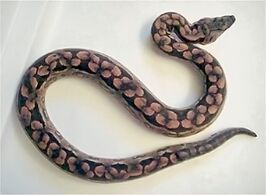
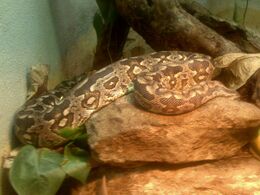
The color pattern consists of a gray-brown ground color with darker patches, forming an effective camouflage against the leaf litter of the forest floor of their native habitat.[9]
-
-
 in London Zoo
 -
 in Isalo National Park, Madagascar


_male_head_Isalo.jpg)
Distribution and habitat
A. dumerili is found on Madagascar. The type locality given in the original description is "Amérique mérid. ?", which is later given as "?" by Jan (1863).[2]
Durmeril Ground Boa's live in semi-arid forest along the western to southwestern parts of Madagascar. Their habitats consist of leaf litter, loose dirt, and rocky terrain for camouflage. When needed, these snakes will use burrows made by other animals as a shelter.
Feeding
The diet of A. dumerili consists of small animals, such as birds, lizards, and small mammals, including juvenile lemurs. It is also known to prey on other snakes.[10] These snakes are opportunistic feeders that may hunt during the day or at night. They can also be found on the ground floor or in trees when hunting (Raxworthy 2003; Vences and Glaw 2003; Gardner et al. 2017). They have been found to have toads, insects, and indigestible plants, as well as detritus in their stomach. These were all either eaten in the process of hunting another animal or were in the stomach of the animal that they consumed (Pendlebury 1974). They will use their muscular body type to constrict their prey prior to consumption. Although they can reach up to 6-8 feet in length, they typically are more docile creatures and will continue to eat smaller animals and amphibians.
Reproduction
In A. dumerili sexual maturity is reached within 3 to 5 years of age. Males have anal spurs, which are used in courtship.
Conservation status
The species A. dumerili is classified as Least Concern (LC) on the IUCN Red List for the following criteria: A1cd (v2.3, 1994).[3] This means that a population reduction of at least 20% has been observed, estimated, inferred or suspected over the last 10 years or three generations, whichever is the longer, based on a decline in area of occupancy, extent of occurrence and/or quality of habitat, and based on actual or potential levels of exploitation.[11] The species was last assessed in 2011.[3]
A. dumerili is also listed as CITES Appendix I, which means that it is threatened with extinction and CITES prohibits international trade except when the purpose of the import is not commercial, for example for scientific research.[12]
Captivity
References
- ↑ "Appendices | CITES". https://cites.org/eng/app/appendices.php.
- ↑ 2.0 2.1 McDiarmid RW, Campbell JA, Touré TA (1999). Snake Species of the World: A Taxonomic and Geographic Reference, Volume 1. Washington, District of Columbia: Herpetologists' League. 511 pp. ISBN 1-893777-00-6 (series). ISBN 1-893777-01-4 (volume).
- ↑ 3.0 3.1 3.2 Cite error: Invalid
<ref>tag; no text was provided for refs namediucn status 20 November 2021 - ↑ "Acrantophis dumerili". Integrated Taxonomic Information System. https://www.itis.gov/servlet/SingleRpt/SingleRpt?search_topic=TSN&search_value=635010. Retrieved 17 February 2014.
- ↑ Glaw, Frank; Vences, Miguel (2007). A Field Guide to the Amphibians and Reptiles of Madagascar (3rd ed.). Cologne, Germany: Vences & Glaw Verlags. ISBN 978-3-929449-03-7.
- ↑ Beolens, Bo; Watkins, Michael; Grayson, Michael (2011). The Eponym Dictionary of Reptiles. Baltimore: Johns Hopkins University Press. xiii + 296 pp. ISBN 978-1-4214-0135-5. (Acrantophis dumerili, p. 77).
- ↑ Burnie, David; Wilson, Don E. (editors-in-chief) (2001). Animal. London: Dorling Kindersley. 624 pp. ISBN 0-7894-7764-5.
- ↑ Weidensaul, Scott (1991). Snakes of the World. Chartwell House. ISBN 978-1-55521-733-4.
- ↑ Bartlett, Richard; Bartlett, Patricia (2003). Red-Tailed Boas and Relatives. B.E.S. Publishing. ISBN 978-0-7641-2279-8.
- ↑ Andreone, Franco & Efcurio, Vincenzo. (2005). Acrantophis dumerilii (Dumeril's Ground Boa). Diet.. Herpetological Review. 36. 185-186.
- ↑ 1994 Categories & Criteria (version 2.3) at the IUCN Red List. Accessed 10 July 2008.
- ↑ Acrantophis dumerili at CITES and United Nations Environment Programme / World Conservation Monitoring Centre. Accessed 10 July 2008.
Further reading
- Boulenger GA (1893). Catalogue of the Snakes in the British Museum (Natural History). Volume I., Containing the Families ... Boidæ ... London: Trustees of the British Museum (Natural History). (Taylor and Francis, printers). xiii + 448 pp. + Plates I-XXVIII. (Boa dumerilii, p. 120).
- Jan G, [ Sordelli F ] "1861" [1860]. Iconographie générale des Ophidiens, Première livraison. Paris: Baillière. Index + Plates I-VI. (Acrantophis dumerili, new species, Plate II). (in French).
- Kluge AG (1991). "Boine Snake Phylogeny and Research Cycles". Miscellaneous Publications, Museum of Zoology, University of Michigan (178): 1-58. PDF at University of Michigan Library. Accessed 11 July 2008.
- Vences M, Glaw F, Kosuch J, Böhme W, Veith M (2001). "Phylogeny of South American and Malagasy Boine Snakes: Molecular Evidence for the Validity of Sanzinia and Acrantophis and Biogeographic Implications". Copeia 2001 (4): 1151–1154. PDF at Miguel Vences. Accessed 29 August 2008.
- Vences M, Glaw F (2003). "Phylogeography, systematics and conservation status of boid snakes from Madagascar (Sanzinia and Acrantophis)". Salamandra, Reinbach 39 (3/4): 181–206. PDF at Miguel Vences. Accessed 29 August 2008.
External links
 |
Wikimedia Commons has media related to Acrantophis dumerili. |
- Acrantophis dumerili at the Reptarium.cz Reptile Database. Accessed 10 July 2008.
Wikidata ☰ Q911147 entry Template:Species named after A.M.C. Duméril
 |  |
- ↑ Steeil, James C.; Schumacher, Juergen; Hecht, Silke; Baine, Katherine; Ramsay, Edward C.; Ferguson, Sylvia; Miller, Debra; Lee, Nathan D. (March 2013). "Diagnosis and Treatment of a Pharyngeal Squamous Cell Carcinoma in a Madagascar Ground Boa (Boa madagascarensis)". Journal of Zoo and Wildlife Medicine 44 (1): 144–151. doi:10.1638/1042-7260-44.1.144. ISSN 1042-7260.


