Biology:Aloe divaricata
| Aloe divaricata | |
|---|---|

| |
| Aloe divaricata in cultivation | |
Scientific classification 
| |
| Kingdom: | Plantae |
| Clade: | Tracheophytes |
| Clade: | Angiosperms |
| Clade: | Monocots |
| Order: | Asparagales |
| Family: | Asphodelaceae |
| Subfamily: | Asphodeloideae |
| Genus: | Aloe |
| Species: | A. divaricata
|
| Binomial name | |
| Aloe divaricata | |
| Infraspecific taxa[3] | |
| |
| Synonyms | |
| |
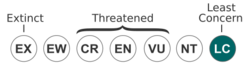
Aloe divaricata is a species of succulent plant in the genus Aloe. Endemic to Madagascar, it is common and widely distributed across the island. Four infraspecific taxa are recognised: three subspecies and one variety.
Taxonomy and history
Aloe divaricata was described in 1905 by German botanist Alwin Berger based on a type specimen collected from Mahajanga.[3][8] The specific epithet divaricata is derived from the Latin word divaricate, meaning "spreading", in reference to the species' branched inflorescence.[9]
Three subspecies and one variety are recognised:[3][8]
- Aloe divaricata subsp. divaricata (autonym)
- Aloe divaricata subsp. tulearensis (T.A.McCoy & Lavranos) J.-P.Castillon
- Aloe divaricata subsp. vaotsohy (Decorse & Poiss.) J.-P.Castillon
- Aloe divaricata var. rosea (Decary) Reynolds
Distribution and habitat
Aloe divaricata is the most widely distributed endemic Aloe of Madagascar, occurring in the former Fianarantsoa, Mahajanga, and Toliara provinces. It grows on lateritic soils in arid plains, dry spiny forests, limestone plateaus, and sandy coastal forests. It can be found from sea level up to 800 m (2,600 ft) above sea level.[1]
References
- ↑ 1.0 1.1 Rakotoarisoa, S.E. (2020). "Aloe divaricata". IUCN Red List of Threatened Species 2020. doi:10.2305/IUCN.UK.2020-3.RLTS.T110039563A110040111.en. https://www.iucnredlist.org/species/110039563/110040111. Retrieved 5 November 2025.
- ↑ "Aloe divaricata A. Berger" (in en). UN Environment Programme World Conservation Monitoring Centre. https://speciesplus.net/#/taxon_concepts/17563.
- ↑ 3.0 3.1 3.2 "Aloe divaricata A.Berger" (in en). Royal Botanic Gardens, Kew. http://www.plantsoftheworldonline.org/taxon/529407-1.
- ↑ "Aloe divaricata subsp. divaricata" (in en). Royal Botanic Gardens, Kew. http://www.plantsoftheworldonline.org/taxon/77170846-1.
- ↑ "Aloe divaricata subsp. tulearensis (T.A.McCoy & Lavranos) J.-P.Castillon" (in en). Royal Botanic Gardens, Kew. http://www.plantsoftheworldonline.org/taxon/77120970-1.
- ↑ "Aloe divaricata subsp. vaotsohy (Decorse & Poiss.) J.-P.Castillon" (in en). Royal Botanic Gardens, Kew. http://www.plantsoftheworldonline.org/taxon/77120969-1.
- ↑ "Aloe divaricata var. rosea (Decary) Reynolds" (in en). Royal Botanic Gardens, Kew. http://www.plantsoftheworldonline.org/taxon/60462531-2.
- ↑ 8.0 8.1 Newton, L. E. (2020). "Aloe Asphodelaceae". in Eggli, Urs; Nyffeler, Reto. Monocotyledons. Illustrated Handbook of Succulent Plants (Second ed.). Berlin, Germany: Springer Nature. pp. 548–549. doi:10.1007/978-3-662-56486-8. ISBN 978-3-662-56484-4. OCLC 1145609055.
- ↑ Grace, Olwen M.; Klopper, Ronell R.; Figueiredo, Estrela; Smith, Gideon F. (2011). The Aloe Names Book. Strelitzia. 28. South African National Biodiversity Institute & Royal Botanic Gardens, Kew. p. 50. ISBN 978-1-84246-419-9. OCLC 729841885.
Wikidata ☰ Q291773 entry
 |  |


