Biology:Aloe succotrina
| Aloe succotrina Fynbos aloe | |
|---|---|

| |
| The Fynbos aloe in flower in its natural habitat. | |
Scientific classification 
| |
| Kingdom: | Plantae |
| Clade: | Tracheophytes |
| Clade: | Angiosperms |
| Clade: | Monocots |
| Order: | Asparagales |
| Family: | Asphodelaceae |
| Subfamily: | Asphodeloideae |
| Genus: | Aloe |
| Species: | A. succotrina
|
| Binomial name | |
| Aloe succotrina Lam.
| |

| |
| Aloe succotrina is restricted to the mountains of the Cape Peninsula, and the mountainous coast between Kogelberg and Hermanus | |
Aloe succotrina, the Fynbos aloe, is an aloe which is endemic to Cape Town and the south-western corner of the Western Cape, South Africa.
Distribution
Description

The Aloe succotrina plant forms clusters of between 1–2 metres (3.3–6.6 ft) diameter, with its leaves forming dense rosettes. In winter when it flowers (June to September) it produces a tall raceme, bearing shiny red flowers that are pollinated by sunbirds. Taxonomically, it forms part of the Purpurascentes series of very closely related Aloe species, together with Aloe microstigma, Aloe gariepensis, Aloe khamiesensis and Aloe framesii.[2]
Cultivation and uses
Aloe succotrina can easily be grown as an ornamental plant in Mediterranean climate gardens, rockeries, and in containers. It is particularly striking in winter, when it flowers. Western Cape gardens use it in Fynbos native plant themed natural landscaping.
This species has uses as a medicinal plant.[3]
See also
- Biodiversity of Cape Town
- Cape Floristic Region
- Index: Fynbos - habitats and species.
- Table Mountain
- Table Mountain National Park
References
- ↑ "Aloe succotrina All." (in en). UN Environment Programme World Conservation Monitoring Centre. https://speciesplus.net/#/taxon_concepts/22604.
- ↑ Reynolds, G.W. 1950. The aloes of Southern Africa. Balkema, Cape Town.
- ↑ Köhler, Franz Eugen (1887) Köhler's Medicinal Plants
Gallery
-
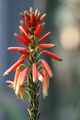 Inflorescence detail.
-
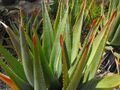 Foliage detail.
-
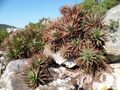 Adult Fynbos aloes on a Cape Peninsula rock face.


External links
Wikidata ☰ Q24380 entry
 |  |


