Biology:American ermine
| American ermine | |
|---|---|
.jpg)
| |
| Near Beaverhill Lake, Alberta | |
Scientific classification 
| |
| Kingdom: | Animalia |
| Phylum: | Chordata |
| Class: | Mammalia |
| Order: | Carnivora |
| Family: | Mustelidae |
| Genus: | Mustela |
| Species: | M. richardsonii
|
| Binomial name | |
| Mustela richardsonii Bonaparte, 1838
| |
| Subspecies | |
|
See text | |
| Synonyms | |
| |
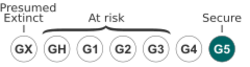
The American ermine or American stoat (Mustela richardsonii) is a member of the family Mustelidae and of the genus mustelid. Previously thought of as conspecific with the stoat (M. erminea),they have a body plan typical of weasels and are native to most of North America. There are currently 13 recognized subspecies.[2][3] American ermines are small carnivorous mammals that live in a variety of terrestrial habitats, such as forests and wetlands.
Description
The American ermine has a body plan typical of weasels. It has short legs, a long body and neck, and a small triangular head with short round ears. It has a brown dorsum with a white venter (except during winter when the coat is fully white) and a short, black-tipped tail.[4] The black coloring of the tail may serve to distract predators and divert attacks away from the body, which blends in more with its surroundings.[5] American ermines are sexually dimorphic and males are 30% larger than females.[6]
Taxonomy
The specific epithet, richardsonii, refers to Arctic explorer and naturalist Sir John Richardson.[7] The American ermine was long considered conspecific with the stoat (M. erminea), but a 2021 study found it to be a distinct species, forming distinct genetic clades from erminea.[2][8][9] The finding has been accepted by the American Society of Mammalogists.[10] The Haida ermine (M. haidarum) is thought to be a hybrid species originating from ancient hybridization between M. erminea and M. richardsonii.[2]
Distribution
The species is found throughout most of North America aside from most of Alaska (although it is found on some islands in southeastern Alaska), eastern Yukon, most of Arctic Canada, and Greenland, where it is replaced by M. erminea. It reaches the northern extent of its range in Ellesmere Island and a portion of eastern mainland Nunavut and ranges from here to cover almost all of western North America south to northern New Mexico, and eastern North America south to northern Virginia. It is absent from most of the Southeastern United States and the Great Plains.[2]
Diet
Ermines are primarily nocturnal hunters, although they can also be seen frequently during the day.[3] In North America, where the ecological niche for rat- and rabbit-sized prey is taken by the larger long-tailed weasel (Neogale frenata), the carnivorous American ermine preys mainly on mice and voles. Shrews, young cottontails, chipmunks, deer mice, jumping mice, and house mice are also preyed on. Occasionally, small birds, frogs, small fish, and earthworms are eaten. Usually the ermine kills by biting at base of skull.[11][12]
Habitat and Breeding
Ermines are terrestrial and non-migratory, with an average home range of 12-16 hectares.[3] They are found in a variety of habitats, including wetlands, woodlands, forests, and alpine terrain. However, they prefer environments with thick understories near water.[3][13] Ermines live in hollow spaces in logs, under rocks or stumps, or in burrows and man-made structures. Sometimes, they will take over the nest of their prey and use their prey's fur as lining.[12] In the winter, ermines usually stay beneath the surface of the snow.[3]
Ermines breed in dense parts of the forest. Males mature in a year, while females take only three to four months to mature. The breeding season is from July to August. The females carry a litter of four to nine babies, with an average of six to seven, for 255 days, then give birth in mid-April to early May.[3][14]
Predators
Some of the larger wild predators of ermines are minks, martens, fishers, bobcats, coyotes, and large owls and hawks. Occasionally a domesticated cat or dog may kill an ermine. Their small agile bodies help them evade these predators, while also allowing them to compete with their predators for food in more barren months.[12]
Subspecies
About 13 subspecies are known[2]:
| Subspecies | Trinomial authority | Description | Range | Synonyms |
|---|---|---|---|---|
| Junean stoat
M. r. alascensis. |
Merriam, 1896 | Similar to M. r. richardsonii, but with a broader skull and more extensive white tips on the limbs[15] | Juneau, Alaska | |
| Vancouver Island stoat
M. r. anguinae |
Hall, 1932 | Vancouver Island | ||
| Western Great Lakes stoat
M. r. bangsi |
Hall, 1945 | The region west of the Great Lakes | cicognani (Mearns, 1891)
pusillus (Aughey, 1880) | |
| Bonaparte's stoat
M. r. cigognanii 150x150px |
Bonaparte, 1838 | A small subspecies with a dark brown summer coat; its skull is more lightly built than that of richardsonii.[16] | The region north and east of the Great Lakes | pusilla (DeKay, 1842)
vulgaris (Griffith, 1827) |
| M. r. fallenda | Hall, 1945 | BC, Canada | ||
| M. r. gulosa | Hall, 1945 | Washington, USA | ||
| M. r. initis | Hall, 1945 | Baranof Island, AK, USA | ||
| M. r. invicta | Hall, 1945 | Idaho, USA | ||
| Southwestern stoat or New Mexico ermine
M. r. muricus |
Bangs, 1899 | The smallest subspecies of richardsonii.[4] | The southwestern extremity of the species' American range (Nevada, Utah, Colorado and other states) | leptus (Merriam, 1903) |
| Olympic stoat
M. r. olympica |
Hall, 1945 | The Olympic Peninsula, Washington | ||
| Richardson's stoat
M. r. richardsonii |
Bonaparte, 1838 | Similar to M. r. cigognanii, but larger, with a dull chocolate brown summer coat[16] | Newfoundland, Labrador and nearly all of Canada (save for the ranges of other American stoat subspecies) | imperii (Barrett-Hamilton, 1904)
microtis (J. A. Allen, 1903) mortigena (Bangs, 1913) |
| Baffin Island stoat
M. r. semplei |
Sutton and Hamilton, 1932 | Baffin Island and the adjacent parts of the mainland | labiata (Degerbøl, 1935) | |
| M. r. stratori | Merriam, 1896 | Similar to M. r. cigognanii, but smaller and dark chocolate brown with color encroaching on the belly.[15] | The West Coast of the USA |
Gallery
-
 American ermine surplus killing a family of chipmunks, as illustrated by Ernest Thompson Seton
 -
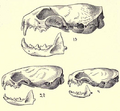 Skulls of a long-tailed weasel (top), an American ermine (bottom left), and least weasel (bottom right), as illustrated in Merriam's Synopsis of the Weasels of North America
 -
 Winter coat


References
- ↑ "NatureServe Explorer 2.0". https://explorer.natureserve.org/Taxon/ELEMENT_GLOBAL.2.1223017/Mustela_richardsonii.
- ↑ 2.0 2.1 2.2 2.3 2.4 Colella, Jocelyn P.; Frederick, Lindsey M.; Talbot, Sandra L.; Cook, Joseph A. (2021). "Extrinsically reinforced hybrid speciation within Holarctic ermine (Mustela spp.) produces an insular endemic" (in en). Diversity and Distributions 27 (4): 747–762. doi:10.1111/ddi.13234. ISSN 1472-4642. Bibcode: 2021DivDi..27..747C.
- ↑ 3.0 3.1 3.2 3.3 3.4 3.5 "NatureServe Explorer 2.0". https://explorer.natureserve.org/Taxon/ELEMENT_GLOBAL.2.1223017/Mustela_richardsonii.
- ↑ 4.0 4.1 Frey, Jennifer K. (2023) (in English). Wild Carnivores of New Mexico. University of New Mexico Press. pp. 667. ISBN 9780826351531.
- ↑ Caro, Tim (2013-06-01). "The colours of extant mammals". Seminars in Cell & Developmental Biology. Genetic basis and evolutionary causes of colour variation in vertebrates 24 (6): 542–552. doi:10.1016/j.semcdb.2013.03.016. ISSN 1084-9521. https://www.sciencedirect.com/science/article/pii/S1084952113000529.
- ↑ Webmaster, David Ratz. "American Ermine - Montana Field Guide" (in en). https://fieldguide.mt.gov/speciesDetail.aspx?elcode=AMAJF02070.
- ↑ Charlesworth, Edward (1838). "Remarks on the genus Mustela" (in en). The Magazine of natural history 2: 38. https://www.biodiversitylibrary.org/page/2296788.
- ↑ "Distinct Species of Adorable Weasels Have Been Hiding in Plain Sight" (in en-us). 13 April 2021. https://gizmodo.com/distinct-species-of-adorable-weasels-have-been-hiding-i-1846673520.
- ↑ "Adorable Killer Ermines Found To Contain Three Distinct Species Of Fluffy Weasels" (in en). 15 April 2021. https://www.iflscience.com/plants-and-animals/adorable-killer-ermines-found-to-contain-three-distinct-species-of-fluffy-weasels/.
- ↑ "Mustela richardsonii Bonaparte, 1838". https://www.mammaldiversity.org/explore.html#genus=Mustela&species=richardsonii&id=1006533.
- ↑ Verts & Carraway 1998, p. 417
- ↑ 12.0 12.1 12.2 Ahlborn, G. “Life History Account for Ermine.” Life History Accounts for Species in the California Wildlife Habitat Relationships (CWHR) System, 1988.
- ↑ "American Ermine Status - New York Natural Heritage Program". https://guides.nynhp.org/status/2.1223017/.
- ↑ "Ermine" (in en). https://www.esf.edu/aec/adks/mammals/ermine.php.
- ↑ 15.0 15.1 Merriam 1896, pp. 12–13
- ↑ 16.0 16.1 Merriam 1896, pp. 11–12
Bibliography
- Merriam, Clinton Hart (1896). Synopsis of the weasels of North America. Washington, D.C.: Govt. Print. Off.. https://archive.org/details/synopsisofweasel00merriala.
- Verts, B. J.; Carraway, Leslie N. (1998). Land Mammals of Oregon. University of California Press. ISBN 0-520-21199-5. https://books.google.com/books?id=8KI1AmzIDnwC&pg=PA415.
Wikidata ☰ Q41085321 entry
 |  |


