Biology:Amorpha juglandis
| Walnut sphinx | |
|---|---|

| |
Scientific classification 
| |
| Kingdom: | Animalia |
| Phylum: | Arthropoda |
| Class: | Insecta |
| Order: | Lepidoptera |
| Family: | Sphingidae |
| Tribe: | Mimatini |
| Genus: | Amorpha J. Hübner, 1809 |
| Species: | A. juglandis
|
| Binomial name | |
| Amorpha juglandis (J. E. Smith, 1797)[2]
| |
| Synonyms[2] | |
| |
Amorpha juglandis, the walnut sphinx, is the only species in the monotypic moth genus Amorpha, which is in the family Sphingidae, erected by Jacob Hübner in 1809. The species was first described by James Edward Smith in 1797.
Distribution
It is native to North America, where it is distributed from the Atlantic Ocean to the Rocky Mountains in Canada and the United States.
Description
The wingspan is 45–75 mm.
-
 Female
 -
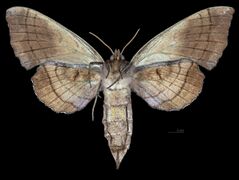 Female underside
 -
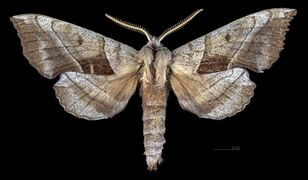 Male
Male -
 Male underside


Biology
The adult moth is nocturnal, active mainly during the early hours of the night.[3]
The caterpillar feeds on alder (Alnus), hickory (Carya), hazelnut (Corylus), beech (Fagus), walnut (Juglans), and hop-hornbeam (Ostrya) species. When attacked by a bird, the caterpillar produces a high-pitched whistle by expelling air from pairs of spiracles in its abdomen. This whistle is similar to the alarm signal produced by various bird species. One group of researchers in Montana hypothesized that this is a form of mimicry that functions as an antipredator adaptation to startle the bird, causing them to potentially reject the caterpillar.[4]
References
- ↑ NatureServe (2 August 2024). "Amorpha juglandis". Arlington, Virginia: NatureServe. https://explorer.natureserve.org/Taxon/ELEMENT_GLOBAL.2.119905/Amorpha_juglandis.
- ↑ 2.0 2.1 "Amorpha juglandis (Smith, J.E., 1797)". https://sphingidae.myspecies.info/taxonomy/term/481.
- ↑ Fullard, James H.; Napoleone, Nadia (2001). "Diel flight periodicity and the evolution of auditory defences in the Macrolepidoptera". Animal Behaviour 62 (2): 349. doi:10.1006/anbe.2001.1753.
- ↑ Lindsay, Jessica (2015). "Why do Caterpillars Whistle? Acoustic Mimicry of Bird Alarm Calls in the Amorpha juglandis Caterpillar". Undergraduate Theses, Professional Papers, and Capstone Artifacts: 60. https://scholarworks.umt.edu/utpp/60.
 |
Wikispecies has information related to Amorpha |
Further reading
- Bura, V. L.; Rohwer, V. G.; Martin, P. R.; Yack, J. E. (2010). "Whistling in caterpillars (Amorpha juglandis, Bombycoidea): Sound-producing mechanism and function". Journal of Experimental Biology 214 (Pt 1): 30–7. doi:10.1242/jeb.046805. PMID 21147966.
- Knight, K. (2010). "Whistling Caterpillars Startle Birds". Journal of Experimental Biology 214 (Pt 14): ii. doi:10.1242/jeb.054155. PMID 21834205.
External links
- Lotts, Kelly; Naberhaus, Thomas (2017). "Walnut sphinx Amorpha juglandis (J.E. Smith, 1797)". https://www.butterfliesandmoths.org/species/Amorpha-juglandis.
- "Amorpha juglandis (J. E. Smith, 1797)". Sphingidae of the Americas. Archived June 29, 2006.
- Cotinis (December 19, 2012). "Genus Amorpha". https://bugguide.net/node/view/4143.
Wikidata ☰ {{{from}}} entry
 |  |


