Biology:Arctic skate
| Arctic skate | |
|---|---|

| |
Scientific classification 
| |
| Kingdom: | Animalia |
| Phylum: | Chordata |
| Class: | Chondrichthyes |
| Subclass: | Elasmobranchii |
| Superorder: | Batoidea |
| Order: | Rajiformes |
| Family: | Rajidae |
| Genus: | Amblyraja |
| Species: | A. hyperborea
|
| Binomial name | |
| Amblyraja hyperborea (Collett, 1879)
| |
The Arctic skate (Amblyraja hyperborea) is a species of fish in the family Rajidae. It lives near the seabed between 140 and 2,500 m deep in the Arctic Ocean and waters around Canada and northern and north-western Europe, in the northern Pacific Ocean, and in waters surrounding Antarctica and New Zealand.[2]
The Arctic skate is about 1 m long and is gray-brown with large dark spots. Its underside is white with dark patterns. It has thorns in line from back to near the end of its tail. It is oviparous; its eggs are capsules with hard horns on each corner. It eats all sorts of small animals at the bottom of the sea.[2]
Description
The Arctic Skate has a total length of 16–23 centimetres (6.3–9.1 in) at birth, and a maximum total length of approximately 112 centimetres (44 in). The dark margins on the underside of the Arctic Skate increase as it ages. Its dorsal surface is scattered with small thornlets and has a coarse texture.[3]
Distribution and habitat
Amblyraja hyperborea has been found to occur between 165–3,165 metres (541–10,384 ft), but primarily below 800 metres (2,600 ft) in waters under 4.0 °C (39.2 °F), and have a preference for rough rocky substrate or cobblestone reefs.[3]
Taxonomy
This species was first described by Robert Collett in 1879 and named Raja hyperborea.[4]
Conservation
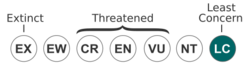
The Arctic skate is classified as being of "least concern" by the IUCN Red List of Threatened Species.[1]
In New Zealand, the Department of Conservation has classified the Arctic skate as "Not Threatened" under the New Zealand Threat Classification System.[5]
References
- ↑ 1.0 1.1 Kulka, D.W.; Barker, A.S.; Pasolini, P.; Orlov, A.; Walls, R.H.L. (2016). "Amblyraja hyperborea". IUCN Red List of Threatened Species 2016. doi:10.2305/IUCN.UK.2016-1.RLTS.T63119A68608464.en. https://www.iucnredlist.org/species/63119/68608464. Retrieved 13 November 2021.
- ↑ 2.0 2.1 "Amblyraja hyperborea summary page" (in en). https://www.fishbase.us/summary/Amblyraja-hyperborea.html.
- ↑ 3.0 3.1 Ebert, David A.; Dando, Marc (2021). Field Guide to Sharks, Rays, and Chimaeras of Europe and the Mediterranean. Princeton, New Jersey: Princeton University Press. pp. 91. ISBN 978-0-691-20598-4.
- ↑ Collett, Robert (1879). "Fiske fra Nordhavs-Expeditionens sidste Togt, Sommeren 1878.". Forhandlinger I Videnskabs-selskabet I Christiania. 1878: 1–64. https://biodiversitylibrary.org/page/43992911.
- ↑ Duffy, Clinton A. J.; Francis, Malcolm; Dunn, M. R.; Finucci, Brit; Ford, Richard; Hitchmough, Rod; Rolfe, Jeremy (2016). Conservation status of New Zealand chondrichthyans (chimaeras, sharks and rays), 2016. Wellington, New Zealand: Department of Conservation. pp. 8. ISBN 978-1-988514-62-8. OCLC 1042901090. https://www.doc.govt.nz/globalassets/documents/science-and-technical/nztcs23entire.pdf.
Wikidata ☰ Q238519 entry
 |  |


