Biology:Aspidosperma polyneuron
| Aspidosperma polyneuron | |
|---|---|

| |
Scientific classification 
| |
| Kingdom: | Plantae |
| Clade: | Tracheophytes |
| Clade: | Angiosperms |
| Clade: | Eudicots |
| Clade: | Asterids |
| Order: | Gentianales |
| Family: | Apocynaceae |
| Genus: | Aspidosperma |
| Species: | A. polyneuron
|
| Binomial name | |
| Aspidosperma polyneuron Müll.Arg.[2]
| |
| Synonyms[3] | |
| |
Aspidosperma polyneuron, commonly known as Peroba and Peroba Rosa,[1] is a species of tree native to eastern and southern Brazil, northeastern Argentina (Misiones Province), and Paraguay in eastern South America, and to Colombia, Peru, and Venezuela in northwestern South America.[3][4] It is a characteristic tree of the Atlantic Forest of eastern Brazil. In addition, it is useful for beekeeping.[5][6][7]

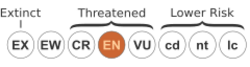
It is a popular timber tree, and has been over-exploited across parts of its range. The IUCN Red List assesses the species as Endangered.[1]
A carboline alkaloid contained in Aspidosperma polyneuron is called Polyneuridine.[8]
Description
It grows up to a height of 40 m, at a rate of 50 cm/year; in the forest, it is an emergent tree.
It flowers from September to November and fruits from October to November.
Uses
The wood is dark pink, with a specific gravity of 0.7 g/cm³. It is easy to work. In Argentina, Paraguay, and Brazil, it is used for construction, furniture, carpentry, and flooring.
References
- ↑ 1.0 1.1 1.2 Americas Regional Workshop (Conservation & Sustainable Management of Trees, Costa Rica, November 1996) (1998). "Aspidosperma polyneuron". IUCN Red List of Threatened Species 1998. doi:10.2305/IUCN.UK.1998.RLTS.T32023A9674981.en. https://www.iucnredlist.org/species/32023/9674981. Retrieved 22 March 2026.
- ↑ {{citation | mode = cs1 | title = Aspidosperma polyneuron | work = Germplasm Resources Information Network (GRIN) | url = | publisher = [[Organization:Agricultural Research ServAgricultural Research Service (ARS), United States Department of Agriculture (USDA) | access-date = 2008-04-02 }}
- ↑ 3.0 3.1 "Aspidosperma polyneuron Müll.Arg.". Royal Botanic Gardens, Kew. https://powo.science.kew.org/taxon/urn:lsid:ipni.org:names:77433-1.
- ↑ "Kew World Checklist of Selected Plant Families". https://apps.kew.org/wcsp/namedetail.do?name_id=17339.
- ↑ Walderley, M.G.L., Shepherd, G.J., Melhem, T.S. & Giulietti, A.M. (eds.) (2005). Flora Fanerogâmica do Estado de São Paulo 4: 1-392. Instituto de Botânica, São Paulo.
- ↑ Oliveira-Filho, A.T. (2006). Catálogo das Árvores nativas de Minas Gerais: 1-423. Editora UFLA, Lavas, Brasil.
- ↑ Hokche, O., Berry, P.E. & Huber, O. (eds.) (2008). Nuevo Catálogo de la Flora Vascular de Venezuela: 1-859. Fundación Instituto Botánico de Venezuela.
- ↑ Antonaccio, L. D.; Pereira, N. A.; Gilbert, B.; Vorbrueggen, H.; Budzikiewicz, H.; Wilson, J. M.; Durham, L. J.; Djerassi, Carl. (June 1962). "Alkaloid Studies. XXXIII. 1 Mass Spectrometry in Structural and Stereochemical Problems. VI. 2 Polyneuridine, A New Alkaloid from Aspidosperma polyneuron and Some Observations on Mass Spectra of Indole Alkaloids 3". Journal of the American Chemical Society 84 (11): 2161–2169. doi:10.1021/ja00870a030.
External links
- (in Portuguese) Aspidosperma polyneuron
- (in Portuguese) Aspidosperma polyneuron
- (in Portuguese) Aspidosperma polyneuron
Wikidata ☰ Q2719026 entry
 |  |


