Biology:Attenborougharion rubicundus
| Attenborougharion rubicundus | |
|---|---|
Scientific classification 
| |
| Missing taxonomy template (fix): | Attenborougharion |
| Species: | Template:Taxonomy/AttenborougharionA. rubicundus
|
| Binomial name | |
| Template:Taxonomy/AttenborougharionAttenborougharion rubicundus (Dartnall & Kershaw, 1978)
| |
| Synonyms[2] | |
| |
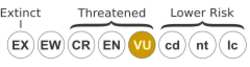
Attenborougharion rubicundus is a species of air-breathing semi-slug, terrestrial pulmonate gastropod molluscs in the family Helicarionidae.
It has been referred to as the "burgundy snail",[1] but should not be confused with Helix pomatia, which is also known by that name.
Taxonomy
This species was described under the name Helicarion rubicundus in 1978.[3] The species was reassigned from genus Helicarion to Attenborougharion its own monotypic genus, named after David Attenborough, in 2017 by researchers at the Australian Museum.[4] The description of this genus was formally published on 9 August 2017.[5]
Distribution
This species is endemic to Australia, and is known only from the Forestier Peninsula and a small portion of the Tasman Peninsula on the island of Tasmania.[5]
Description
These semi-slugs are about 27.5–45 mm in length and are bright green and bright red.[5] The species has a flattened body and their reproductive system has an irregular shape compared to the usual V-shaped rows.[6]
See also
- List of things named after David Attenborough and his works
References
- ↑ 1.0 1.1 Smith B. (1996). Helicarion rubicundus. 2006 IUCN Red List of Threatened Species. Downloaded on 7 August 2007.
- ↑ "Attenborougharion rubicundus (Dartnall & Kershaw, 1978)". Species. GBIF. http://www.gbif.org/species/9240795.
- ↑ Dartnall, A. J., & Kershaw R. C. (1978). "Description of a new species of Helicarion (Stylommatophora: Helicarionidae) in Tasmania". Records of the Queen Victoria Museum 62: 1–18.
- ↑ Love, Madelaine (2017-02-07). "Native Tasmanian snail named after Sir David Attenborough". The Australian Museum. https://www.australianmuseum.net.au/blogpost/museullaneous/native-tasmanian-snail-named-after-sir-david-attenborough. Retrieved 2017-02-09.
- ↑ 5.0 5.1 5.2 Hyman, I.; Köhler, F. (2017). "Attenborougharion gen. nov. (Mollusca: Pulmonata: Helicarionidae): a likely case of convergent evolution in southeastern Tasmania". Records of the Australian Museum 69 (2): 65–72. doi:10.3853/j.2201-4349.69.2017.1676. https://zenodo.org/records/4676991/files/source.pdf.
- ↑ Hyman, Isabel T.; Köhler, Frank (2017-08-09). "Attenborougharion gen. nov. (Mollusca: Pulmonata: Helicarionidae): a likely case of convergent evolution in southeastern Tasmania" (in en). Records of the Australian Museum 69 (2): 65–72. doi:10.3853/j.2201-4349.69.2017.1676. ISSN 2201-4349. https://journals.australian.museum/hyman-2017-rec-aust-mus-692-6572/.
External links
- Otley H.M. (1999). Survey report for the burgundy snail (Helicarion rubicundus) on the Forestier and Tasman Peninsulas. Report to Forestry Tasmania. source list 23 April 2008
- Taylor R.J. (1991). "Distribution and habitat of Helicarion rubicundus (Pulmonata: Helicarionidae), a rare land snail". Papers and Proceedings of the Royal Society of Tasmania 125: 27-28. source list 23 April 2008
Wikidata ☰ Q32394936 entry
 |  |


